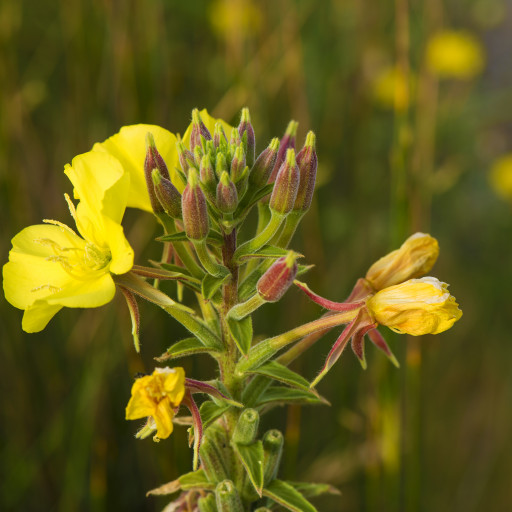
Plant Overview
Often called the "King’s Cure-all" or the "Evening Star," Oenothera biennis is a botanical drama queen that saves its best performance for the moonlight. Native to North America, this biennial plant spends its first year as a humble, ground-hugging rosette before shooting up a towering flower spike in its second year. Its lemon-scented yellow blossoms are famous for their "timed" opening, bursting into bloom just as the sun sets to greet nocturnal pollinators.
🔍 How to Identify
- 🌼 Petal Power: Look for four large, heart-shaped yellow petals arranged in a cross. They possess a subtle, sweet citrus fragrance that intensifies at night.
- 🌱 Leaf Logic: The leaves are lance-shaped with slightly wavy edges and a prominent central vein. In the first year, they form a flat circle on the ground; in the second year, they spiral up a sturdy, often reddish, hairy stem.
- 🌾 Seed Pods: After the flowers fade, they leave behind elongated, four-angled green capsules that eventually turn woody, providing a winter feast for finches.
🏡 In Your Garden
- 🦋 Pollinator Party: This is the centerpiece of a "Moon Garden." It specifically attracts Hawkmoths, which hover like tiny hummingbirds to drink nectar under the stars.
- 🏜️ The Taproot Secret: It thrives in sandy, well-drained soil and is incredibly drought-tolerant. However, because it grows a deep, carrot-like taproot, it hates being transplanted. Once you plant it, let it stay put!
- ✂️ Self-Seeding: Be aware that this plant is an enthusiastic traveler. If you don't want a Primrose forest next year, snip the flower stalks after they bloom but before the seed pods turn brown and pop open.
⚠️ Safety & Toxicity
- 🥗 Generally Safe: Historically, almost every part of this plant is edible. The roots are said to taste like peppery parsnips, and the seeds are the source of the famous "Evening Primrose Oil."
- 🐾 Pet Context: While non-toxic to most livestock, ingestion by curious dogs or cats can occasionally cause mild digestive upset or vomiting if eaten in large quantities. It is best kept as a visual treat rather than a snack for pets.
✨ Fun Fact
⏱️ The Fast Bloom: The flowers of the Evening Primrose open so rapidly—sometimes in under a minute—that if you sit quietly at dusk, you can actually watch the petals unfurl and "pop" open right before your eyes!

Detailed Care Instructions
| Color | Pink, White, Or Yellow |
| Soil Ph | Slightly Acidic To Neutral |
| Invasive | Weed |
| Lighting | Full Sun |
| Toxicity | Toxic |
| Soil Type | Loose, Well-Draining |
| Bloom Time | Summer To Fall |
| Plant Type | Perennial |
| Mature Size | 3-6 Ft. |
| Native Area | Central To Southwestern United States |
| Sun Exposure | Full Sun |
| Hardiness Zones | 4-9 |
To grow Oenothera biennis, also known as evening primrose, follow these steps:
- Climate and soil: Determine if your climate is suitable for growing evening primrose, as they prefer temperate regions. They can tolerate a wide range of soil types but grow best in well-drained, loamy soil.
- Seed selection: Purchase evening primrose seeds from a reputable source or collect them from mature plants. Ensure the seeds are fresh and healthy.
- Site selection: Choose a sunny location with at least six hours of direct sunlight per day for your evening primrose. They can tolerate partial shade, but full sun is ideal.
- Soil preparation: Prepare the soil by clearing away any debris or weeds. Loosen the soil to a depth of approximately 6-8 inches using a garden fork. Add organic matter, such as compost or well-rotted manure, to improve soil fertility and drainage.
- Seed sowing: Scatter the evening primrose seeds over the prepared soil, ensuring there is a spacing of approximately 12-18 inches between each seed. Do not cover the seeds with soil, as they require light for germination.
- Watering: Water the seeds gently immediately after sowing to ensure they settle into the soil. Keep the soil consistently moist but not waterlogged throughout the germination process, which usually takes around 7-14 days.
- Thinning: Once the seedlings start to emerge and grow their second set of leaves, thin them to maintain the desired spacing. Remove weaker seedlings, allowing the healthiest ones to grow.
- Care and maintenance: Water your evening primrose regularly, especially during dry spells, to promote healthy growth. Apply a layer of mulch around the base of the plants to retain moisture and suppress weed growth. Fertilize the plants with a balanced, slow-release fertilizer according to the package instructions.
- Pests and diseases: Evening primrose is relatively resistant to pests and diseases. However, you may need to watch out for slugs, snails, and aphids. Control them using organic remedies or appropriate insecticides if necessary.
- Harvesting: Evening primrose produces yellow, fragrant flowers that open in the evening and attract nocturnal pollinators like moths. The flowers turn into seed capsules, which should be harvested when fully matured and dry. Collect and store the seeds in a cool, dry place for future sowing or culinary/medicinal use.
By following these steps, you can successfully grow Oenothera biennis and enjoy this beautiful flowering plant in your garden.

Place in a bright room that is sun drenched almost all day. Or directly in a south-facing window.

This plant can be watered with a watering can or a hose. It is best to water it deeply once or twice a week, rather than shallowly and frequently. Be sure to water the soil around the base of the plant, rather than getting water on the leaves or flowers. If the plant is in a container, make sure it has drainage holes to prevent the soil from becoming waterlogged. It is important to check the soil moisture level regularly and adjust watering frequency based on the plant's needs and the weather conditions. Overwatering can lead to root rot, so be careful not to water too much.
For this plant, fertilize with a balanced fertilizer such as 10-10-10 or 20-20-20. Apply the fertilizer in the early spring, before new growth starts, and again in mid-summer. Use 1/4 to 1/2 cup of fertilizer per plant. Water thoroughly after fertilizing. Avoid getting fertilizer on the leaves or stems as it can cause damage.
The best type of soil to use for this plant is well-draining and rich in organic matter. It should have a pH level between 6.0 and 7.5, and be somewhat sandy to ensure proper drainage while retaining moisture. This plant prefers nutrient-rich soils, so adding compost or aged manure can be beneficial. Avoid using heavy clay soils as they can hold too much water and cause root rot. Additionally, avoid using soils that are too acidic or alkaline, as this can harm the plant's growth.
The propagation of this plant can be done through seed collection and sowing. When the flowers have faded and the seed capsules have formed, they can be collected and allowed to dry for a few days. The seeds can then be separated from the capsules and sown in the desired location.
If the plant has already established itself in the garden, it can also be propagated through division. This involves digging up a clump of the plant and separating it into smaller sections, each with its own root system. These sections can then be replanted in their desired locations.
Another method of propagation is through stem cuttings. This involves cutting a section of the stem, typically around 4 inches in length, and removing the lower leaves. The cutting can then be planted in moist soil and kept in a warm, humid location until roots form. Once the cutting has established a strong root system, it can be transplanted to its permanent location in the garden.
Common pests of the common evening-primrose include Spider mites, aphids. Make a habit of checking your common evening-primrose frequently for pests so that any infestations can be caught and managed early.








