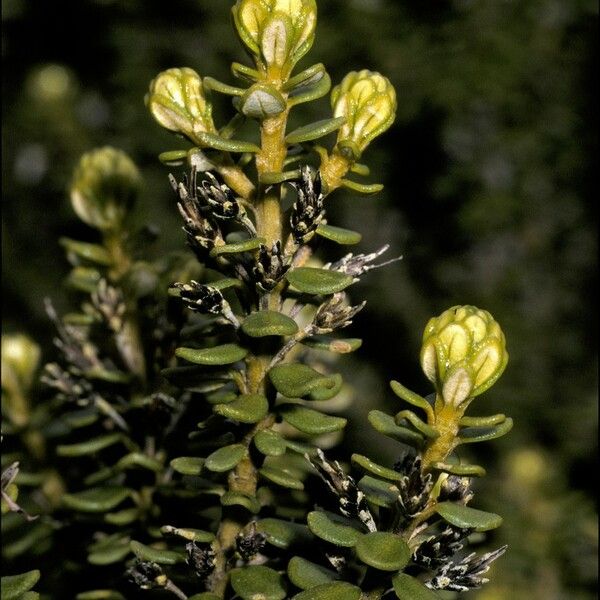
Plant Overview
Known as the "Round-leaved Daisy Bush," this New Zealand native is a master of resilience. Its Latin name, nummulariifolia, literally translates to "money-leaved," referring to the small, thick, coin-shaped foliage that crowds its branches. While it looks like a delicate ornamental shrub, it is actually an alpine survivor, built to withstand the rugged winds and rocky soils of the Southern Alps.
🔍 How to Identify
- 🪙 The "Money" Leaves: Its most striking feature is the tiny, circular, leathery leaves that are tightly packed along the stems. They are often a deep olive green with a slightly yellowish underside.
- 🌼 Daisy-like Blooms: In late spring and summer, it produces small, solitary white flowers with yellow centers. They aren't as "showy" as garden daisies, but they add a delicate charm to the dense foliage.
- 🪵 Stiff, Woody Stems: The plant grows as a dense, rounded shrub. The younger stems often have a distinctive golden or yellowish hue, which turns greyish and woody as they age.
🏡 In Your Garden
- 🏔️ Alpine Roots: Because it originates from high-altitude areas, this plant demands excellent drainage. It thrives in rock gardens or sandy soils; if left in standing water, the roots will quickly succumb to rot.
- 🌬️ Coastal Hero: It is incredibly wind-tolerant and salt-hardy. This makes it an excellent choice for coastal gardens or as a low-maintenance "structural" plant in exposed, windy sites where softer plants would tatter.
- ✂️ The Boxwood Alternative: Due to its small leaves and dense growth, it can be pruned into tight shapes or low hedges, serving as a tough, drought-tolerant alternative to traditional Boxwood (Buxus).
⚠️ Safety & Toxicity
- ✅ General Status: Olearia nummulariifolia is generally considered non-toxic to humans and common household pets.
- 🐾 Pet Note: While not poisonous, the leathery, stiff leaves can be a choking hazard or cause mild stomach upset if a curious dog or cat decides to ingest a large amount of the woody foliage.
✨ Fun Fact
The specific epithet nummulariifolia comes from the Latin word "nummulus," meaning a small coin. In its native New Zealand, early settlers sometimes referred to it as the "Hardy Daisy" because of its ability to survive in environments where almost nothing else would grow!

Detailed Care Instructions







