Plant Overview
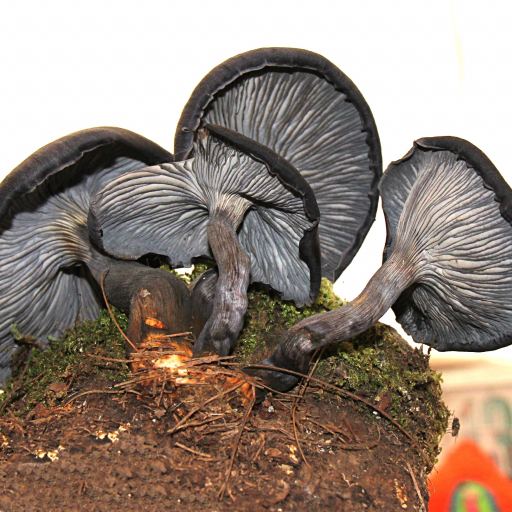
Often called the Mexican Jack-o'-Lantern, Omphalotus mexicanus is a striking fungus that looks like it belongs in a dark fantasy novel. Unlike its bright orange cousins found in the US and Europe, this species is famous for its deep, moody colors and its "ghostly" ability to glow in the dark. It is a master of disguise, frequently found clustered at the base of old trees where it plays a vital role in breaking down wood.
🔍 How to Identify
- 🍄 The Cap: Usually funnel-shaped with wavy edges, the cap features deep, dark tones—ranging from navy blue and charcoal to olive-brown—often with a metallic sheen.
- 🕸️ Decurrent Gills: The gills are thin and crowded, running significantly down the length of the stem. They often retain a yellowish or orange tint that contrasts with the dark cap.
- 🪵 Growth Habit: These mushrooms almost always grow in dense, overlapping clusters (caespitose) rather than individually, typically emerging from buried wood or at the base of stumps.
🌲 Habitat & Ecology
- 🍂 Nature's Recycler: It is a saprobic fungus, meaning it feeds on dead organic matter. You will find it most often on the decaying roots or stumps of hardwoods and occasionally pines.
- ☁️ Cloud Forest Resident: It thrives in the humid, high-altitude forests of Mexico and Central America, appearing during the rainy season when the forest floor is consistently damp.
⚠️ Safety & Toxicity
- 🚫 WARNING: Omphalotus mexicanus is POISONOUS. It must never be eaten.
- 🤢 The Danger: If ingested, it causes severe "Jack-o'-Lantern Syndrome," characterized by intense vomiting, painful abdominal cramps, and diarrhea. While rarely fatal for healthy adults, it is a miserable experience.
- 🍄 The Lookalike: Foragers must be extremely careful not to confuse "Jack-o'-Lantern" species with edible Chanterelles. Remember: Jack-o'-Lanterns have true, blade-like gills and grow on wood, whereas Chanterelles have shallow ridges and grow from the soil.
✨ Fun Fact
🌟 The Living Lantern: This mushroom is truly bioluminescent! If you take a fresh specimen into a pitch-black room and let your eyes adjust for several minutes, you can see the gills emitting a faint, eerie green glow caused by a chemical reaction involving the enzyme luciferase.

Detailed Care Instructions
Omphalotus mexicanus, commonly known as the Mexican jack-o'-lantern mushroom, is a type of bioluminescent mushroom that typically grows in woodlands. However, it’s important to note that this species, like many fungi, is not a traditional plant and does not grow in the same way as typical garden plants. If you are interested in cultivating Omphalotus mexicanus or similar mushrooms, here are some general steps to help you get started:
Cultivation Tips for Omphalotus mexicanus
- Research and Preparation:
- Learn about the specific requirements for cultivating Omphalotus mexicanus, including its preferred substrate and environmental conditions.
- Learn about the specific requirements for cultivating Omphalotus mexicanus, including its preferred substrate and environmental conditions.
- Substrate:
- This mushroom typically grows on decaying wood. You can use hardwood sawdust, wood chips, or logs as a substrate. Ensure that the substrate is free from contaminants.
- This mushroom typically grows on decaying wood. You can use hardwood sawdust, wood chips, or logs as a substrate. Ensure that the substrate is free from contaminants.
- Spawn:
- Obtain high-quality mushroom spawn from a reputable supplier. This is the mycelium that will colonize your substrate.
- Obtain high-quality mushroom spawn from a reputable supplier. This is the mycelium that will colonize your substrate.
- Inoculation:
- Inoculate your substrate with the mushroom spawn under sterile conditions to prevent contamination. This can be done by mixing the spawn into the substrate or placing it on the surface of the substrate.
- Inoculate your substrate with the mushroom spawn under sterile conditions to prevent contamination. This can be done by mixing the spawn into the substrate or placing it on the surface of the substrate.
- Incubation:
- Keep the inoculated substrate in a warm, dark place for several weeks. The ideal temperature for colonization is typically around 70-80°F (21-27°C). During this time, the mycelium will colonize the substrate.
- Keep the inoculated substrate in a warm, dark place for several weeks. The ideal temperature for colonization is typically around 70-80°F (21-27°C). During this time, the mycelium will colonize the substrate.
- Fruit Development:
- After the substrate is fully colonized, move it to a cooler, more humid environment with indirect light. This changes the conditions and can trigger the formation of fruiting bodies (mushrooms).
- After the substrate is fully colonized, move it to a cooler, more humid environment with indirect light. This changes the conditions and can trigger the formation of fruiting bodies (mushrooms).
- Humidity and Airflow:
- Maintain high humidity (around 85-95%) and good air circulation to encourage proper mushroom growth. You may need to mist the substrate occasionally to keep humidity levels up.
- Maintain high humidity (around 85-95%) and good air circulation to encourage proper mushroom growth. You may need to mist the substrate occasionally to keep humidity levels up.
- Harvesting:
- Once the mushrooms have matured (you will know they are ready to harvest when the caps expand and the edges are not curled), you can harvest them by cutting at the base.
General Considerations
- Once the mushrooms have matured (you will know they are ready to harvest when the caps expand and the edges are not curled), you can harvest them by cutting at the base.
- Legal Considerations: Ensure that it is legal to cultivate this mushroom in your area, as some species may have restrictions.
- Safety: Be aware that Omphalotus mexicanus is inedible and can be toxic if consumed. Always educate yourself thoroughly about any mushroom species before attempting to cultivate or consume them.
Note
Growing mushrooms can be a complex process, and success may take time and experimentation. If you're new to mushroom cultivation, consider starting with more commonly grown species that may be easier to manage.
To water this plant, first check the soil moisture by inserting your finger about an inch deep into the soil. If the soil feels dry, water the plant slowly and thoroughly until water comes out through the drainage holes. The frequency of watering will depend on the temperature and humidity of your environment, but typically once a week is sufficient. Avoid getting water on the foliage as this can encourage disease. Use room temperature, non-chlorinated water.
Omphalotus mexicanus requires a careful approach to fertilization to promote healthy growth. Here are the instructions to follow:
- Soil Preparation: Use a well-draining substrate rich in organic matter. A mix of compost, peat, and coarse sand can provide a suitable base.
- Fertilizer Type: Opt for a balanced, slow-release fertilizer with an N-P-K ratio of around 10-10-10 or 14-14-14. Alternatively, an organic option like fish emulsion or seaweed extract can be beneficial.
- Application Timing: Fertilize during the growing season, typically in spring and early summer. Avoid fertilizing in late fall or winter when the plant is dormant.
- Application Rate: Follow the manufacturer’s guidelines for the appropriate dosage. Generally, for slow-release fertilizers, apply according to the size of the plant.
- Watering: After applying fertilizer, water the plant thoroughly to help the nutrients reach the root zone and to prevent fertilizer burn.
- Frequency: Reapply slow-release fertilizers every 6-8 weeks throughout the growing season. For liquid fertilizers, dilute according to recommendations and apply every 4-6 weeks.
- Observation: Monitor the plant for signs of over-fertilization, such as yellowing leaves or reduced growth. If these occur, reduce the amount of fertilizer.
- Soil Testing: Consider testing the soil pH and nutrient levels annually to tailor your fertilization approach and make adjustments as needed.
By following these guidelines, you can help promote the healthy growth of Omphalotus mexicanus.
Omphalotus mexicanus thrives in well-draining soil that retains some moisture while allowing excess water to escape. A suitable soil mix for this organism typically consists of the following components:
- Base Material: Use a base of loamy or sandy soil, which provides good drainage and aeration. This is crucial to prevent root rot and other moisture-related issues.
- Organic Matter: Incorporate organic matter such as compost or well-rotted leaf litter. This enriches the soil with nutrients and improves moisture retention, essential for healthy growth.
- Soil pH: Aim for a slightly acidic to neutral pH range (around 5.5 to 7.0). This range supports optimal nutrient availability and growth for this species.
- Supplementary Additives: You can add perlite or coarse sand to enhance drainage further. These materials help maintain an airy soil structure, preventing compaction.
- Mulch: A layer of organic mulch, such as wood chips or straw, can be applied on top of the soil. This helps retain moisture and provides a habitat for beneficial microorganisms.
When preparing the soil mix, it's important to ensure that it is well-aerated and not too compact, as this organism prefers conditions that mimic its natural habitat, often found in decaying wood or forest litter. Regularly monitor moisture levels, avoiding both drought and waterlogging to create optimal growth conditions.
Omphalotus mexicanus can be propagated primarily through two methods: spores and vegetative means.
1. Spores:
Harvesting Spores:
- Wait for mature fruiting bodies, which typically appear in moist areas, preferably during the rainy season.
- Collect mature caps. Place them cap-down on a sterile piece of paper or glass in a controlled environment to allow them to release spores for 24-48 hours.
- Once spore print is complete, the resulting powder can be collected for storage.
Culturing Spores: - Prepare a sterile growth medium, often comprised of wood-based substrates such as sawdust or lignin-rich materials.
- Mix the spores into the substrate, ensuring even distribution while maintaining sterile conditions.
- Place the mixture in a covered container or bag, and incubate at an appropriate temperature – typically between 20-25°C (68-77°F).
- Maintain humidity levels high to facilitate mycelium growth.
- Transfer to a suitable environment when mycelium has fully colonized the substrate.
2. Vegetative Propagation:
Using Mycelium: - Obtain a healthy mycelium culture from a mature fruiting body or through spore culturing.
- Prepare a substrate as mentioned previously and inoculate it directly with the mycelium.
- Ensure that the mycelium is properly and evenly distributed throughout the substrate.
- Incubate under controlled humidity and temperature until colonization is complete.
Transplanting: - Once the substrate is fully colonized by mycelium, you can introduce it to outdoor locations or logs where you want to establish a new colony, ensuring the conditions mimic their natural habitat (moist, shaded areas with decaying wood).
Environmental Conditions:
- Throughout the propagation process, it is vital to maintain optimal environmental conditions, including humidity, temperature, and light to encourage healthy growth and reproduction.
Additional Notes:
- Be vigilant about contamination during the spawning or inoculation processes, as wild types can easily be overwhelmed by competing fungi.
- Note that propagation from spores may take longer to establish fruiting bodies compared to mycelial propagation, which can produce a quicker yield under suitable conditions.
Utilizing these methods should help propagate Omphalotus mexicanus successfully and sustainably.







