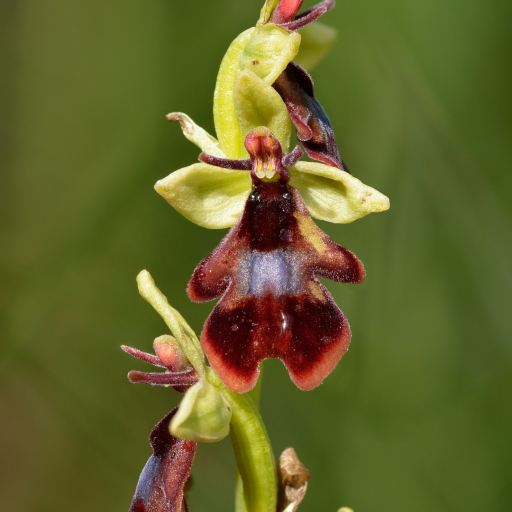
Plant Overview
Often called the Fly Orchid, this botanical masterpiece is one of nature’s most convincing imposters. It doesn't just look like a fly; it mimics the scent and texture of a female insect to trick males into "mating" with it. Found across Europe, this clever deception is its unique evolutionary strategy for pollination, making it a favorite for hikers and nature photographers.
🔍 How to Identify
- 🪰 The Flower: Each blossom features a dark, velvet-textured lower lip (labellum) that looks remarkably like the body of a fly, complete with two pale, reflective "wing" patches in the center.
- 🌿 The Foliage: It grows from a modest rosette of narrow, blue-green leaves at the base, with a few smaller leaves clasping the lower part of the stem.
- 📏 The Stem: A thin, upright green stalk that can reach up to 40cm, holding a sparse arrangement of 2 to 15 small "fly" flowers that bloom from May to July.
🌲 Habitat & Ecology
- ⛰️ Soil Specialist: The Fly Orchid is a "calcicole," meaning it thrives almost exclusively in lime-rich, alkaline soils. You will typically find it in chalk grasslands, scrubland, or the sun-dappled edges of beech woodlands.
- 🍄 Fungal Partnership: Like most wild orchids, it lives in a complex symbiotic relationship with underground mycorrhizal fungi. It relies on these fungi for nutrients, especially during its early growth stages, which makes it extremely sensitive to soil disturbance or chemical fertilizers.
⚠️ Safety & Toxicity
- 🛡️ Low Toxicity: The Fly Orchid is not known to be toxic to humans, cats, or dogs. However, like all wild orchids, it is not edible and should not be consumed.
- 🚫 Conservation Warning: This plant is rare and protected by law in many countries. Uprooting or picking the Fly Orchid is often illegal and highly detrimental to the local ecosystem, as it rarely survives being moved due to its dependence on specific soil fungi.
✨ Fun Fact
- 🎭 Sexual Deception: This plant performs "pseudocopulation." It emits pheromones that mimic the scent of a female digger wasp so accurately that male wasps are lured in for a romantic encounter. As the confused male attempts to mate with the flower, the orchid glues two pollen sacs (pollinia) to his head to be carried to the next plant!

Detailed Care Instructions
To grow Ophrys Insectifera (fly orchid), follow these steps:
- Soil and Location: Choose a well-draining soil mix with a pH between 6.0 and 7.5. Ophrys Insectifera prefers a slightly acidic to neutral soil. Select a location that receives partial sunlight, as these orchids thrive in shaded or partially shaded areas.
- Planting: Obtain Ophrys Insectifera rhizomes or tubers from a reputable source. Plant them in the fall, around September or October, as this is their natural growing season. Make sure the rhizomes are covered with soil but avoid burying them too deeply.
- Watering: Water the newly planted rhizomes thoroughly but avoid waterlogging. As the plants do not have pseudobulbs to store water, it is crucial to keep the soil consistently moist but not soggy. During the winter dormant period, reduce watering but do not let the soil completely dry out.
- Temperature: Ophrys Insectifera prefers cool to mild temperatures. It can withstand cold temperatures but not extreme frost. Provide protection against freezing conditions by using a layer of mulch or covering the plants during harsh winters.
- Fertilization: Use a balanced orchid fertilizer or a slow-release granular fertilizer with an NPK ratio of 20-20-20. Apply the fertilizer according to the package instructions during the active growth phase, typically from early spring to late summer. Avoid overfertilization as it may damage the plants.
- Pollination: Ophrys Insectifera relies on specific insects for pollination. In their native habitats, these orchids attract male bees with their flowers, which mimic females of the bee species. Proper pollination is necessary for seed production and successful propagation.
- Propagation: Ophrys Insectifera can be propagated through division. Wait until the orchid has several healthy rhizomes before attempting division, which is best done during the dormant period in late winter or early spring. Gently separate the rhizomes and pot them separately, ensuring each division has enough roots and shoots.
- Maintenance: Regularly inspect the plants for pests and diseases like aphids, spider mites, or fungal infections. Remove any affected parts and treat the plants with appropriate remedies if necessary. Also, remove any dead foliage or spent flowers to maintain a tidy appearance and encourage healthier growth.
Remember, growing Ophrys Insectifera may require patience and careful attention to their specific needs. It is essential to respect their natural life cycle, protecting them during dormant periods and providing optimal conditions for growth and blooming.

Place in a window with dappled sun or a spot in the middle of a room. Or directly in a window facing west or east.

Ophrys Insectifera plant should be watered regularly to maintain optimal moisture levels in the soil. It is important to ensure that the soil is well-drained and not waterlogged. Overwatering can lead to root rot and other diseases, which can harm the plant's growth and health.
When watering the plant, it is recommended to water the roots directly rather than the foliage. This will prevent any water droplets from remaining on the petals, which can damage their delicate surface and compromise their appearance.
The frequency of watering will depend on a variety of factors, such as the temperature and humidity levels in the environment and the type of soil in which the plant is growing. In general, it is best to water Ophrys Insectifera plant when the top layer of soil feels dry to the touch.
During the winter months, when the plant is in a state of dormancy, watering can be reduced to prevent the soil from becoming too damp. In the spring and summer, when the plant is actively growing, frequent watering may be necessary to provide the moisture and nutrients needed for healthy growth.
Overall, it is important to monitor the plant's moisture levels and adjust the watering schedule as needed to ensure optimal growth and health.
To fertilize Ophrys Insectifera, follow these instructions:
- Choose a balanced liquid or granular fertilizer specifically formulated for orchids or epiphytic plants.
- Dilute the fertilizer according to the instructions on the packaging. It is typically recommended to use a weaker concentration than what is indicated for regular houseplants.
- Apply the fertilizer during the active growing season, which is usually in spring or early summer.
- Ensure that the plant's roots are moist before applying the fertilizer to avoid any potential damage.
- Use a spray bottle or watering can to evenly distribute the fertilizer over the plant's foliage and root zone.
- Avoid direct contact between the fertilizer and the plant's leaves or pseudobulbs to prevent any burning or damage.
- After application, thoroughly water the plant to help the fertilizer reach the roots and facilitate absorption.
- Keep track of the fertilizing schedule, and repeat the process every two to four weeks during the active growing period.
- During the plant's dormant season, usually in late summer or fall, reduce or stop fertilization to allow the plant to rest.
- Regularly monitor the plant's overall health and adjust the fertilizing routine as necessary to promote optimal growth and blooming.
The ideal soil for this plant is a loose, well-draining mix with a neutral pH. It should be rich in organic matter, such as composted bark or leaf mold, and contain minerals like calcium and magnesium. This will help provide essential nutrients and support healthy root growth. Additionally, the soil should be kept moist but not waterlogged, as this can lead to root rot. A layer of mulch around the plant can help retain moisture and prevent weeds from competing for nutrients.
Ophrys Insectifera is a terrestrial orchid species that can be propagated using two methods - seed propagation and vegetative propagation.
Seed Propagation:
- Collect mature seed pods from the parent plant when they have dried up, and the seeds are brownish in color. Avoid collecting green pods as they may not be mature enough.
- Soak the seeds in water for 24 hours to soften the seed coat, which helps with germination.
- Sterilize a potting mix by baking it in an oven or microwave. It is necessary to kill any harmful microorganisms that can cause disease in the young plants.
- Fill the sterilized potting mix in a seed tray and moisten it with water.
- Sow the seeds onto the moist potting mix, cover the tray with a lid or plastic wrap to retain moisture.
- Place the tray in a warm and bright spot but avoid direct sunlight.
- Keep the potting mix moist by spritzing it with water using a spray bottle.
- Germination occurs in 2-3 weeks, after which the lid or plastic wrap can be removed.
- Transplant the seedlings into individual pots when they have grown four leaves and are well-established.
Vegetative Propagation:
- Select a mature and healthy parent plant that has numerous pseudobulbs.
- Use a sterilized sharp knife or scissors to cut the pseudobulbs into smaller sections. Each section should have at least two to three healthy leaves and some roots.
- Sterilize a potting mix and fill it into individual pots.
- Plant the pseudobulb sections in the prepared pots and firm the potting mix around it.
- Place the pots in a warm and bright spot, avoiding direct sunlight.
- Keep the potting mix moist but not waterlogged.
- The propagated plantlets should develop new growth within a few weeks, after which they can be transplanted into larger containers or directly into the garden.








