Plant Overview
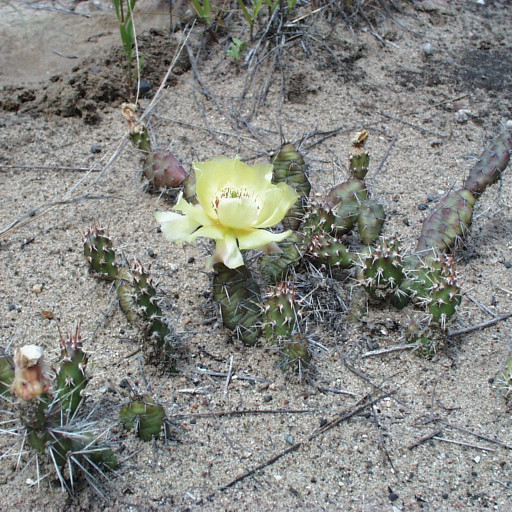
Often called the Brittle Prickly Pear or "Little Prickly Pear," this diminutive cactus is a true survivor of the North American wilderness. Unlike its giant desert cousins, Opuntia fragilis has adapted to endure the freezing winters of Canada and the northern United States, making it one of the cold-hardiest cacti in the world. It earned its name from its "fragile" joints, which break away at the slightest touch—a clever survival tactic for hitchhiking to new locations.
🔍 How to Identify
- 🌵 The Pads: Unlike flat, plate-like prickly pears, these pads are small, plump, and egg-shaped or nearly cylindrical. They grow in low-creeping mats rather than tall bushes.
- 🌼 The Flowers: In early summer, it produces stunning, waxy blossoms that are usually a brilliant lemon-yellow, sometimes featuring a peach or pinkish center with greenish filaments.
- ⚔️ The Spines: Each pad is armed with 1 to 4 long, tan-colored central spines, but the real defense is the clusters of "glochids"—tiny, barbed bristles that are notoriously difficult to remove from skin.
🏡 In Your Garden
- ❄️ Cold Weather Champion: This is the perfect cactus for northern gardeners. While most cacti turn to mush in the frost, this species survives by dehydrating itself in autumn, wrinkling up to prevent its cells from freezing and bursting.
- 🏜️ The "Fragile" Strategy: Be careful where you plant it! Because the pads detach so easily, they are designed to "hitchhike" on the fur of passing animals or the boots of gardeners. If a pad falls on bare soil, it will quickly sprout roots and start a new colony.
⚠️ Safety & Toxicity
- 🌵 Physical Irritant: While Opuntia fragilis is not chemically poisonous, it is physically aggressive. The large spines are painful, but the nearly invisible glochids can cause lasting skin irritation, redness, and even infection if not removed.
- 🐾 Pet & Child Warning: Keep this plant away from high-traffic areas or curious pets. Dogs and cats can easily get the "hitchhiking" pads stuck in their fur or paws, leading to a very stressful grooming session.
✨ Fun Fact
The Brittle Prickly Pear is a world-class traveler without ever moving its roots. Because it rarely produces viable seeds in the wild, it relies almost entirely on "clonal dispersal"—clinging to the fur of bison or deer to be carried miles away before falling off and starting a brand-new, genetically identical plant!

Detailed Care Instructions
| Color | Flowers Are Large And Yellow, With Creamy Greenish To Reddish Centers |
| Soil Ph | 6-7.5 |
| Humidity | Dry |
| Lighting | Full Sun |
| Toxicity | Poisonous |
| Soil Type | Dry, Sandy Or Gravelly, Well-Draining |
| Bloom Time | June To July |
| Difficulty | Easy |
| Plant Type | Herbaceous Perennial |
| Mature Size | The Succulent Stem Segments, Or Pads, Are 0.5 To 5 Inches Wide |
| Native Area | Americas |
| Sun Exposure | Full Sun |
| Hardiness Zones | 7-10 |
Here are some steps to help you grow Opuntia Fragilis plant:
- Choose a suitable location: Opuntia Fragilis plants thrive in full sun and well-draining soil. Pick a spot in your garden that receives at least 6-8 hours of direct sunlight every day. Ensure the soil is sandy and loamy for optimal drainage.
- Prepare the soil: Before planting the Opuntia Fragilis, loosen the soil in the selected area and remove any rocks or debris. You may also add organic matter or compost to improve the soil's fertility and drainage.
- Planting: Dig a hole that is slightly larger than the size of the Opuntia Fragilis plant's root ball. Gently place the plant into the hole and backfill it with soil. Make sure the plant is positioned at the same soil level as it was in the nursery container. Firmly tamp down the soil around the plant to eliminate air pockets.
- Watering: Immediately after planting, water the Opuntia Fragilis thoroughly to help settle the soil. Afterward, water the plant deeply once every week during dry periods. However, this plant is drought-tolerant and does not require frequent watering.
- Mulching: Apply a layer of organic mulch around the base of the plant to help retain moisture, suppress weed growth, and regulate soil temperature. Avoid piling the mulch against the plant's stem.
- Maintenance: Opuntia Fragilis plants are relatively low-maintenance. Prune away any damaged, dead, or overcrowded pads to promote better air circulation and prevent disease. Wear thick gloves and use tongs or pliers to handle the prickly pads.
- Protection from cold: Opuntia Fragilis is a cold-hardy plant but may require protection in extremely cold climates. You can cover the plant with burlap or a frost blanket during winter or provide a temporary shelter to shield it from freezing temperatures.
- Propagation: Opuntia Fragilis can be propagated by severing a mature pad from the main plant and allowing the cut end to dry out for a few weeks. Once the cut end has dried, bury the pad partially in well-draining soil, and it should slowly develop roots and grow into a new plant.
Remember to check for any regulations or restrictions regarding growing Opuntia Fragilis plants in your area, as it is considered an invasive species in some regions.

Place in a bright room that is sun drenched almost all day. Or directly in a south-facing window.

To successfully water the Opuntia Fragilis plant, you should take the following steps. First, you should identify the soil type and ensure that it is well-draining. Next, you should wait until the soil has completely dried out before watering the plant. When you do water, make sure to thoroughly saturate the soil, allowing the water to soak deep into the roots. Be careful not to water too frequently, as this can lead to root rot. Finally, make sure that the plant is receiving adequate sunlight and has proper air circulation to prevent any fungal diseases.
- Gather a balanced fertilizer, such as a 10-10-10 or 20-20-20 formula, as this will provide equal amounts of nitrogen, phosphorus, and potassium.
- Apply the fertilizer according to the manufacturer's instructions, being careful to not apply too much or too little.
- Apply the fertilizer in the early spring, just as the plant is coming out of its dormant state.
- Water the plant thoroughly after fertilizing to help distribute the nutrients evenly throughout the soil.
- Repeat the fertilization process once every 4-6 weeks throughout the growing season, which typically lasts from late spring to early fall.
- Avoid fertilizing during the winter months, as the plant will be in a dormant state and will not be able to absorb the nutrients effectively.
The soil suitable for Opuntia Fragilis plant should be well-draining and slightly acidic. It should also contain a good amount of organic matter to help the plant thrive. The soil should not be too heavy or compacted as it can lead to waterlogging and root rot. A sandy loam soil mixed with perlite or coarse sand can be a good option for this plant. The plant prefers a soil pH between 5.5 and 7.0. A soil test can be done to determine the pH level of the soil and adjust it accordingly. Additionally, the plant prefers a soil that is low in nutrients as too much fertilizer can lead to excessive growth and weaken the plant. It is recommended to fertilize the plant only once or twice a year with a low-nitrogen fertilizer.
Opuntia Fragilis is a type of cactus that can be propagated in a few different ways. One method is through stem cuttings. To do this, select a healthy stem and use a clean, sharp knife to cut a section that is several inches long. Let the cutting dry and callous over for a few days, then plant it in a well-draining soil mix. Water sparingly and keep the cutting in a bright, indirect light until it develops roots and begins to grow.
Another way to propagate Opuntia Fragilis is through offsets or "pups." These are new plants that grow out from the base of the parent plant. To propagate this way, carefully remove the offset from the parent plant and plant it in a separate pot with a well-draining soil mix. Water sparingly and provide bright, indirect light until it establishes itself.
Lastly, Opuntia Fragilis can also be propagated through seeds. Collect the seeds from a mature fruit, and plant them in a well-draining soil mix. Keep the soil moist and provide bright, indirect light. The seeds should germinate in a few weeks, and the resulting plants can be transplanted into individual pots once they are big enough.
No matter which propagation method you choose, make sure to use a well-draining soil mix and provide the plant with plenty of bright, indirect light. Opuntia Fragilis is a desert plant and does not require much water, so be careful not to overwater. With proper care, your new plants should thrive and grow into healthy, beautiful specimens.
Common pests of the loose prickly-pear include Scale insect, mealybugs, spider mites. Make a habit of checking your loose prickly-pear frequently for pests so that any infestations can be caught and managed early.








