Plant Overview
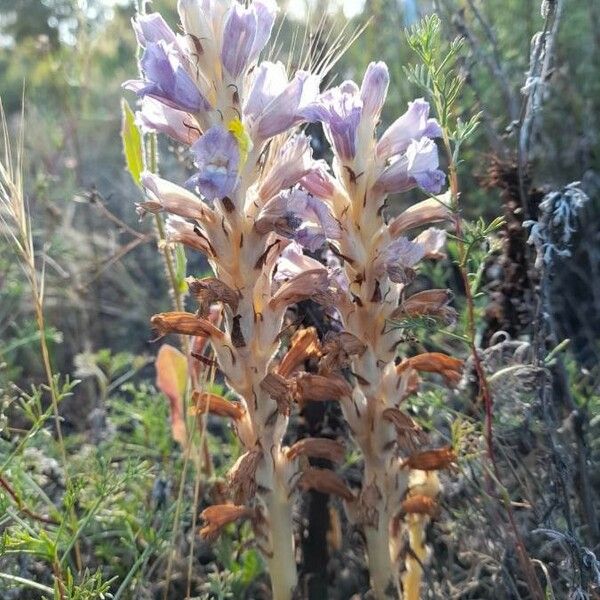
Often called the Nodding Broomrape, this botanical bandit is a "holoparasite," meaning it completely lacks chlorophyll and cannot perform photosynthesis. Instead of making its own food, it lives like a vampire, attaching itself to the roots of host plants—most notably sunflowers, tomatoes, and tobacco—to steal their water and nutrients. Because it doesn't need sunlight to eat, it often emerges from the ground like a pale, ghostly sentinel.
🔍 How to Identify
- 🦹 Ghostly Stems: The plant lacks any green color. Instead, it features fleshy, upright stems that range from pale yellow to a dusty brownish-purple.
- 🔔 Nodding Blooms: The flowers are tubular and slightly curved or "nodding." They are usually white at the base with striking violet or blue-purple tips.
- 🍂 Scaly Leaves: You won't find traditional leaves here. Because it doesn't need to catch sunlight, the leaves have evolved into small, brown, scale-like appendages pressed against the stem.
🏡 In Your Garden & Ecology
- 🧛 The Host Hunter: In a garden or farm setting, this plant is usually considered a "weed" or a pest. It specifically targets the Solanaceae and Asteraceae families, where it can significantly weaken the host plant's growth and fruit production.
- ⏳ Long-Term Sleeper: The seeds of the Nodding Broomrape are microscopic and can remain dormant in the soil for over 10 to 20 years, waiting patiently for the chemical signal from a host plant to begin germinating.
⚠️ Safety & Toxicity
- 🟢 Status: Non-toxic to humans and pets upon contact.
- 📋 Details: While it isn't known to be poisonous if touched, it is not considered edible. Its primary "danger" is ecological and agricultural, as it can devastate local crops if left unchecked. If you find it in your vegetable patch, it is best to remove it before it sets seed to protect your other plants.
✨ Fun Fact
The Nodding Broomrape is a master of chemical warfare. It only germinates when it "smells" specific hormones called strigolactones exuded by the roots of its host. If no host is nearby, the seed refuses to wake up, staying perfectly preserved underground for decades!

Detailed Care Instructions

Place in a bright room that is sun drenched almost all day. Or directly in a south-facing window.

To properly water this plant, it is important to avoid getting water on the leaves and to water the soil directly around the base of the plant. The frequency of watering will depend on the specific needs of the plant and the climate in which it is growing. It is recommended to allow the soil to dry out slightly between waterings to prevent overwatering and potential root rot. A good technique is to water deeply and slowly to ensure the water reaches the roots of the plant. It is also important to ensure that the soil is well-draining to prevent water from sitting around the roots for too long. Regularly monitoring the soil moisture levels can help ensure that the plant is receiving the right amount of water.
The ideal soil for Orobanche cernua plant is a well-draining, sandy soil that is nutrient-poor. It is important to avoid using soils that are high in nitrogen, as this can encourage excessive foliage growth at the expense of flower development. The soil pH should be slightly acidic to neutral, with a range between 5.5 and 7.0. The plant also requires good moisture retention in the soil, but be careful not to overwater as this can lead to root rot and other fungal diseases. Adding organic matter to the soil, such as compost or leaf mold, can help improve soil structure and fertility without overly fertilizing the plant.