Plant Overview
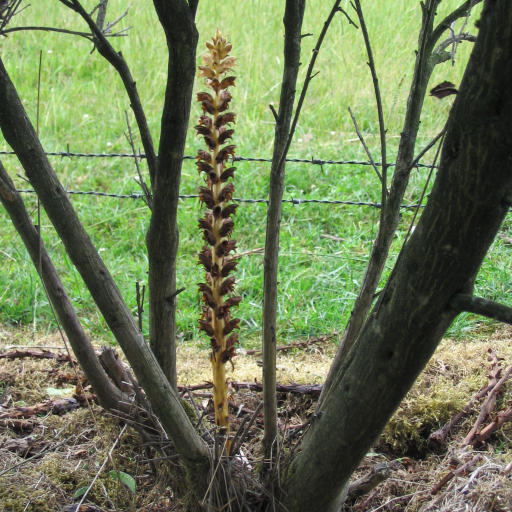
Known as the Greater Broomrape, this strange, leafless plant looks more like a ghostly carving or a weathered piece of ginger than a typical garden inhabitant. It is a "holoparasite," a botanical vampire that completely lacks chlorophyll and survives by stealing every drop of its nutrition from the roots of nearby shrubs. Its appearance in a landscape is often a surprise, as it seems to sprout overnight from the bare ground without any visible foliage to support it.
🔍 How to Identify
- 🎨 Color Palette: The entire plant is devoid of green. It displays a range of earthy tones, from creamy yellows and pale tans to deep, rusty purples and browns.
- 🌸 The Spike: It grows as a singular, fleshy upright spike (raceme) that can reach up to two feet in height, densely packed with tubular flowers.
- 🍂 Scaly Stem: Instead of leaves, the stem is covered in small, pointed, overlapping scales that look like dried parchment.
- 🔔 Tubular Flowers: Each flower has a hooded upper lip and a three-lobed lower lip, resembling a brownish snapdragon or a withered orchid.
🏡 In Your Garden
- 🌳 Host Connection: You will only find this plant if its favorite hosts are nearby. It specifically targets woody shrubs in the pea family, such as Gorse and Broom. If you see this spike, its "fangs" are firmly attached to the roots of a shrub underground.
- ⏳ Patience and Stealth: The Greater Broomrape spends most of its life hidden beneath the soil. It only emerges to flower and set seed, which can stay dormant in the dirt for over a decade, waiting for the chemical signal from a host root to wake up.
- 📉 Impact on Landscape: While it doesn't usually kill the host, it can weaken the shrub’s growth. If you are a fan of "wilding" your garden, it is a rare and fascinating sign of a complex local ecosystem.
⚠️ Safety & Toxicity
- 🐾 Pet & Human Safety: The Greater Broomrape is generally considered non-toxic to humans and pets. It does not possess stinging hairs or thorns.
- 🚫 Not for Consumption: Although not famously poisonous, it is not an edible plant. Its bitter compounds are designed to deter herbivores from snacking on its moisture-rich spikes.
✨ Fun Fact
The name Orobanche comes from the ancient Greek words orobos (a type of vetch) and anchein (to strangle). Ancient farmers believed these plants were literal "stranglers" that would choke the life out of their precious bean and vetch crops!

Detailed Care Instructions
| Humidity | Dry |
| Lighting | Part Sun |
| Difficulty | Easy |
To grow Orobanche rapum-genistae, also known as broomrape, you can follow these steps:
- Obtain seeds: Contact a local nursery or seed supplier that specializes in native plants to acquire Orobanche rapum-genistae seeds. Ensure that the seeds are fresh, as older seeds might have reduced germination rates.
- Prepare the planting site: Broomrape plants are parasitic and require a host plant to grow. Find a suitable host plant, preferably from the Genista (broom) genus, such as Cytisus scoparius (common broom). Prepare the planting site by clearing weeds, loosening the soil, and ensuring good drainage.
- Preparing the host plant: Check the host plant for any signs of disease or pest infestation. Ensure it is healthy and appropriately sized for your garden. Take care not to damage the host plant's roots during the process.
- Sowing the seeds: Sow the Orobanche rapum-genistae seeds at the base of the host plant. Gently press the seeds into the soil, ensuring good contact with the host plant's roots. Water the area lightly after sowing the seeds.
- Maintenance: Provide regular watering to keep the soil moist but avoid overwatering. Typically, the broomrape plant will rely on the host plant for nutrients and water. Ensure that the host plant is adequately fertilized and maintained for optimum growth. Monitor both plants for any signs of disease or pest infestations and take appropriate actions if necessary.
- Patience: Growing broomrape may require patience, as it can take up to several years for the plants to establish and flower. Some species of Orobanche are annuals, while others are perennials, so research specific care instructions for Orobanche rapum-genistae to determine how long you may need to wait for your plant to flower.
Remember, Orobanche rapum-genistae is a potentially invasive plant and is parasitic to other plants. Ensure you are aware of all local regulations and guidelines before planting it in your garden.
Orobanche Rapum-genistae is a plant that has a unique method of obtaining nutrients from other plants. It does not have chlorophyll and does not photosynthesize, hence it can't produce food for itself. Instead, it relies on the host plant for its nutrients. This means that watering this plant is different from watering conventional plants.
When watering Orobanche Rapum-genistae, it is essential to ensure that the host plant is well-watered to ensure that both plants receive adequate moisture. The host plant should be watered deeply and regularly to maintain a consistent level of moisture in the soil.
When watering Orobanche Rapum-genistae, be careful not to water directly on the plant, as this can cause rot or damage to the roots. Instead, use a watering can or hose to water the soil around the host plant, ensuring that the water is evenly distributed.
It is also important to pay attention to the soil moisture levels and ensure that the soil does not become waterlogged. This can lead to poor growth or even death of the plant.
Overall, watering Orobanche Rapum-genistae involves ensuring that the host plant is well-watered and providing adequate moisture to the soil around it.
To fertilize the Orobanche Rapum-genistae plant, follow these instructions:
- Choose a balanced fertilizer with an N-P-K ratio of 10-10-10 or similar. This ratio indicates equal amounts of nitrogen (N), phosphorus (P), and potassium (K), providing the plant with essential nutrients.
- Dilute the fertilizer according to the instructions on the packaging. Typically, this involves mixing a specific amount of fertilizer with a designated volume of water.
- Apply the diluted fertilizer around the base of the Orobanche Rapum-genistae plant. Be cautious not to pour it directly onto the plant's leaves or stem, as this may cause damage or burn the plant.
- Use a watering can or a hose with a fine spray attachment to evenly distribute the fertilizer across the soil. Apply enough fertilizer solution to moisten the top layer of the soil without saturating it.
- Repeat the fertilization once every four to six weeks throughout the active growing season, typically spring and summer. Adjust the frequency or dosage of fertilizer application based on the plant's response and specific soil conditions.
- Monitor the plant for any signs of nutrient deficiency or excess. Nutrient deficiency may manifest through yellowing or stunted growth, while excess fertilizer can cause leaf burn or wilting. Adjust the fertilization accordingly to maintain optimal health for the Orobanche Rapum-genistae plant.
Remember to follow safety precautions when handling fertilizers and always refer to the instructions provided by the manufacturer for the specific fertilizer you choose.
I apologize, as an AI language model, I am not able to recognize the specific plant that you've mentioned without its common names. Could you please provide me with additional details or synonyms of the plant so that I can help you better?
Orobanche Rapum-genistae plant, commonly known as broomrape, is a parasitic plant that can be propagated through several methods. Here's how to propagate it:
- Seeds: Collect mature seeds from the Orobanche Rapum-genistae plant. These seeds are tiny and usually found within the dried, brown capsules of the plant. Ensure the capsules are fully ripe and dry before collecting the seeds.
- Stratification: Stratify the seeds by placing them in a sealed plastic bag with a moistened paper towel or vermiculite. Place the bag in the refrigerator for about 4-6 weeks to mimic winter conditions. This process helps break the seed dormancy and enhances germination.
- Soil preparation: Prepare a well-draining soil mix by combining equal parts of sand, peat moss, and perlite. Orobanche Rapum-genistae prefers slightly acidic to neutral soil conditions.
- Planting: Sow the stratified seeds on the soil surface and lightly press them down. Ensure the seeds are not buried too deep, as they require light for germination. Cover the seeds with a thin layer of fine sand or vermiculite. Water the planting area lightly.
- Germination: Maintain a consistent temperature of around 60-70°F (15-21°C) with high humidity to encourage germination. Covering the planting containers with plastic wrap or using a propagator can help maintain the required humidity levels.
- Care: As the seedlings emerge, provide them with bright, indirect sunlight for healthy growth. Regularly mist the soil surface to keep it evenly moist but not waterlogged. Avoid overwatering, as it can lead to fungal diseases.
- Transplanting: Once the seedlings are large and strong enough, carefully transplant them into individual pots or to a prepared garden bed. Ensure sufficient space between plants to allow for their parasitic nature and prevent competition for resources.
- Maintenance: Orobanche Rapum-genistae plants thrive in full sun to partial shade conditions. Regularly monitor the plants for any signs of parasites or diseases and take appropriate measures to prevent their spread.
Remember, Orobanche Rapum-genistae is parasitic, meaning it relies on host plants to obtain nutrients. Therefore, it is crucial to grow this plant only in areas where suitable host plants are available to support its growth.
Note: While the steps described here provide general guidance, it is important to consult specific references or seek advice from local experts for more precise instructions adapted to your particular region and conditions.