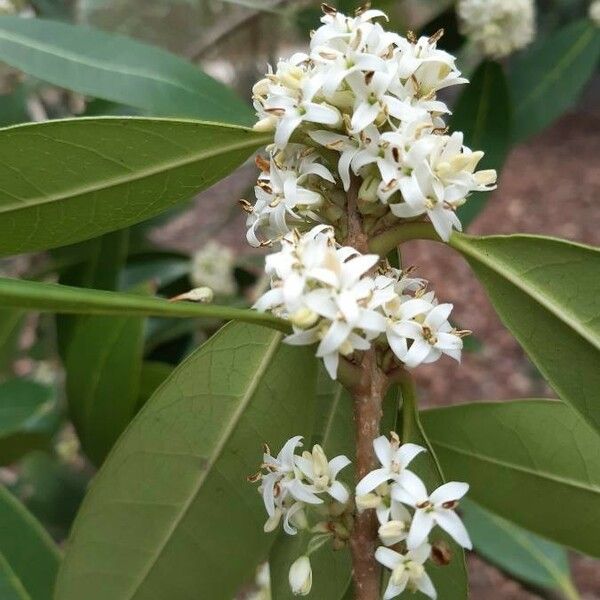
Plant Overview
Commonly known as the Garland Osmanthus, this elegant evergreen is a hidden gem of the horticultural world. Native to the mountainous regions of Turkey and the Caucasus, it was once known as Phillyrea decora before being welcomed into the fragrant Osmanthus family. It is beloved by gardeners for its "unshakeable" nature, providing a lush, deep-green backdrop even in the depths of winter.
🔍 How to Identify
- 🍃 Leathery Foliage: The leaves are thick, dark green, and lance-shaped, usually measuring about 5 inches long. They have a smooth, polished texture that reflects sunlight beautifully.
- 🌸 Hidden Blooms: Unlike some showy shrubs, its tiny, tubular white flowers appear in clusters along the stems in mid-spring. While small, their sweet, delicate scent is unmistakable.
- 🫐 Dark Fruit: Following the flowers, the plant produces small, egg-shaped fruits that ripen into a deep purple-black color, resembling miniature olives.
🏡 In Your Garden
- 🛡️ Wind Protection: While this plant is incredibly hardy, it appreciates a spot sheltered from harsh, drying winter winds. Cold winds can cause "leaf scorch," turning the tips of its beautiful evergreen canopy brown.
- 🌱 Slow and Steady: This is not a plant that will take over your yard overnight. It has a slow growth habit, making it perfect for low-maintenance hedging or as a structural "anchor" in a mixed border.
- ⛰️ Soil Preference: It thrives in well-drained soil but is surprisingly tolerant of heavy clay, provided it doesn't sit in a puddle. Once established, it is remarkably drought-tolerant.
⚠️ Safety & Toxicity
- ✅ General Safety: Osmanthus decorus is generally considered non-toxic to humans, cats, and dogs. It is a safe choice for family-friendly landscapes.
- 🚫 Non-Edible Berries: While not known to be dangerously toxic, the dark berries are not palatable and should not be consumed by humans. They are best left for the birds!
✨ Fun Fact
The name Osmanthus is derived from the Greek words osme (meaning "fragrance") and anthos (meaning "flower"). Although this specific species has a more subtle scent than its cousin, the "Sweet Olive," its perfume is often described as a delicate mix of apricot and jasmine.

Detailed Care Instructions
To successfully grow an Osmanthus decorus plant, follow these steps:
- Climate: Osmanthus decorus thrives in USDA hardiness zones 7 to 10. It prefers a mild and temperate climate with moderate rainfall.
- Sunlight: Choose a location that receives full sun to partial shade. Osmanthus decorus plants require at least 6 hours of sunlight per day.
- Soil: Use well-draining soil that is rich in organic matter. Amend heavy clay soil with compost or sand to improve drainage. The pH level should be neutral to slightly acidic.
- Planting: Dig a hole twice the size of the root ball and place the plant in it, ensuring that the top of the root ball is level with the ground. Backfill the hole with soil, gently firming it around the roots.
- Watering: Water the plant deeply after planting and continue to water regularly. Keep the soil consistently moist, especially during the first year of growth. However, avoid overwatering, as it can lead to root rot.
- Mulching: Apply a layer of organic mulch around the base of the plant to retain moisture, suppress weed growth, and insulate the roots. Keep the mulch at least 2-3 inches away from the stem to prevent rotting.
- Fertilizer: Feed the Osmanthus decorus plant with a balanced, slow-release fertilizer in early spring. Follow the instructions on the fertilizer packaging for the correct application rate.
- Pruning: Prune the plant after flowering to maintain its shape and promote bushier growth. Remove dead, damaged, or crossing branches. Avoid heavy pruning as Osmanthus decorus may not tolerate a drastic cutback.
- Pests and diseases: Monitor the plant regularly for pests such as scale insects, aphids, or spider mites. Treat any infestations promptly with appropriate organic or chemical insecticides. Watch for signs of diseases such as root rot, leaf spot, or powdery mildew and apply suitable treatments.
- Propagation: Osmanthus decorus can be propagated from cuttings taken in early summer. Use a rooting hormone to improve success rates. Alternatively, it can also be propagated from seeds, although this method may take longer to establish.
Remember, Osmanthus decorus is a relatively low-maintenance plant, but regular care and attention will ensure its healthy growth and blooming.

Place in a bright room that is sun drenched almost all day. Or directly in a south-facing window.

Osmanthus Decorus is a plant that requires a sufficient amount of water in order to thrive. When watering this plant, it is important to make sure the soil is evenly moist but not waterlogged. Overwatering can lead to root rot and other issues.
To water this plant, start by checking the moisture level of the soil. You can do this by sticking your finger into the soil up to your second knuckle. If the soil feels dry at this depth, it's time to water.
When watering, use room temperature water and pour it slowly into the soil around the base of the plant. Avoid getting water on the leaves or flowers, as this can lead to disease. Water until you see water running out of the bottom of the pot, which indicates that the soil is properly saturated.
During periods of hot, dry weather, you may need to water your Osmanthus Decorus more frequently. Conversely, during cooler weather or if the plant is kept in a cooler environment, you may need to water it less frequently. Always keep an eye on the moisture level of the soil and adjust your watering accordingly.
- Choose a balanced fertilizer: Select a fertilizer that has an equal ratio of nitrogen (N), phosphorus (P), and potassium (K). This will ensure that all essential nutrients are provided to the plant.
- Dilute the fertilizer: Mix the fertilizer with water according to the manufacturer's instructions. It is important not to use too concentrated a solution, as this can damage the roots.
- Apply during the growing season: Fertilize the Osmanthus Decorus plant during its active growth period, which is typically in spring and early summer. This is when the plant is actively taking up nutrients for foliage and flower development.
- Water the plant: Before applying fertilizer, water the plant thoroughly. This will allow the nutrients to penetrate the soil more effectively and discourage root burn.
- Apply the fertilizer: Pour the diluted fertilizer solution evenly around the base of the plant, avoiding direct contact with the foliage. Take care not to over-fertilize, as it can lead to salt buildup in the soil.
- Repeat as recommended: Follow the fertilizer manufacturer's guidelines for the frequency of application. For most plants, a monthly feeding during the growing season is sufficient. However, always refer to specific instructions for the Osmanthus Decorus plant.
- Monitor the plant's response: Watch for any signs of fertilizer burn, such as yellowing or browning of the leaf margins. If this occurs, reduce the frequency or concentration of fertilizer application.
- Adjust for specific needs: Depending on the specific condition of your Osmanthus Decorus plant, you may need to make adjustments to the fertilizer application. For instance, if the plant shows signs of nutrient deficiencies, such as pale leaves or slow growth, consider using a fertilizer with a higher nitrogen content.
Remember, it is always recommended to refer to the specific needs and recommendations for your Osmanthus Decorus plant, as factors such as soil pH, light conditions, and local climate may influence fertilization requirements.
Osmanthus Decorus prefers well-draining soil that is rich in organic matter. The soil should be slightly acidic with a pH level between 5.5 to 7.5. A mixture of sandy loam and peat moss can be used for the soil. The soil should be moist but not waterlogged as it can lead to root rot. It is essential to ensure good drainage by adding sand or perlite to the mix. Mulching around the base of the plant can help to retain the moisture in the soil. Fertilizing the plant with a balanced fertilizer during the growing season can ensure healthy growth and flowering.
To propagate Osmanthus decorus plant, follow these steps:
- Start by obtaining a healthy and mature Osmanthus decorus plant from which you can take cuttings. Ensure that the parent plant is disease-free and shows vigorous growth.
- Prepare a clean work surface and gather all necessary tools, including sharp and sterilized pruning shears, rooting hormone (optional), clean pots or containers, and well-draining potting soil.
- Select a suitable stem for cutting, ideally a non-flowering softwood shoot. Softwood typically refers to the softer, more flexible new growth that is not yet fully matured or hardened.
- Using sterilized pruning shears, make a clean cut just below a node (the point where a leaf emerges from the stem). The cutting should ideally be around 4-6 inches long, containing at least two or three nodes.
- Remove the lower leaves from the cutting, leaving only a few leaves on the upper portion. This reduces water loss and directs the plant's energy towards root development.
- If desired, dip the cut end of the stem into a rooting hormone powder or gel. This step is optional but can enhance rooting success by promoting the development of new roots.
- Prepare the pot or container by filling it with well-draining potting soil. Poke a small hole in the soil with your finger or a pencil.
- Insert the prepared cutting into the hole in the soil, ensuring that at least one node is buried in the potting mix. Gently press the soil around the cutting to secure it in place.
- Water the cutting thoroughly, ensuring that the soil is evenly moist but not waterlogged. Place the pot in a warm location with bright, indirect light.
- To maintain humidity and encourage root growth, cover the cutting and pot with a clear plastic bag or place it inside a propagator. This helps create a greenhouse-like environment that retains moisture.
- Check the cutting regularly for signs of growth and monitor the moisture levels in the potting mix. Avoid overwatering, as this can lead to rotting, but also ensure that the soil doesn't dry out completely.
- After a few weeks or months, the cutting should start developing roots. You can gently tug on the cutting to check for resistance, indicating the presence of roots.
- Once significant root development has occurred, gradually acclimate the new plant to the outdoor conditions by exposing it to increasing periods of sunlight and reducing humidity.
- Transplant the rooted cutting into a larger pot or directly into the garden, ensuring it receives the appropriate amount of sunlight and water for Osmanthus decorus plants.
Remember, propagation success can vary depending on various factors such as temperature, humidity, and the health of the parent plant. It may take time and patience, but with proper care and attention, you can successfully propagate Osmanthus decorus plant through stem cuttings.








