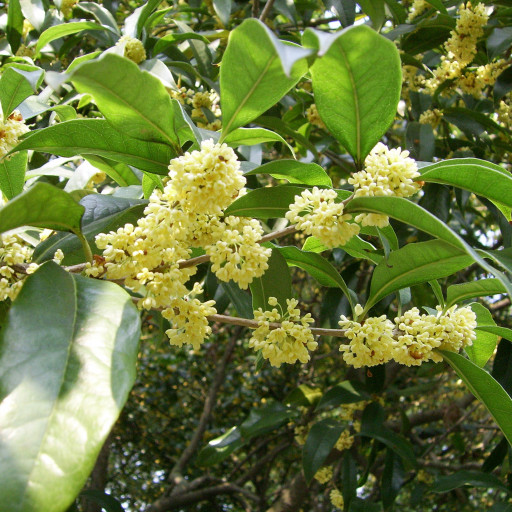
Plant Overview
Often called the "Sweet Olive" or "Tea Olive," this evergreen shrub is a legend in East Asian gardens. In China, it is known as Guihua, where its arrival marks the mid-autumn festival with a scent so powerful it can drift through entire neighborhoods. It is more than just a plant; it is a living perfume bottle that fills the air with the aroma of sun-ripened apricots and peaches.
🔍 How to Identify
- 🍃 Glossy Foliage: The leaves are leathery, dark green, and oval-shaped, usually featuring finely serrated edges that give the shrub a crisp, clean look.
- 🌼 Tiny Clusters: The flowers are remarkably small and delicate, hidden in dense clusters tucked tightly into the leaf axils (where the leaf meets the stem).
- 🎨 Color Variations: Depending on the specific variety, the tiny blossoms can range from a creamy white and pale yellow to a vibrant, fiery orange.
🏡 In Your Garden
- ⏳ Patience is a Virtue: This is a slow-growing shrub or small tree. While it takes time to reach its full height, its slow pace makes it an excellent choice for a fragrant privacy screen or a formal hedge that won't quickly overgrow its space.
- 💧 Humidity Lover: While it requires well-draining soil, it truly thrives in humid environments. If you live in a dry climate, planting it in a sheltered spot away from drying winds will help prevent the leaf tips from browning.
- ✂️ Pruning Strategy: It handles pruning exceptionally well, but because it blooms on old wood, heavy pruning right before the flowering season (autumn) may significantly reduce the number of blossoms.
⚠️ Safety & Toxicity
- ✅ Safe Status: Osmanthus fragrans is generally considered non-toxic to humans and common household pets like dogs and cats.
- 🍵 Edible Tradition: The flowers are actually prized in culinary circles; they are frequently dried and used to scent green or oolong teas, create sweet jams, and even infuse traditional liqueurs. Always ensure your plant is pesticide-free before using flowers for tea.
✨ Fun Fact
In Chinese folklore, a giant Osmanthus tree is said to grow on the moon. The mythical figure Wu Gang is perpetually tasked with cutting it down as punishment, but because the tree heals itself instantly with every swing of the axe, his work never ends—a poetic explanation for the shifting shadows seen on the lunar surface.

Detailed Care Instructions
Yes and no. The purple drupes that ripen after the flowers fade are considered edible, but they are quite small and occupied mostly by seeds, and thus are almost never harvested for food as are other members of the olive family. The fruits are also quite bitter until they fully ripen, which can take as much as six months.However, the aromatic flowers of this plant are often used to infuse teas, jams, and other recipes—this is the reason the plant is called "tea olive."
What does the botanical name mean?
The name Osmanthus (in the botanical name Osmanthus fragrans) comes from the Greek words osme meaning fragrant and anthos meaning flower. All species of the Osmanthus genus are fragrant, but O. fragrans has the most pronounced scent.
How is this plant used in the landscape?
Fragrant tea olive is often used as a large specimen plant in lawn areas, as a screen or hedge plant, or in the backdrop of a perennial border. Placing it near pathways, patios, or entrances will allow you to readily enjoy its fragrance.It can also be grown as a potted plant.
How long does a fragrant tea olive live?
Like most members of the olive family, O. fragrans is a long-lived species. Barring disease or major cultural issues, species can live for many decades. These are not the ancient olive trees of biblical legend, but a fragrant tea olive may well outlive you.
Are there other broadleaf evergreen shrubs to consider for my southern garden?
Depending on your region, other broadleaf evergreens that might be suitable for your garden include boxwood, holly, inkberry, rhododendron, camellia, gardenia, and cotoneaster. Some species have both deciduous and evergreen varieties, so do your research before choosing.
| Color | White |
| Soil Ph | 5.5-7.5 |
| Humidity | Normal |
| Lighting | Part Sun |
| Toxicity | Non-Toxic |
| Soil Type | Well Drained, Moist |
| Bloom Time | Spring, Then Intermittent |
| Difficulty | Medium |
| Plant Type | Shrub |
| Hibernation | Cold Period |
| Mature Size | 15 To 30 Feet Tall |
| Native Area | Eastern North America, Mexico, Southeast Asia, Hawaii, And New Caledonia |
| Temperature | 18°C - 24°C |
| Sun Exposure | Full Sun To Partial Shade |
| Hardiness Zones | 8-11 |
To grow an Osmanthus Fragrans plant, you can follow the following steps:
- Select a suitable location: Choose a spot with well-drained soil and partial shade to full sun exposure. Osmanthus fragrans can tolerate various light conditions but tends to bloom more profusely in full sun.
- Prepare the soil: Ensure the soil is well-draining and rich in organic matter. If your soil is heavy or clayey, amend it with compost, peat moss, or well-rotted manure to improve its drainage and nutrient content.
- Planting: Dig a hole that is twice as wide and deep as the root ball of the plant. Gently remove the plant from its container and place it in the hole, making sure the top of the root ball is level with or slightly above the soil surface. Backfill the hole with soil, gently firming it around the root ball.
- Watering: Immediately after planting, water the plant thoroughly to settle the soil and eliminate air pockets. During the establishment period, which generally lasts for the first year, water regularly to keep the soil evenly moist but not waterlogged. Once the plant is established, reduce the frequency of watering, allowing the soil to dry slightly between waterings.
- Mulching: Apply a layer of organic mulch, such as wood chips or bark, around the base of the plant. Mulch helps retain moisture, suppress weeds, and provide some insulation to the roots during extreme temperatures.
- Pruning: Osmanthus fragrans generally does not require much pruning. However, you can shape or prune the plant after it finishes blooming to maintain its desired size and shape. Remove any dead, damaged, or crossing branches, and thin out crowded areas to improve airflow and light penetration.
- Fertilizing: Apply a balanced, slow-release fertilizer in early spring, just as new growth begins. Follow the instructions on the fertilizer packaging for the appropriate dosage and application method. Avoid over-fertilization, as it can lead to excessive foliage growth and reduced flower production.
- Pests and diseases: Osmanthus fragrans is generally pest and disease resistant. However, it may occasionally be susceptible to aphids, scale insects, or fungal leaf spots. Regularly inspect the plant for any signs of pests or diseases and take appropriate measures to control them, such as using insecticidal soap or fungicides if necessary.
By following these steps and providing proper care, your Osmanthus Fragrans plant should thrive and produce its aromatic flowers.

Place in a window with dappled sun or a spot in the middle of a room. Or directly in a window facing west or east.

The best way to water this plant is to keep the soil consistently moist, but not overly wet. This can be achieved by watering deeply once per week or as needed, depending on the temperature and humidity in your location. It is important to ensure that the water is able to penetrate the soil, rather than just spraying the leaves, as this can encourage fungal growth and leaf damage. You can also monitor the plant for signs of underwatering, such as wilted leaves or dry soil, and adjust your watering frequency accordingly. Additionally, it is recommended to avoid using cold or chlorinated water, as this can stress the roots and damage the plant over time.
To fertilize this plant, apply a balanced, slow-release fertilizer in early spring and then again in late summer. Make sure to follow the package instructions for application rates. Avoid fertilizing during the winter months, as the plant is dormant and doesn't require additional nutrients. Water deeply after fertilizing to help distribute the nutrients throughout the root zone.
Osmanthus Fragrans prefers a well-draining soil that is slightly acidic (pH 6.0-6.5) and rich in organic matter. The soil should be loose and well-aerated to promote healthy root growth, and it should retain moisture without becoming waterlogged. A mix of peat moss, perlite, and sandy loam soil is ideal for growing Osmanthus Fragrans. It is important to avoid using heavy clay soils or sandy soils that drain too quickly. Adding compost to the soil during planting and regularly applying fertilizer can help provide the plant with the nutrients it needs to thrive.
Propagation of this plant can be done through various techniques such as seed germination, stem cuttings, layering, and air layering. Seed germination can be challenging and requires much patience, but it is a cost-effective method. Stem cuttings are easy to propagate and produce a healthy plant. Layering is an effective method that can be done naturally by bending a branch to the ground and pinning it in place for a few weeks until roots appear. Air layering is a more intricate technique that involves making a cut in the middle of the stem, wrapping it with a moist material, and covering it with plastic. After a few weeks, roots should appear, and the stem can be planted in soil. Regardless of the method used, it is important to ensure that the plant is healthy, and the conditions are suitable to facilitate growth.
Common pests of the sweet osmanthus include Spider mites, aphids, whiteflies. Make a habit of checking your sweet osmanthus frequently for pests so that any infestations can be caught and managed early.








