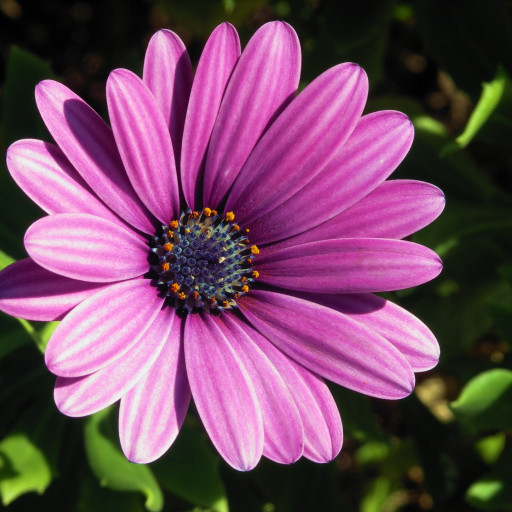
Plant Overview
Often called the African Daisy or Cape Daisy, these sun-loving beauties bring a splash of South African sunshine to any landscape. With their jewel-toned centers and petals that seem painted by hand, they are a favorite for spring and fall containers. They are famous for their "sleep movements," closing their petals tightly when the sun goes down as if tucking themselves in for the night.
🔍 How to Identify
- 🌸 Petal Palette: Look for classic daisy shapes in vivid shades of purple, pink, white, or orange, often featuring a contrasting, dark-blue or metallic-looking central "eye."
- 🍃 Foliage Texture: The leaves are usually lance-shaped and can be slightly toothy or lobed, providing a deep green, sturdy backdrop for the vibrant blooms.
- 🥄 Specialty Shapes: Some unique cultivars feature "spooned" petals where the middle of each petal is pinched into a narrow tube, expanding into a flat tip at the end.
🏡 In Your Garden
- ☀️ Solar Powered: These plants are strictly diurnal. To see the flowers fully open, they need direct sunlight; on cloudy days or in heavy shade, the petals will remain tightly shut.
- 🌡️ The Summer Siesta: Unlike many tropical summer flowers, Osteospermum actually prefers the cooler temperatures of spring and autumn. They often stop blooming during the peak "dog days" of mid-summer heat, only to return with a second flush once the nights cool down.
- ✂️ Energy Management: Removing spent flowers (deadheading) isn't just for looks; it prevents the plant from wasting energy on seed production, encouraging it to focus on creating more buds.
⚠️ Safety & Toxicity
- 🐾 Pet Friendly: These are generally considered non-toxic to dogs, cats, and horses, making them a worry-free choice for household gardens and low-reaching flower beds.
- 👶 Kid Safe: They are safe for children, though the foliage can occasionally cause very mild skin irritation in sensitive individuals due to the slightly resinous or fuzzy texture of the stems.
✨ Fun Fact
While they look exactly like the common field daisy, Osteospermum belongs to a specific tribe of the sunflower family that is genetically closer to the giant sunflower than the common European daisy!

Detailed Care Instructions
All daisy genera belong to the Asteraceae family, but the one most often confused for African daisy is the gerbera daisy (Gerbera spp.) Gerbera daisies generally are shorter plants with larger flowers, usually in intense solid shades of red, orange, and yellow, rather than the slightly less intense colors found in taller African daisies.
What are the best ways to use African daisy in the landscape?
African daisies make good flowers for borders and mixed beds, but unlike many daisies, they aren't well suited for wildflower meadows or other naturalized gardens. They also work well in containers on patios and decks. Some designers recommend planting African daisies alongside plants with yellow or chartreuse foliage, which highlights the colors of the flowers.
Are there other flower species also called African daisies?
Several other species are sometimes sold under the name African daisy. In particular, annual plants from the Dimorphotheca genus may carry this name. Originally, Osteospermum species were included in the Dimorphotheca genus, but these perennial species were then split out into their own genus. In addition, gerbera daisies (Gerbera spp.) are sometimes known as African daisies.
Can potted African daisies be moved indoors for the winter?
Unlike some tender perennials, daisies do not work very well as indoor plants. Potted outdoor African daisies often die when brought indoors, unless you happen to have an ideal location, such as a sunroom. Gardeners who want to overwinter African daisies usually have better luck by taking cuttings and rooting them indoors.
| Humidity | Normal |
| Lighting | Full Sun |
| Toxicity | Poisonous |
| Difficulty | Easy |
| Hibernation | Cold Period |
| Temperature | 18°C - 30°C |
| Hardiness Zones | 9 - 10 |
To successfully grow Osteospermum plants, also known as African Daisies, you can follow these steps:
- Choose the right location: Osteospermum plants prefer full sun or partial shade. Select a spot in your garden that receives at least 6 hours of sunlight per day.
- Prepare the soil: Ensure your soil is well-draining with a pH level of around 6-7. If your soil is heavy or clay-like, amend it with organic matter like compost to improve drainage and provide nutrients.
- Planting: Start by digging a hole slightly larger than the root ball of your plant. Place the plant in the hole at the same level it was growing in the pot. Fill the hole with soil, gently firming it around the plant. Space multiple Osteospermum plants about 12-18 inches apart.
- Watering: After planting, water the Osteospermum thoroughly to settle the soil. Maintain consistent watering, especially during hot and dry periods. However, be cautious not to overwater, as excessive moisture can cause root rot.
- Fertilization: Feed your Osteospermum plants with a balanced fertilizer every two weeks during the growing season. This will encourage healthy growth and abundant blooms.
- Deadheading: To promote continuous blooming, regularly deadhead the faded flowers. Pinch or cut off the spent blossoms, taking care not to damage the surrounding foliage. This will divert the plant's energy into producing more flowers instead of seed production.
- Mulching: Apply a layer of mulch around the base of the plant to help retain moisture, suppress weed growth, and regulate soil temperatures.
- Winter care: Osteospermum plants are typically grown as annuals, but they can be overwintered indoors if desired. Before the first frost, dig up the plants and pot them, placing them in a sunny window or under grow lights. Reduce watering and fertilization during dormancy to promote rest.
- Pests and diseases: Monitor your plants for common pests like aphids, whiteflies, or spider mites. If necessary, treat with organic insecticides or appropriate measures. Osteospermums are generally resistant to diseases, but overwatering can lead to root rot, so proper watering is essential.
By following these guidelines, you can grow healthy and vibrant Osteospermum plants that will add beauty to your garden.

Place in a window with dappled sun or a spot in the middle of a room. Or directly in a window facing west or east.

To properly water this particular plant, it is important to ensure that the soil is moist but not waterlogged. When watering, it is recommended to water deeply and thoroughly, rather than giving small amounts of water frequently. It is also important to allow the soil to dry out slightly between waterings, as this will prevent root rot and other moisture-related problems. When watering, be sure to pour the water directly onto the soil rather than directly onto the plant, as wet conditions can encourage disease and pest problems. In addition, it is best to water early in the day or late in the afternoon to minimize evaporation and ensure the plant has adequate time to absorb water before temperatures rise.
- Choose a fertilizer with a balanced N-P-K ratio that also includes micronutrients.
- Apply the fertilizer according to the package instructions.
- Apply the fertilizer in the early spring before new growth emerges.
- Alternatively, apply the fertilizer every four to six weeks during the growing season.
- Water the plant lightly after fertilizing to help the nutrients soak into the soil.
- Avoid over-fertilizing as this can cause damage to the plant.
- If using a liquid fertilizer, dilute it to half strength to prevent burning the plant.
Osteospermum plants prefer a well-draining soil mix that is rich in organic matter. The ideal soil pH should be slightly acidic to neutral (between 6.0 and 7.0). A good soil mix for these plants should contain a mixture of peat moss, perlite, and sand or gravel to promote good drainage. Organic compost can also be added to the soil mix to improve soil fertility and moisture retention. Avoid using heavy or compacted soils and ensure that the soil is moist but not waterlogged as overwatering can lead to root rot.
There are a few ways to propagate this plant. One way is through stem cuttings. To do this, select a healthy stem that is at least 4 inches long and has some leaves on it. Cut the stem just below a set of leaves. Remove the leaves from the bottom 2 inches of the stem. Dip the cut end in rooting hormone and plant it in a pot with potting soil. Keep the soil moist and the cutting in a warm, bright location, but out of direct sunlight. Roots should start to form in 2-4 weeks.
Another way to propagate is through division. Carefully dig up the plant and separate it into smaller sections. Each section should have roots attached. Plant each section in its own pot with potting soil.
Finally, Osteospermum can also be propagated from seed. Sow the seeds in potting soil and keep the soil moist. Germination should occur within 1-2 weeks. Once the seedlings are large enough to handle, transplant them into individual pots.







