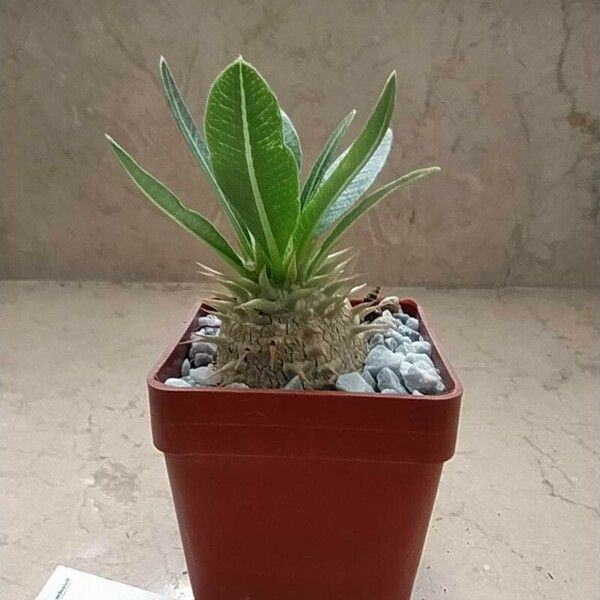
Plant Overview
Often called the Ivory Elephant’s Foot, the Pachypodium eburneum looks less like a plant and more like a living sculpture carved from silver stone. Native to the sun-scorched rocky highlands of Madagascar, this rare succulent has evolved to store water in its swollen, metallic-looking trunk. It is a slow-growing crown jewel for any rare plant collector, prized for its "alien" aesthetic and its remarkably large, cream-colored flowers.
🔍 How to Identify
- 🪨 The Caudex: It features a fat, compressed, silver-gray trunk (caudex) that stays relatively low to the ground, resembling a smooth, weathered boulder.
- 🌵 Protective Spines: The trunk is armored with short, conical spines that usually appear in pairs, though they become less sharp as the plant ages and the trunk thickens.
- 🌸 Ivory Blooms: Unlike its yellow-flowered cousins, this species produces large, trumpet-shaped flowers in a stunning shade of ivory-white with a yellow throat.
- 🍃 Leaf Crown: Deep green, oval leaves sprout in a cluster from the top of the trunk during the growing season, creating a tiny "palm tree" effect.
🏡 In Your Garden
- ☀️ Light Craving: This plant is a sun-worshipper. To maintain its compact, silver shape, it needs the brightest spot in the house; low light will cause it to stretch and lose its sculptural "fatness."
- 🏜️ Mineral Diet: In the wild, it grows among quartz rocks. It thrives in "poor" soil that is extremely gritty. If the soil stays damp for too long, the taproot can rot almost overnight.
- 💤 Winter Dormancy: During the winter, it will drop all its leaves and look like a dormant stone. This is a natural defense mechanism—reduce watering to nearly zero during this time to let the plant rest.
⚠️ Safety & Toxicity
- 🚫 Toxic Latex: Like most members of the Apocynaceae family, the plant contains a milky sap (latex) that is toxic if ingested and can cause significant skin irritation.
- 🐕 Keep Away from Pets: The combination of sharp spines and internal toxins makes this a "look but don't touch" plant for households with curious pets or small children.
✨ Fun Fact
The name eburneum is derived from the Latin word for "ivory." It was long considered a natural hybrid between two other species before being recognized as its own unique, rare species native only to a very small region in central Madagascar.

Detailed Care Instructions

Place in a window with dappled sun or a spot in the middle of a room. Or directly in a window facing west or east.

When the top few inches of soil dry out, water your plants. If the top few inches of soil are still moist, do not water your plant. Wait a few days, then poke your finger into the soil to see if anything has changed. Overwatering poses a disease risk, such as the development of fungal diseases in the roots. These plants have adaptations in there leaves that allow them to survive in low water supply.
These plants can thrive without taking help from any fertilizer. However, if the medium of growth is something other than soil for instance sand then you may need to add little fertilizer. The best way to know if your plants need fertilizer or not is to check for yellowing of leaves. If the leaves start to turn yellow it’s fertilizing time.
You may use All Purpose Plant Food or Green Plant Food or Cactus Fertilizer for your Pachypodium Eburneum








