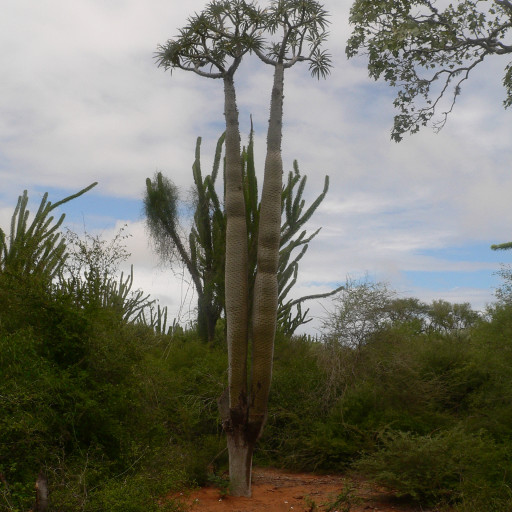
Plant Overview
Often called the "Madagascar Palm," this plant is a master of disguise. Despite its name and palm-like silhouette, it is actually a stem succulent more closely related to Oleanders than to any true palm tree. It looks like a prehistoric relic or something plucked from a Dr. Seuss book, featuring a shimmering silver trunk guarded by a fortress of sharp spines.
🔍 How to Identify
- 🌵 The Trunk: A thick, metallic-grey "bottle" stem (caudex) covered in formidable, three-forked spines that spiral up the plant in a geometric pattern.
- 🍃 The Foliage: Long, narrow, glossy green leaves that sprout exclusively from the very top of the trunk, creating a whimsical "mop-top" appearance.
- 🌸 The Blooms: On mature specimens (usually those over 4 feet tall), large, fragrant, white star-shaped flowers with a yellow throat emerge during the peak of summer.
🏡 In Your Garden
- 💧 Built-in Reservoir: That swollen, succulent trunk is a highly evolved water tank. Because it stores its own hydration, it is incredibly drought-tolerant; it prefers its soil to dry out completely, as "wet feet" will quickly lead to root rot.
- ☀️ Sun Seeker: This is not a plant for dim corners. It requires intense, direct light to maintain its structural integrity. If kept in too much shade, the trunk will become weak and may begin to lean or "stretch" toward the nearest window.
- 💤 The Winter Baldness: Do not be alarmed if your plant drops every single one of its leaves in late autumn. This is a natural dormancy period. In this state, the plant is "sleeping" and needs almost no water until new leaves sprout in the spring.
⚠️ Safety & Toxicity
- 🚫 Dual Threat: The Madagascar Palm defends itself in two ways. The visible spines are very sharp and can cause painful punctures, while the internal milky sap is toxic if ingested.
- 🐾 Pet & Child Safety: Due to the height of the spines and the chemical irritants in the sap, this plant should be kept in a low-traffic area away from curious pets and toddlers. Wear gloves when repotting to avoid both the "pins" and the "juice."
✨ Fun Fact
In the wild rocky landscapes of Madagascar, these plants are remarkably long-lived and can grow into massive silver pillars reaching over 20 feet in height, looking like shimmering sentinels against the horizon.

Detailed Care Instructions
| Color | White, Yellow, Red, Or Pink |
| Soil Ph | Alkaline |
| Humidity | Normal |
| Lighting | Part Sun |
| Toxicity | Toxic |
| Soil Type | Cactus Compost, Well-Drained Chalk, Loam, Or Sand |
| Bloom Time | Summer |
| Difficulty | Medium |
| Plant Type | Deciduous Succulent (Not Related To True Palms) |
| Mature Size | 12 To 24 Ft. Tall, 10 To 12 Ft. Wide |
| Native Area | Southern Madagascar |
| Temperature | 18°C - 25°C |
| Sun Exposure | Full Sun |
| Hardiness Zones | 9-11 |
To successfully grow a Pachypodium lamerei plant, also known as the Madagascar palm or the bottle tree, you can follow these steps:
- Climate and temperature: Pachypodium lamerei prefers warm and dry climates. It can tolerate temperatures above 50°F (10°C) but is typically grown indoors in cooler regions. If growing it indoors, place it near a bright window with indirect sunlight.
- Soil: Use well-draining soil, such as a cactus mix or a mixture of sand and potting soil. Good drainage is crucial to prevent root rot.
- Watering: Like most succulents, Pachypodium lamerei prefers infrequent watering. Allow the soil to dry out completely between waterings, and water deeply. Be cautious not to overwater, as this can cause root rot.
- Light: Provide bright but indirect sunlight. Pachypodium lamerei can tolerate full sun for a few hours a day but can get sunburned if exposed to intense, direct sunlight for extended periods.
- Potting: Choose a pot with drainage holes that is slightly larger than the current root system. Repotting should be done every 2-3 years or when the plant outgrows its current container.
- Fertilizer: Apply a balanced, water-soluble fertilizer diluted to half strength during the growing season (spring and summer) once a month. Avoid fertilizing during the winter dormancy period.
- Pruning: Pachypodium lamerei generally does not require extensive pruning. However, if your plant becomes leggy or top-heavy, you can prune the stems back to maintain a more compact shape.
- Propagation: Pachypodium lamerei can be propagated from seeds or stem cuttings. Seeds require a warm, humid environment to germinate. Stem cuttings should be taken during the growing season, allowed to callus for a few days, and then planted in well-draining soil.
- Pest control: Monitor your plant for common succulent pests like mealybugs or spider mites. Treat any infestations promptly with appropriate insecticides or by wiping the pests off with a cotton swab dipped in alcohol.
Remember to always research and follow specific care instructions tailored to your plant and individual conditions. These guidelines should help you get started in successfully growing a Pachypodium lamerei plant.

Place in a window with dappled sun or a spot in the middle of a room. Or directly in a window facing west or east.

Watering Pachypodium Lamerei plant should be done with caution as it prefers infrequent watering during the growing season. It is important to allow the soil to completely dry out before watering again. It is recommended to water deeply when watering, allowing the water to penetrate the entire root system. During colder months, reduce watering to avoid root rot. It is important to keep the plant in well-draining soil and to never let it sit in standing water.
To fertilize this plant, mix a balanced, water-soluble fertilizer with water according to the label instructions. Use this mixture to water the plant every two weeks during the growing season, and reduce frequency during the dormant season. Do not fertilize when the soil is dry, and avoid getting fertilizer on the plant's leaves and stem.
For best results, it is recommended to use well-draining soil with good aeration. Soil with a slightly acidic to neutral pH range is ideal. A mixture of regular potting soil, coarse sand, and perlite can be used to create a suitable potting mix. The soil should not be kept too moist, as this can lead to root rot. Allow the top inch of soil to dry out between watering. Consider adding a layer of gravel at the bottom of the container to aid with drainage. Fertilize with a balanced, slow-release fertilizer during the growing season.
To propagate this plant, you will need to start by gathering materials such as a sharp, clean knife, rooting hormone, sterile potting soil, and well-draining pots. Then, you will need to identify a healthy stem that has not yet flowered and cut it from the mother plant.
Next, remove any leaves from the lower half of the stem and dip the cut end in rooting hormone. Place the stem in moist potting soil and keep it at a temperature between 68-77°F (20-25°C) and out of direct sunlight.
Water the soil regularly to keep it moist but not soaking. After a few weeks, the stem should start to form new roots. Once these roots reach a size of around 1-2 inches (2.5-5 cm), you can transplant the new plant into a larger pot with fresh soil.
It is important to note that Pachypodium Lamerei plants can be toxic if ingested, so take care when handling them and keep them out of reach of pets and children.
Common pests of the madagascar palm include Scale insect, mealybugs, spider mites, thrips. Make a habit of checking your madagascar palm frequently for pests so that any infestations can be caught and managed early.








