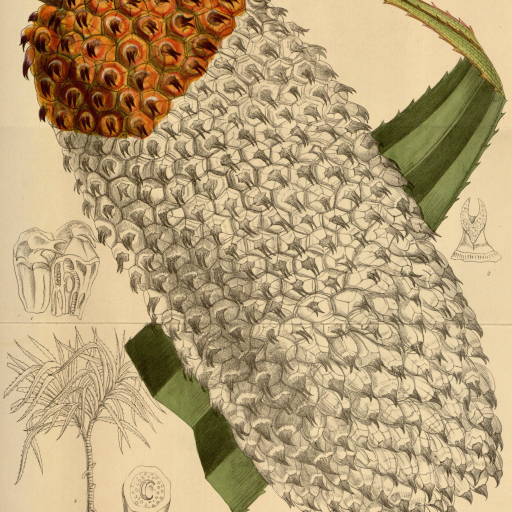
Plant Overview
Often called the Himalayan Screw Pine, this architectural marvel looks like a relic from a prehistoric era. Its name comes from the dramatic, corkscrew-like spiral in which its leaves grow, creating a spinning silhouette that stands out in any landscape. Native to the moist, shaded slopes of the Himalayas and Southeast Asia, it brings a touch of ancient tropical mystery to the modern garden.
🔍 How to Identify
- 🌀 The "Screw" Pattern: The long, leathery leaves are arranged in a tight, three-ranked spiral along the stems, giving the plant its distinctive twisted appearance.
- ⚔️ Serrated Leaves: Each sword-shaped leaf is lined with tiny, sharp spines along the edges and the underside of the midrib—handle with care!
- 🏗️ Prop Roots: As the plant matures, it develops thick, woody "stilt roots" that emerge from the trunk and dive into the soil, providing extra stability in sloped or windy terrain.
- 🍍 Compound Fruit: It produces a large, pendulous fruit that looks remarkably like a woody, orange-red pineapple, composed of many smaller drupes.
🏡 In Your Garden
- 🌱 Soil & Drainage: While it loves the humidity of its native cloud forests, it is prone to root rot if left in standing water. It thrives best in rich, loamy soil that allows water to pass through freely.
- 🌴 Architectural Impact: Because of its unique "stilt" roots and spiral foliage, it is often used as a focal point. It’s a slow grower, so it won’t overwhelm your space overnight, but it does need room to expand its wide footprint.
- 🌤️ Light Nuance: It prefers dappled sunlight or "bright shade." In the wild, it lives under the canopy of larger trees; direct, scorching afternoon sun can bleach or burn the deep green leaves.
⚠️ Safety & Toxicity
- 🌵 Physical Hazard: While not chemically poisonous, the Pandanus furcatus is "mechanically" dangerous. The serrated leaf edges can cause painful scratches or "paper cuts" on skin.
- 🐾 Pets & Kids: It is generally considered non-toxic if nibbled, but the sharp spines make it a poor choice for areas where pets or children play frequently. It is best placed at the back of a garden bed.
✨ Fun Fact
The specific epithet furcatus means "forked" in Latin, referring to the unique forked shape of the bracts (specialized leaves) that surround its flowers. In many cultures, its resilient leaves are dried and woven into incredibly durable mats, baskets, and even sails!

Detailed Care Instructions
To grow a Pandanus furcatus plant, also known as the screw pine or the pandan plant, you will need to follow these steps:
- Climate and soil requirements: Pandanus furcatus thrives in warm, tropical climates with temperatures between 65-85°F (18-29°C). It also prefers well-draining soil and can tolerate a wide variety of soil types, including sandy, loamy, or clayey soils.
- Select a suitable location: Choose a spot that receives abundant sunlight, as Pandanus furcatus requires at least 4-6 hours of direct sunlight each day. If you don't have access to direct sunlight, filtered light or partial shade can also work.
- Planting: Start by germinating the seeds. Soak the seeds in warm water for 24 hours before planting to help facilitate germination. Fill a pot or a seed tray with a well-draining potting mix or a mixture of peat moss and sand. Plant the seeds about half an inch deep into the soil and cover lightly. Keep the soil consistently moist, but make sure it doesn't become waterlogged. Germination can take anywhere from 1-3 months.
- Transplanting: Once the seedlings are 6-8 inches tall, they can be transplanted into larger pots or directly into the ground, depending on your preference. Make sure to choose a pot or location in the ground that provides enough space for the plant to grow as it can eventually reach a height of 10-20 feet (3-6 meters). When transplanting, be cautious not to damage the delicate roots.
- Care and maintenance: Pandanus furcatus is a low-maintenance plant, but it still requires proper care. Water the plant regularly to keep the soil consistently moist, but avoid overwatering, as it can lead to root rot. Fertilize the plant every 2-3 months with a balanced, slow-release fertilizer or a liquid fertilizer diluted to half strength. Prune any dead or damaged leaves to maintain the plant's appearance and improve airflow.
- Pests and diseases: Pandanus furcatus is generally resistant to most pests and diseases. However, keep an eye out for any signs of spider mites, mealybugs, or scale insects. If you notice an infestation, treat it with neem oil or an insecticidal soap according to the manufacturer's instructions.
By following these steps and providing the necessary care, you can successfully grow a Pandanus furcatus plant.
To water this plant, ensure that the soil is dry to the touch before watering. Water deeply and allow excess water to drain out of the pot. Do not let the plant sit in standing water, as this can lead to root rot. Water less frequently in the winter months when the plant is dormant. Avoid getting water on the leaves of the plant, as this can lead to fungal diseases.
To fertilize this plant, use a balanced and slow-release fertilizer during the growing season. Apply the fertilizer according to the instructions on the package and ensure that it is not over-fertilized. Water the plant thoroughly after fertilizing. Avoid fertilizing the plant during the dormant season.
The ideal soil for Pandanus Furcatus should be well-drained and nutrient-rich. It is recommended to use a soil mix containing equal parts of peat moss, coarse sand, and perlite. The peat moss provides organic matter and water-retention properties, while the sand and perlite improve drainage and aeration. The pH level should be around 6.0-7.0. It is also important to ensure that the pot has drainage holes and to use a potting mix that is appropriate for the size of the plant. Avoid using heavy, compacted soils that can retain water and lead to root rot.
To propagate this plant, you will need to collect mature and healthy leaves. Take care not to damage the parent plant when collecting leaves. Use a sharp, sterilized blade or scissors to cut the leaves at the base of the stem.
Once you have collected the leaves, you will need to prepare the propagation site. Choose a container that is large enough to accommodate the leaves. Fill the container with a well-draining potting mix that contains equal parts of sand, perlite, and peat moss.
Make a hole in the potting mix and insert the cut end of the leaf into the soil. Gently press the soil around the base of the leaf to secure it in place. Water the soil thoroughly, and place the container in a bright, warm location that is out of direct sunlight.
Keep the soil moist but not waterlogged by watering it regularly. After a few weeks, new roots should start to form, and a new plant should begin to grow. Once the new plant is established, it can be transplanted into a larger pot or into a suitable outdoor location.








