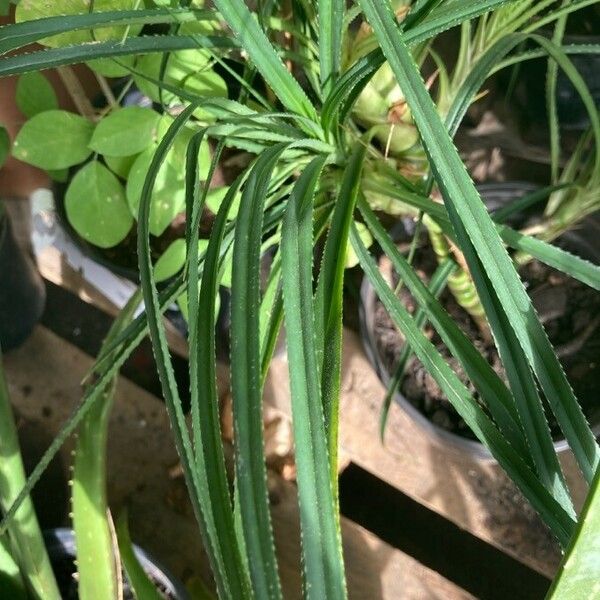
Plant Overview
Often called the Pygmy Screw Pine, this architectural gem from Madagascar brings a touch of prehistoric drama to small spaces. Unlike its massive cousins that dominate tropical coastlines, this dwarf version stays compact, forming a dense, bristly mound. It is a favorite for collectors who love the geometric "screw" pattern of its foliage but don't have the room for a full-sized tree.
🔍 How to Identify
- 🍃 Spiral Growth: The most striking feature is the way the leaves emerge in a tight, perfect spiral from the central stem, resembling the threads of a mechanical screw.
- 🗡️ Saw-Toothed Edges: The long, narrow leaves are lined with tiny, needle-sharp serrations along the margins and the underside of the midrib.
- 🏗️ Aerial Stilt Roots: As the plant matures, it develops characteristic "prop" or stilt roots that emerge from the stem and dive into the soil, giving it the appearance of "walking" above the ground.
🏡 In Your Garden
- 🏝️ Humidity is Key: Hailing from the moist forests of Madagascar, this plant craves moisture in the air. If kept as an indoor specimen, it appreciates regular misting or a pebble tray to prevent its leaf tips from turning brown and crispy.
- 🪴 Clumping Nature: Unlike taller Pandanus species that grow a single trunk, the Pygmy variety is a "clumper." It will naturally produce "pups" or offsets at the base, eventually creating a lush, spiky thicket that serves as an excellent textured groundcover in frost-free zones.
⚠️ Safety & Toxicity
- 🩹 Physical Hazard: While the plant is not known to be chemically toxic to humans or common household pets, the leaves are genuinely sharp. The serrated edges can cause "grass cuts" or skin irritation if handled without gloves.
- 🐾 Pet Interaction: Most pets will avoid this plant after one sniff because of the prickly texture, but keep it out of reach of very curious animals to avoid scratches to their noses or eyes.
✨ Fun Fact
- 🧬 Despite the common name "Screw Pine," this plant is not a pine tree or even a conifer. It is more closely related to palms and grasses. In its native Madagascar, larger relatives of this plant are used to weave everything from hats and mats to sails for outrigger canoes!

Detailed Care Instructions
To grow a Pandanus Pygmaeus plant, follow these steps:
- Climate and Location: Pandanus Pygmaeus plants thrive in warm, tropical climates. Ensure that your region has a minimum average temperature of 65°F (18°C). These plants also prefer indirect sunlight or partial shade, so choose a location that provides filtered light.
- Soil: The plant requires well-draining soil. Mix organic compost or peat moss into the soil to improve drainage. Pandanus Pygmaeus plants prefer slightly acidic to neutral soil, with a pH range of 6.0 to 7.5.
- Watering: These plants require regular watering to keep the soil consistently moist but not waterlogged. Water deeply, allowing the water to penetrate the root zone. Avoid letting the plant sit in standing water, as it can lead to root rot.
- Fertilizer: Use a balanced, slow-release fertilizer or a liquid fertilizer with a ratio of 10-10-10 to feed Pandanus Pygmaeus plants. Apply fertilizer every 2-3 months during the growing season, following the manufacturer's instructions.
- Propagation: Pandanus Pygmaeus plants can be propagated by taking stem or tip cuttings. Cut a healthy section of the plant, at least 2-4 inches in length. Remove lower leaves and dip the cut end in a rooting hormone. Plant the cutting in a small pot filled with a well-draining potting mix, keep it moist, and place it in a warm location. After a few weeks, roots will form, and the cutting can be transferred to a larger pot.
- Pruning: Regular pruning is necessary to maintain the desired size and shape of the plant. Remove any yellow or brown leaves, and trim back any overgrown branches. Use clean, sharp pruning shears to avoid causing damage to the plant.
- Pest and Disease Control: Pandanus Pygmaeus plants are generally resistant to pests and diseases. However, keep an eye out for common houseplant pests like aphids, mealybugs, and spider mites. If you notice any infestation, treat it with insecticidal soap or a horticultural oil.
- Transplanting: If your Pandanus Pygmaeus plant outgrows its current pot, you can transplant it into a larger container. Choose a pot that provides enough room for the root system to grow comfortably. Carefully remove the plant from its current pot without damaging the roots, place it in the new pot, and fill in with fresh potting mix.
By following these steps and providing proper care, your Pandanus Pygmaeus plant should gradually grow and thrive.
To properly water this plant, it is important to first determine the soil type and the plant's watering needs. Generally, it is best to keep the soil evenly moist, but not waterlogged. It is important to not let the soil dry out completely, but also not to let it stay too wet.
One method to determine when to water is to stick your finger about an inch into the soil and if it feels dry, it is time to water. Another method is to lift the pot and if it feels light, it likely needs water.
When watering, water thoroughly until water runs out the bottom of the pot and then discard any excess water. It is important to allow the soil to dry out slightly between waterings. To prevent root rot, ensure that the plant is not sitting in standing water.
The frequency of watering will depend on several factors such as the size of the pot, the type of soil, the humidity level, and the amount of light the plant receives. It is recommended to check the plant's watering needs regularly and adjust as necessary.
- Choose a balanced fertilizer with equal amounts of nitrogen, phosphorus, and potassium.
- Dilute the fertilizer according to package instructions.
- Apply the fertilizer evenly to the soil around the base of the plant.
- Water the plant thoroughly after fertilizing to distribute the nutrients.
- Repeat fertilization every two to three months during the growing season, which is typically spring and summer.
The best soil to use for the Pandanus Pygmaeus plant is a well-draining, sandy soil that is rich in organic matter. The soil should be slightly acidic, with a pH level between 5.5 and 6.5. It is important to ensure that the soil is not waterlogged, as this can lead to root rot and other issues.
Adding compost or other organic matter to the soil can help to improve its fertility and moisture-retention capacity. The plant also benefits from occasional fertilization with a balanced, slow-release fertilizer.
In addition to proper soil, the Pandanus Pygmaeus plant requires regular watering and bright, indirect sunlight. It should be kept away from cold drafts and excessive heat, and may benefit from occasional misting to increase humidity levels. Regular pruning can also help to maintain its shape and size.
- Start by selecting a healthy, mature plant that has several side shoots growing from its base.
- Use a sharp, clean knife to cut off one of the side shoots, making sure to take a small piece of the parent plant with it.
- Mix together a well-draining potting soil mix that consists of equal parts perlite, sand, and peat moss.
- Moisten the potting soil mix until it is damp but not waterlogged.
- Fill a small pot with the potting soil mix and make a small hole in the center.
- Insert the bottom of the cutting into the hole, pressing the soil around it gently to hold it in place.
- Place the pot in a bright location but out of direct sunlight, and keep the soil moist but not soggy.
- Wait until new growth appears, which can take several weeks to several months depending on the plant and growing conditions.
- Once the new plant has established roots and is growing well, it can be transplanted into a larger pot or outdoors into a suitable location.








