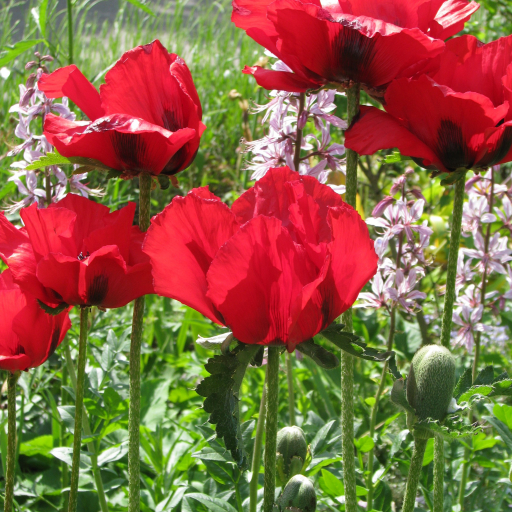
Plant Overview
Known as the "Great Scarlet Poppy" or "Persian Poppy," this Iranian native is the dramatic giant of the poppy family. Its colossal, blood-red blooms look as though they have been plucked straight from a classical botanical painting, commanding instant attention in any summer border. Unlike its more delicate cousins, this poppy is a sturdy, deep-rooted perennial that brings a sense of ancient, wild grandeur to the modern landscape.
🔍 How to Identify
- 🌸 The Bloom: Massive, cup-shaped flowers (up to 8 inches across) with deep scarlet petals, almost always featuring a prominent, velvety black rectangular spot at the base of each petal.
- 🌿 The Bracts: Its namesake feature; look for small, green leaf-like structures (bracts) sitting directly underneath the flower head, which distinguishes it from the common Oriental Poppy.
- 🧵 Texture: The entire plant is covered in stiff, bristly white hairs, giving the thick stems and deeply lobed, fern-like leaves a coarse, sandpaper-feel.
🏡 In Your Garden
- 🏜️ Deep Roots: This poppy develops a long, sensitive taproot designed to seek out water deep in the soil. Because of this "anchor," it absolutely hates being transplanted; once you tuck it into a sunny spot, it is best to let it stay there for life.
- ☀️ The Summer Vanishing Act: Do not be alarmed if the plant appears to "die" in late July. It enters a natural dormancy after flowering to survive the heat, often disappearing entirely before sprouting a fresh tuft of green foliage when the autumn rains arrive.
⚠️ Safety & Toxicity
- 🚫 Toxic Status: High toxicity. Unlike the common breadseed poppy, this species contains high concentrations of thebaine, an alkaloid that is dangerous if ingested.
- 🐾 Kids & Pets: Keep curious pets and children away from the seed pods and leaves. Ingestion can cause nausea, lethargy, or more serious neurological symptoms like tremors in small animals.
✨ Fun Fact
While it does not produce morphine, Papaver bracteatum is a major legal source for the pharmaceutical industry. It is grown commercially to extract thebaine, which scientists use to synthesize Naloxone—the life-saving medication used to reverse opioid overdoses!

Detailed Care Instructions
To grow Papaver Bracteatum, also known as the Himalayan Blue Poppy, follow these steps:
- Climate and soil requirements: Choose a location that has cool summers and mild winters. The plant prefers well-draining, rich, and slightly acidic soil.
- Starting from seeds: Start the seeds indoors 6 to 8 weeks before the last frost date. Moisten the soil and sprinkle the seeds on top, then gently press them into the soil. Keep the soil consistently moist but not waterlogged. Place the seeds in a warm and bright location, ensuring they receive indirect sunlight.
- Transplanting: Once the seedlings are about 2-3 inches tall and have multiple leaves, they can be transplanted outdoors. Choose a partially shaded spot with protection from strong winds. Dig a hole slightly larger than the root ball and gently place the seedling into the hole. Backfill with soil and water thoroughly.
- Watering: Keep the soil consistently moist but not soggy. Water deeply once or twice a week, especially during dry spells. Mulching around the plant can help maintain soil moisture and regulate temperature.
- Fertilization: Apply a balanced, organic fertilizer once a month during the growing season to promote healthy growth. Follow the instructions on the fertilizer package for the recommended dosage.
- Pruning: Trim off any dead or faded flowers to encourage further blooming. After blooming has finished, cut the plant back to ground level to promote new growth for the following year.
- Overwintering: In colder climates, provide protection during the winter. Apply a thick layer of mulch around the base of the plant to insulate the roots. You can also cover the plant with a frost blanket or burlap to shield it from harsh temperatures and winds.
With proper care and maintenance, your Papaver Bracteatum plant should grow well and produce beautiful blue flowers.
To adequately water this plant, it is essential to consider the natural environment in which it thrives. Papaver Bracteatum prefers a moderately moist growing medium that is well-draining. Watering should be done deeply and infrequently to allow the roots to fully absorb moisture. It is important to avoid overwatering, as it can lead to root rot and other issues such as mold growth.
The best time of day to water the plant is in the morning, as the soil will have time to dry out slightly before nightfall. It is important to avoid watering during the hottest part of the day, as this can cause water to evaporate too quickly and not be absorbed properly by the roots.
When watering, apply enough water to moisten the soil to a depth of at least 6 inches. It is important to apply water only to the soil, avoiding the plant's leaves and flowers to prevent fungal growth.
In periods of high heat or drought, it may be necessary to water more frequently, but always ensure the soil has time to dry slightly between watering sessions.
Overall, Papaver Bracteatum should be watered conservatively, allowing the soil to dry out slightly before providing another deep watering session.
To properly fertilize this plant, begin by selecting a balanced fertilizer with equal parts nitrogen, phosphorus, and potassium. When applying the fertilizer, measure out the recommended amount for the size of your the plant and sprinkle it evenly around the base of the stem. Be sure to not get the fertilizer directly on the foliage or flowers. Water the plant immediately after fertilizing to ensure that the nutrients are absorbed into the soil. Fertilize this plant once every few months during the growing season for optimal growth and health.
Papaver Bracteatum is a plant that requires a well-draining soil with good fertility. It prefers a slightly acidic to neutral soil pH and can tolerate sandy loam to clay loam soil types. The soil should be enriched with organic matter such as compost or well-decomposed manure to provide the necessary nutrients for the plant's growth and development. It is important to avoid compacted soil, which can limit root growth and lead to poor plant performance. Additionally, the soil should be kept consistently moist but not waterlogged to avoid root rot and other problems. With proper soil preparation and care, Papaver Bracteatum can thrive and produce beautiful blooms over a long growing season.
To propagate this plant, you will need to collect mature seed pods from an existing plant. The pods should be dry and brown in color. Once you have collected the pods, split them open and remove the tiny black or brown seeds.
Next, fill a small seed tray or pot with a well-draining soil mixture. Sprinkle the seeds on top of the soil and press them lightly into the surface. Do not bury the seeds too deeply, as they require light to germinate.
Water the tray or pot lightly and place it in a warm and bright location, such as a windowsill or greenhouse. Keep the soil moist but not waterlogged.
The seeds should germinate within 2-3 weeks. Once the seedlings have grown to a manageable size, they can be transplanted into individual pots or into a larger growing container. Provide the plants with regular watering and fertilization to encourage healthy growth.
As the plants mature, they will develop their characteristic flowers and foliage. With proper care, these plants can thrive and produce many years of beautiful blooms.








