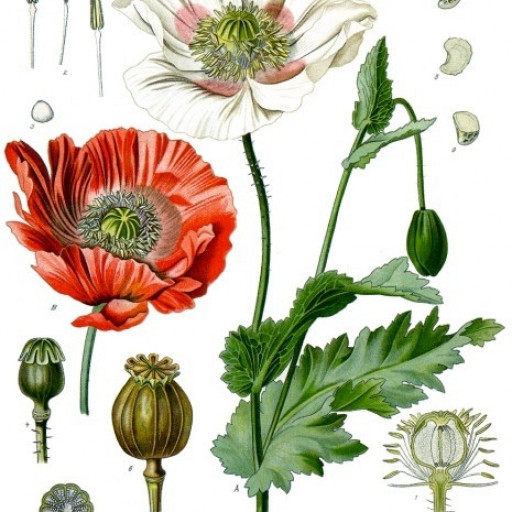
Plant Overview
Often called the "Opium Poppy" or "Breadseed Poppy," Papaver somniferum is a plant that has shaped the course of human history more than almost any other. From the Sumerians who called it the "Joy Plant" to its modern presence in both medicine cabinets and bagel shops, it is a species of duality. Its striking, oversized blooms look like delicate crumpled silk dancing atop sturdy, frosted stems.
🔍 How to Identify
- 🍃 Glaucous Foliage: The leaves are a distinct silvery, blue-green color with a waxy coating. They are deeply lobed, "clasping" the stem directly without a leaf stalk.
- 🌸 Crumpled Petals: The flowers are large (up to 4-5 inches across) with four broad petals that often have a dark, contrasting "thumbprint" spot at the base.
- 🍯 Crown-Topped Pods: After the petals fall, they leave behind a smooth, barrel-shaped green capsule topped with a flat, radiating disc that looks like a tiny permanent crown.
🏡 In Your Garden
- 🌱 The Taproot Rule: This poppy develops a long, sensitive taproot very early. Because of this, it absolutely hates being moved; always sow seeds directly into the garden rather than starting them in pots.
- ☀️ Sun Seeker: While it thrives in full sun, it is a "cool-season" annual. It prefers to germinate in the chilly soil of early spring and will often wither away once the extreme heat of mid-summer arrives.
- 💨 Self-Seeding Habit: Once the pods turn brown and "rattle," they release thousands of tiny seeds through small vents. If you don't harvest them, expect a colony of volunteers to pop up in the same spot next year.
⚠️ Safety & Toxicity
- 🚫 High Toxicity: This plant contains potent alkaloids, including morphine and codeine. While it has medicinal value in a controlled pharmaceutical context, raw ingestion of any part of the plant (especially the sap) is extremely dangerous.
- 🐾 Pet Warning: The plant is toxic to dogs, cats, and horses. Ingestion can lead to sedation, respiratory depression, or even coma. Keep these blooms out of reach of curious nibblers.
✨ Fun Fact
The very same plant responsible for powerful medicines also provides the poppy seeds used in baking. While the sap in the green pods is narcotic, the tiny black seeds inside the dried pods contain almost no alkaloids and are perfectly safe—and delicious—to eat!

Detailed Care Instructions
| Humidity | Dry |
| Invasive | Weed |
| Lighting | Full Sun |
| Toxicity | Poisonous |
| Difficulty | Easy |
| Hibernation | Cold Period |
| Temperature | 21°C - 24°C |
| Hardiness Zones | 3 - 8 |
To grow Papaver Somniferum, also known as the opium poppy, follow these steps:
- Choose the right location: Select a sunny area in your garden with well-draining soil. Poppies prefer full sun or partial shade.
- Prepare the soil: Loosen the soil and remove any weeds or grass. Add organic matter such as compost or aged manure to improve soil fertility and drainage.
- Sow the seeds: Poppies can be directly sown outdoors when the soil temperature reaches around 50°F (10°C), typically in early spring or fall. Sprinkle the seeds on the soil surface and gently press them down. Avoid burying the seeds as they require light to germinate.
- Watering: Keep the soil consistently moist during the germination period, which usually takes around 7-14 days. Once the seedlings emerge, water them regularly but avoid overwatering as it can lead to root rot.
- Thinning: When the seedlings are about 2-3 inches tall, thin them out to avoid overcrowding. Space them 6-12 inches apart to allow adequate airflow and prevent diseases.
- Fertilization: Apply a balanced, water-soluble fertilizer once or twice during the growing season to encourage healthy growth and blooming. Follow the manufacturer's instructions for application rates.
- Maintenance: Remove any weeds around the plants to prevent competition for nutrients and water. Monitor for pests such as aphids or slugs and take appropriate action if necessary.
- Harvesting: The poppies will start to produce flowers in late spring or early summer. Once the flower petals fall off, the seed pods form. Harvest the pods when they are fully mature and the seeds inside turn brownish-black.
Note: It's important to be aware that Papaver Somniferum is a controlled plant in many countries due to its potential for containing opiates. Before growing this plant, ensure you are legally allowed to do so and understand the regulations in your area.

Place in a bright room that is sun drenched almost all day. Or directly in a south-facing window.

1. Identify the plant: Before watering the plant, ensure that you accurately identify it through its distinct physical characteristics.
2. Soil: Check the soil moisture level. This can be done by inserting your finger 1-2 inches into the soil to feel the moisture content. The soil should be slightly moist but not waterlogged.
3. Timing: Water the plant when the soil feels dry. Avoid watering when the soil is still damp, as this can lead to overwatering and root rot.
4. Watering method: Water the plant deeply, ensuring that the water reaches the roots. You can use a watering can or hose with a gentle spray nozzle to prevent damage to the plant.
5. drainage: Ensure that the pot or container has proper drainage holes in the bottom to prevent water accumulation in the soil.
6. Frequency: Water the plant once a week or as needed, based on the environmental conditions and the evaporation rate of the water.
7. Placement: Place the plant in a location that receives adequate sunlight and ventilation to help regulate the moisture level in the soil.
8. Fertilization: Avoid fertilizing the plant during the growing season, as this can lead to rapid growth and weak stems. Instead, fertilize the plant during its dormancy period.
9. Observation: Observe the plant closely for signs of overwatering or underwatering, such as yellowing leaves, stunted growth, and wilting. Adjust the watering frequency and amount accordingly.
To nourish the soil for this plant, apply balanced fertilizer or compost during the growing season. It's best to avoid using high-nitrogen fertilizers as they can cause too much leaf growth at the expense of flower and seed production. Apply fertilizer or compost in the early spring before planting and again when the plants are about six inches tall. Keep the soil moist but not waterlogged. Use organic fertilizers to promote healthy growth.
The ideal soil for growing Papaver Somniferum plants should have a pH range of 6.5-7.5 and be well-draining to prevent waterlogging. The soil should be rich in organic matter and have good fertility to support healthy growth. A mixture of loam, peat moss, and perlite can be used for growing this plant. It is important to avoid using heavy clay or sandy soils, as they can hinder plant growth. Additionally, adding a layer of mulch to the soil surface can help to retain moisture and provide nutrients to the plants.
Propagation of this plant can be achieved through various methods including seed propagation, stem cuttings, and root cuttings. For seed propagation, the seeds should be sown in well-draining soil with a depth of approximately 1-2mm and lightly covered with soil. The soil should be kept moist and in a warm, sunny location until the seeds germinate.
For stem cuttings, choose a healthy stem and cut a section of approximately 10-15cm in length. Remove the lower leaves, leaving only a few at the top. Dip the cut end in rooting hormone and plant in a well-draining soil mix. Water regularly and keep in a warm, shaded location until the roots have developed.
For root cuttings, choose a healthy root and cut a section of approximately 4-5cm in length. Plant vertically in well-draining soil with the top of the cutting just below the surface. Water regularly and keep in a warm, shaded location until new shoots appear.
Propagation of this plant is easy and can be done successfully with proper care and attention to detail.
Common pests of the opium poppy include Aphids, whiteflies, larvae. Make a habit of checking your opium poppy frequently for pests so that any infestations can be caught and managed early.








