Plant Overview
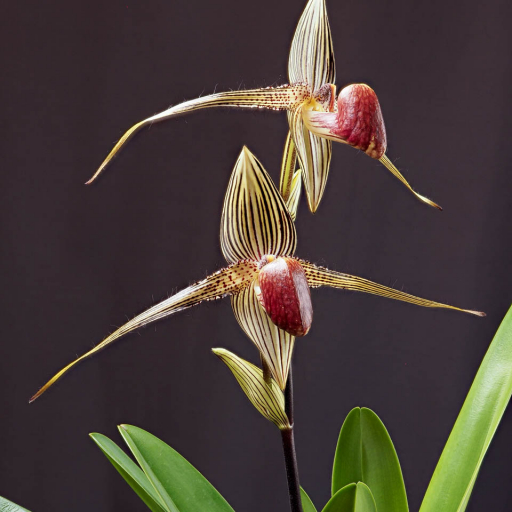
Often hailed as the "King of Orchids," this majestic species is one of the rarest and most sought-after slipper orchids in the world. Named after Baron Ferdinand de Rothschild, it hails exclusively from the misty slopes of Mount Kinabalu in Borneo. Its dramatic, horizontally-stretched petals and regal stripes make it a "holy grail" for collectors and nature lovers alike.
🔍 How to Identify
- 🌸 The "Mustache" Petals: Unlike most orchids, its lateral petals extend horizontally like long, tapering arms, often reaching a wingspan of over 30cm.
- 🦓 Regal Stripes: The sepals and petals are creamy yellow, heavily marked with bold, dark-maroon vertical stripes that give it a fierce, prehistoric look.
- 👟 The Pouch: The "slipper" (labellum) is large, copper-toned to dark red, and shaped like a deep cup designed to trap and guide specific pollinators.
🏡 In Your Garden
- 🧗 High-Altitude Needs: This orchid mimics the cool, humid slopes of Borneo. It demands high humidity (70%+) and constant air movement; without a breeze, it is highly susceptible to crown rot.
- ⏳ The Long Game: This is a slow-growing giant. It can take up to 10 or 15 years to reach blooming size from a seedling. Because of this, mature, flowering-size plants are exceptionally valuable.
- 💧 Water Purity: It is sensitive to salt buildup. It thrives best when watered with rainwater or distilled water, as tap water minerals can quickly "burn" its delicate, hairy roots.
⚠️ Safety & Toxicity
- 🐾 Non-Toxic Status: This orchid is generally considered non-toxic to cats, dogs, and humans, making it a safe choice for a high-end indoor collection.
- 🌿 Skin Irritation: Some enthusiasts report mild skin irritation after handling the foliage. The leaves have very fine hairs that can cause a "fuzzy" itch for those with sensitive skin.
✨ Fun Fact
The Rothschild’s Slipper Orchid is a master of deception! It features dark spots that look exactly like aphid colonies. Hoverflies, which eat aphids, fly in to lay their eggs, only to fall into the orchid’s trap and inadvertently act as pollinators.

Detailed Care Instructions
To successfully grow a Paphiopedilum Rothschildianum plant, follow these steps:
- Optimal conditions: Provide the orchid with intermediate temperatures ranging from 60-75°F (15-24°C) during the day and a cooler temperature drop of 10-15°F (5-8°C) at night. Maintain a relative humidity level of approximately 60-70%.
- Lighting: Provide the plant with bright, indirect light. Avoid direct sunlight, as it can cause leaf burn. A west or east-facing window with a sheer curtain is usually suitable.
- Watering: Water the plant regularly, keeping the medium slightly damp but not soaking wet. Allow the potting medium to dry out slightly between waterings, but do not let it completely dry out. Paphiopedilum orchids prefer consistently moist roots.
- Potting medium: Use a well-draining orchid potting mix that consists of bark, sphagnum moss, and perlite. Avoid using regular potting soil, as it retains too much moisture and can cause root rot.
- Fertilizing: Feed the plant monthly during the growing season (spring and summer) with a balanced orchid fertilizer. Dilute the fertilizer to quarter strength, as Paphiopedilum orchids are sensitive to strong concentrations.
- Air circulation: Provide adequate air circulation around the plant. This can be achieved by using a small fan or ensuring the orchid is not tightly enclosed in a location with poor air movement.
- Repotting: Paphiopedilum orchids generally prefer to be slightly root-bound. Only repot the plant when necessary, usually every 2-3 years, using fresh potting mix.
- Pest control: Monitor the orchid for pests such as aphids, scale insects, and mealybugs. If infested, treat the plant with an appropriate insecticide or use natural remedies like neem oil.
Remember to observe and adjust care based on the specific needs of your Paphiopedilum Rothschildianum plant. Regularly inspect the plant for signs of stress, pests, or disease to maintain its health and promote growth.
Paphiopedilum Rothschildianum plants require careful attention to their watering needs to ensure their optimal growth and health. Here is a detailed guide on watering this particular plant:
- Observe the potting medium: Before watering, check the moisture level of the potting medium. It is advised to use a well-draining potting mix specifically formulated for orchids. The mix should be moist but not overly wet or dry.
- Determine the watering frequency: The frequency of watering depends on various factors like temperature, humidity, light, and potting medium. On average, Paphiopedilum Rothschildianum plants generally need to be watered once every 7 to 10 days, but it's important to monitor the plant's moisture needs frequently.
- Watering techniques: There are two primary methods to water these plants:
a. Soaking method: Fill a basin or sink with tepid water. Place the orchid container in the water, allowing water to reach approximately halfway up the pot. Let the plant soak for about 15-20 minutes. This technique ensures thorough hydration of the potting medium.
b. Pouring method: This involves pouring water directly onto the potting medium until it begins to flow out of the drainage holes. Ensure that water reaches all parts of the medium, evenly saturating it.
- Avoid water accumulation: After watering, always ensure that excess water drains out completely. Stagnant water at the bottom of the pot can lead to root rot and other fungal diseases. Orchids should never sit in standing water.
- Consider environmental factors: Take into account the conditions in which the plant is kept. If the environment is hot and dry, the plant will likely require more frequent watering to prevent dehydration. Conversely, cooler or more humid conditions might necessitate less frequent watering.
- Monitor moisture levels: Regularly check the moisture level of the potting mix by inserting a finger or wooden skewer into it. If the medium feels slightly moist, it indicates that the plant is properly watered. If it feels dry, it's time to water again. However, refrain from watering if the medium is still wet, as overwatering can be harmful.
- Adjust watering schedule: Over time, observe how your Paphiopedilum Rothschildianum responds to the watering routine. Assess the plant's overall health, growth, and root condition. Adjust the watering schedule accordingly if you notice any signs of overwatering or underwatering, such as yellowing leaves or root rot.
Remember, every plant has its unique watering needs, and the information provided here serves as a general guideline. It's essential to be observant and make adjustments based on the specific conditions of your Paphiopedilum Rothschildianum plant to ensure optimal care and growth.
To fertilize Paphiopedilum Rothschildianum, you need to follow these instructions:
- Select a balanced orchid fertilizer with a formulation of 20-20-20 or similar N-P-K ratio.
- Dilute the fertilizer according to the package instructions, usually at a rate of 1/4 to 1/2 strength.
- Water the plant thoroughly before applying the fertilizer to avoid any damage to the roots.
- Apply the diluted fertilizer solution directly to the potting medium, avoiding contact with the leaves and flowers.
- Repeat the fertilizer application every 2-4 weeks during the active growing season, which typically occurs from spring to early fall.
- During the winter months, reduce the frequency of fertilization to once a month or suspend it entirely if the plant enters a period of dormancy.
- Monitor the plant's response to the fertilizer and adjust the frequency or strength of application accordingly. If you notice any signs of fertilizer burn, such as leaf discoloration or wilting, decrease the concentration or frequency of application.
- Always follow the specific instructions provided by the fertilizer manufacturer for best results.
- Regularly flush the potting medium with clear water to prevent the buildup of salts and minerals from the fertilizer.
- Remember to give your plant proper care in terms of light, humidity, airflow, and watering while fertilizing to ensure overall healthy growth.
When considering the soil requirements for Paphiopedilum Rothschildianum, it is important to select a growing medium that meets its specific needs. This type of orchid prefers a well-draining soil mix that replicates its natural epiphytic or lithophytic habitat. The ideal soil composition should provide both stability and moisture retention while allowing sufficient airflow to the roots.
To create an appropriate soil mix for Paphiopedilum Rothschildianum, you can incorporate several key components. Firstly, a combination of fine-grade bark, such as fir or pine bark, helps promote aeration and drainage. The bark should be moistened well before use. Additionally, perlite or vermiculite can be included to enhance drainage and prevent the soil from becoming overly compacted.
To retain moisture, it is beneficial to add sphagnum moss, which has excellent water absorption properties. It helps keep the roots hydrated without causing waterlogged conditions. Some growers also use coconut coir, which provides similar moisture retention qualities while maintaining good drainage.
In addition to these components, one may consider including organic material such as leaf litter or dried moss for added nutritional value. These materials can help create a balanced microenvironment, promoting beneficial microbial activity and nutrient availability.
The soil mix for Paphiopedilum Rothschildianum should be slightly acidic, as this species prefers a pH range between 5.5 and 6.5. It is important to avoid using soils that are rich in minerals or high in lime content, as they can negatively impact the plant's health and its ability to absorb nutrients properly.
Overall, when selecting a soil mix for Paphiopedilum Rothschildianum, it is crucial to prioritize both drainage and moisture retention while mimicking its natural growing conditions. Striking the right balance will ensure optimal growth and vitality for this unique orchid species.
Paphiopedilum rothschildianum, also known as the Rothschild's slipper orchid or the gold of Kinabalu, is a rare and extraordinary species native to the rainforest of Mount Kinabalu in Borneo. This orchid is highly esteemed for its vibrant colors, large size, and unique features.
When it comes to propagating Paphiopedilum rothschildianum, there are a few methods that can be employed to successfully propagate new plants:
- Division: This is the most common method used to propagate Paphiopedilums. It involves separating the plant into smaller segments, each with their own roots and shoots. This can be done when the orchid has grown multiple new growths, and each growth has at least three leaves. Care should be taken to ensure clean cuts are made with sterilized tools to prevent any diseases from spreading. The divided segments can then be potted individually in a well-draining orchid mix.
- Back Bulbs: Paphiopedilums, including P. rothschildianum, often develop back bulbs, which are small bulbs that grow off the main stem or rhizome of the plant. These back bulbs can be carefully removed and potted up to grow as new individuals. It is essential to ensure that each back bulb has some healthy roots attached before potting it up.
- Keiki: Occasionally, Paphiopedilums produce keikis, which are miniature plantlets that grow from the base of the mother plant. When a keiki has developed its own set of leaves and roots, it can be gently removed from the mother plant and potted individually. Proper care should be taken during the separation to avoid damaging the delicate roots.
- Tissue Culture: For large-scale propagation or when dealing with rare varieties, tissue culture is often employed. This involves taking a small piece of tissue from a mother plant, such as a leaf or a stem, and cultivating it in a sterile laboratory environment. The tissue sample is placed on a nutrient-rich culture medium, and under controlled conditions, it develops into a small plantlet. These plantlets are then grown to maturity in a greenhouse and eventually transplanted to pots or the desired growing medium.
Regardless of the propagation method chosen, it is important to provide Paphiopedilum rothschildianum with the right growing conditions to ensure successful establishment. This includes providing them with adequate light (filtered or shade), controlled temperature and humidity, and a suitable well-draining medium. Additionally, regular watering and fertilization routines specific to the needs of this species should be followed to promote healthy growth and blooming.








