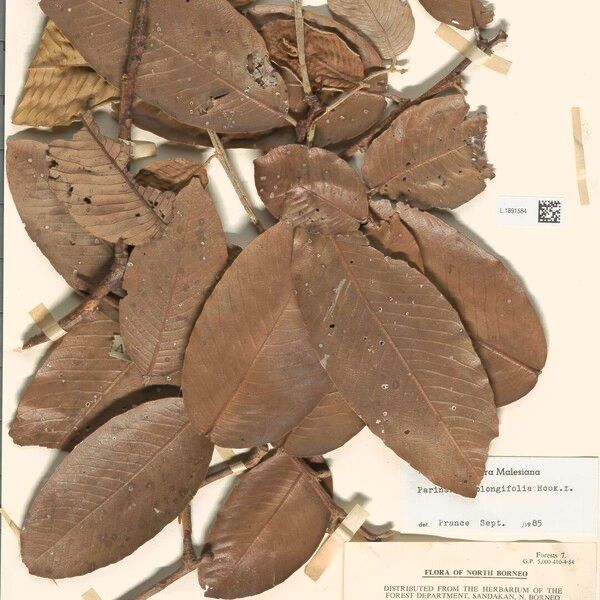
Plant Overview
Often referred to as the "Secret Ingredient" tree or Tabon-tabon, Parinari oblongifolia is a coastal gem native to Southeast Asia and the Pacific. It is a sturdy, tropical hardwood tree that has earned a legendary status in culinary traditions, particularly in the Philippines, for its unique ability to transform raw seafood into a masterpiece. While it looks like an ordinary forest giant, its fruit holds a potent, astringent magic used for centuries to balance flavors and aid digestion.
🔍 How to Identify
- 🍃 The Foliage: Look for leathery, oblong leaves (as the name oblongifolia suggests) that are deep green on top and sometimes feature a duller, slightly fuzzy underside.
- 🌸 The Blooms: It produces clusters of small, delicate flowers that are usually white or pale pink, appearing at the ends of the branches.
- 🥥 The Fruit: The most distinct feature is the fruit—a hard, brown, egg-shaped drupe with a rough, "scurfy" skin that feels almost like sandpaper or a rusted stone.
- 🌳 The Stature: In the wild, it grows into a medium-to-large tree with a dense, rounded canopy that provides excellent shade.
🏡 In Your Garden
- ☀️ Tropical Requirements: This is a sun-lover that thrives in high humidity. If you are planting one, ensure it has plenty of vertical space, as it is a slow-to-moderate grower that eventually reaches significant heights.
- 🏖️ Coastal Resilience: Because it is naturally found near shorelines, it is remarkably tolerant of salt spray and sandy soils. It prefers well-draining earth and "hates" having wet feet for too long.
- 🌱 Root Awareness: Like many members of its family, it develops a strong taproot. It is best to plant it in its "forever home" early, as it can be quite sensitive to root disturbance once established.
⚠️ Safety & Toxicity
- ✅ Status: Generally non-toxic and safe for human contact.
- 🍽️ Edibility: While the fruit pulp is used in traditional cooking (specifically to "cure" raw fish and neutralize odors), it is extremely astringent and tannic. It is not typically eaten as a fresh fruit like a mango or apple.
- 🐾 Pets & Kids: There are no known toxicities for cats or dogs; however, the internal seed is incredibly hard and heavy, posing a significant choking hazard if a pet decides to use a fallen fruit as a chew toy.
✨ Fun Fact
In the southern Philippines, the sap of the Tabon-tabon fruit is the "secret weapon" for making Kinilaw (Filipino ceviche). The tannins in the fruit are so strong that they effectively "cook" the fish and kill bacteria, acting as a natural digestive safeguard for those eating raw seafood!

Detailed Care Instructions








