Plant Overview
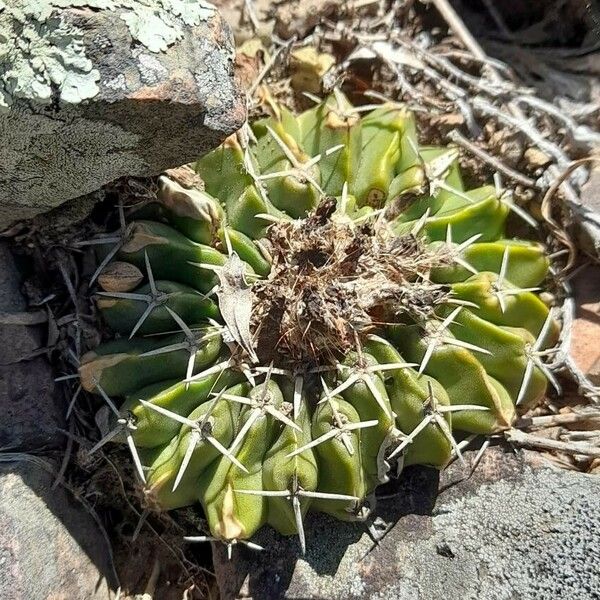
Meet the Parodia erinacea, often affectionately called the "Woolly Ball Cactus." Looking like a meticulously crafted pincushion from the South American pampas, this cactus is beloved for the soft, snowy "wool" that crowns its head. While it looks like a typical desert inhabitant, it is actually a hardy survivor from the rocky grasslands of Brazil and Uruguay, where it hides among tall grasses.
🔍 How to Identify
- 🌵 Body Shape: It typically grows as a solitary, globular sphere, though it can become slightly cylindrical and reach about 6 inches in diameter as it ages.
- 🏔️ Deep Ribs: The body is divided by 15 to 20 sharp, well-defined vertical ribs that give it a distinct, accordion-like geometric appearance.
- 🧶 Woolly Apex: Its most striking feature is the dense, white felt-like wool at the very top (the apex), which acts as a nursery for emerging flowers.
- 🌼 Golden Blooms: It produces silky, bright yellow flowers with red-tinted centers that erupt directly from the woolly crown during the heat of summer.
🏡 In Your Garden
- ☀️ Sun & Shade Balance: Unlike many desert cacti that demand 100% direct, scorching sun, Parodia erinacea appreciates a little light afternoon shade. In its native habitat, it is often filtered by surrounding brush, so "bright indirect light" is its sweet spot.
- 🪨 The Drainage Myth: Many growers fail by using standard potting soil. This plant has a sensitive root system that hates "wet feet." Use a gritty, mineral-heavy mix with plenty of pumice or perlite to ensure water passes through almost immediately.
- 💤 Winter Dormancy: To encourage those beautiful yellow flowers, this cactus needs a cool, dry "nap" during the winter. Stop watering almost entirely from late autumn until spring.
⚠️ Safety & Toxicity
- 🛡️ Status: Generally non-toxic to humans and pets.
- 🧤 Mechanical Injury: While the woolly top looks soft and "pet-able," the spines are stiff and sharp. They can easily puncture skin or get stuck in a curious pet's paw. Always use thick gloves or a rolled-up newspaper "sling" when repotting to avoid injury.
✨ Fun Fact
The species name erinacea comes from the Latin word for "hedgehog." When viewed from above, the combination of its prickly spines and rounded shape makes it look exactly like a tiny green hedgehog curled up for protection!

Detailed Care Instructions

Place in a bright room that is sun drenched almost all day. Or directly in a south-facing window.

When the top few inches of soil dry out, water your plants. If the top few inches of soil are still moist, do not water your plant. Wait a few days, then poke your finger into the soil to see if anything has changed. Overwatering poses a disease risk, such as the development of fungal diseases in the roots. These plants have adaptations in there leaves that allow them to survive in low water supply.
These plants can thrive without taking help from any fertilizer. However, if the medium of growth is something other than soil for instance sand then you may need to add little fertilizer. The best way to know if your plants need fertilizer or not is to check for yellowing of leaves. If the leaves start to turn yellow it’s fertilizing time.
You may use Cactus Fertilizer for your Parodia Erinacea
Common pests of the parodia erinacea include Scale insect, mealybugs, spider mites. Make a habit of checking your parodia erinacea frequently for pests so that any infestations can be caught and managed early.








