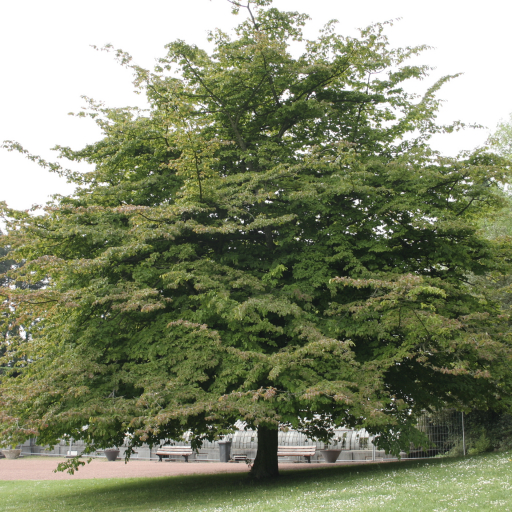
Plant Overview
Meet the "Chinese Ironwood," a rare and sophisticated relative of the Witch Hazel family. Once thought to be nearly extinct in its native Chinese mountain habitats, this tree is a landscape architect’s dream, prized for its "mosaic" bark and a fall foliage display that rivals the most vibrant Maples. It is a slow-growing masterpiece that adds year-round architectural interest to any garden.
🔍 How to Identify
- 🍃 The Foliage: Leaves are thick, oval, and feature charmingly scalloped edges. They emerge with a bronze tint in spring, turn a glossy deep green in summer, and transform into a breathtaking palette of burgundy and royal purple in autumn.
- 🧥 Exfoliating Bark: As the tree matures, the bark begins to peel away in thin, irregular patches. This reveals a stunning "camouflage" pattern underneath, featuring shades of silver, cream, and olive-green.
- 🏮 Winter Blooms: In late winter—often while snow is still on the ground—tiny, ruby-red flowers appear on bare branches. These flowers lack petals and consist of clusters of showy red stamens that look like miniature fireworks.
🏡 In Your Garden
- 🌳 Slow & Steady: Because of its slow growth rate, this tree is an excellent "investment" plant. It develops incredibly dense, strong wood that is highly resistant to wind and ice damage, making it a safer choice near structures than brittle, fast-growing species.
- 🎨 Sun for Color: While it is adaptable to partial shade, the legendary "stained-glass" fall color is most intense when the tree is planted in full sun. It prefers well-drained, slightly acidic soil; if the soil is too alkaline, the leaves may show signs of yellowing (chlorosis).
⚠️ Safety & Toxicity
- ✅ Non-Toxic: The Chinese Ironwood is considered safe for humans, dogs, and cats. It is a "friendly" tree for family backyards.
- 🧤 Pruning Note: While not chemically toxic, the wood is exceptionally hard (hence the name "Ironwood"). If you are pruning, ensure your tools are very sharp to prevent jagged cuts that could invite disease into the tree.
✨ Fun Fact
The Parrotia subaequalis was only "officially" recognized as a distinct species in the 1990s. Before then, it was hidden away in small pockets of Eastern China and often confused with its Persian cousin. Today, it remains one of the rarest deciduous trees in cultivation.

Detailed Care Instructions
To grow Parrotia subaequalis, also known as Chinese Ironwood, follow these steps:
- Location: Choose a planting location that receives full sun to partial shade. The tree can tolerate a variety of soil types but prefers well-draining soil.
- Planting: Dig a hole that is wider and slightly deeper than the root ball of the young tree. Gently loosen the roots and place the tree in the hole. Backfill with soil, ensuring that the top of the root ball is level with or slightly above the soil surface.
- Watering: Water the tree thoroughly after planting, and then water deeply but infrequently thereafter. Keep the soil moist during the first growing season, particularly during dry periods. After the tree is established, it can tolerate occasional dry spells.
- Mulching: Apply a layer of organic mulch around the base of the tree to help retain moisture, suppress weed growth, and insulate the soil. Keep the mulch a few inches away from the trunk to prevent rot.
- Pruning: Prune the tree in late winter or early spring to remove any dead, damaged, or crossing branches. This will help maintain the shape of the tree and improve air circulation.
- Fertilizing: Fertilize the tree in spring using a balanced slow-release fertilizer according to the instructions on the packaging. Avoid applying fertilizer too close to the trunk to prevent root burn.
- Pests and Diseases: Parrotia subaequalis is relatively resistant to pests and diseases. However, monitor the tree for any signs of insect infestations or leaf spots, and treat accordingly if necessary.
- Winter Protection: Although the tree is hardy, providing some protection during harsh winters, especially when young, can prevent damage. Mulch the base of the tree and consider wrapping the trunk with burlap.
- Propagation: Parrotia subaequalis can be propagated from seeds or by taking hardwood cuttings in late winter or early spring.
Remember to give the tree enough time to grow and mature. Parrotia subaequalis is generally a slow-growing tree, so patience is key.

Place in a bright room that is sun drenched almost all day. Or directly in a south-facing window.

To water the plant known as Parrotia Subaequalis, it is important to consider the specific needs of this particular species. The plant should be watered deeply once a week, ensuring that the soil is saturated but not waterlogged. During periods of drought or high heat, additional watering may be necessary to maintain the plant's health.
When watering, it is important to avoid getting water on the leaves or flowers of the plant, as this can increase the risk of fungal growth and disease. Instead, water the plant at its base, allowing the roots to absorb the moisture.
It is also important to ensure that the soil is well-draining, as Parrotia Subaequalis can be susceptible to root rot in waterlogged soil. Adding organic matter to the soil and avoiding standing water can help to improve drainage and prevent this issue.
Monitoring the plant's soil moisture levels and adjusting watering accordingly can help to ensure its health and longevity.
To fertilize this plant, use a well-balanced fertilizer with equal amounts of nitrogen, phosphorus, and potassium, such as a 10-10-10 or 20-20-20 formula. Apply the fertilizer in early spring before new growth starts or in late fall after the leaves have fallen. Water the soil thoroughly before and after applying the fertilizer to prevent burn or stress on the plant. Follow the instructions on the fertilizer package for the appropriate amount to use based on the size of your plant.
The ideal soil for Parrotia Subaequalis is a well-draining loamy soil that is rich in organic matter. The pH level of the soil should be slightly acidic to neutral, with a range of 5.5 to 7.0. Additionally, the soil should have good water retention capabilities and be capable of holding moisture without becoming waterlogged. It is also important to ensure that the soil is not overly compacted or too sandy, as this can lead to drainage issues and poor root growth. Overall, providing a nutrient-rich and well-draining soil will aid in the healthy growth and development of Parrotia Subaequalis.
Parrotia subaequalis is a deciduous plant species that originates from the family Hamamelidaceae. This plant species can be propagated using various methods such as seed propagation, cuttings propagation, and grafting. In this article, we will explain how to propagate the plant without using its common names.
Seed propagation is a common method used to propagate Parrotia subaequalis. The first step in the process is to collect fresh seeds from the mature plant. Place the seeds in a container filled with moist soil or vermiculite, making sure the seeds are completely covered. Keep the container in a warm, shaded location and monitor the moisture level of the soil to ensure it stays moist. The seeds will germinate between two and six weeks after planting.
Cuttings propagation, on the other hand, involves taking a cutting from an established plant. Select a healthy branch cutting from the parent plant, ensuring it has at least two nodes. Cut the branch below a node and dip the cut end in rooting hormone to promote root growth. Plant the cutting in a container filled with well-draining soil, and keep it moist and in a warm location. The cutting will start rooting within a few weeks and can then be transplanted into a larger pot or directly into the ground.
Grafting, yet another method of propagation involves joining the two plants of different species, with a compatible grafting agent and techniques. In Parrotia subaequalis, this technique is used to obtain a new plant of the desired characteristics.
In conclusion, there are several ways to propagate Parrotia subaequalis, including seed propagation, cuttings propagation, and grafting. But these techniques must be carried out with caution and attention to detail to ensure successful plant establishment.








