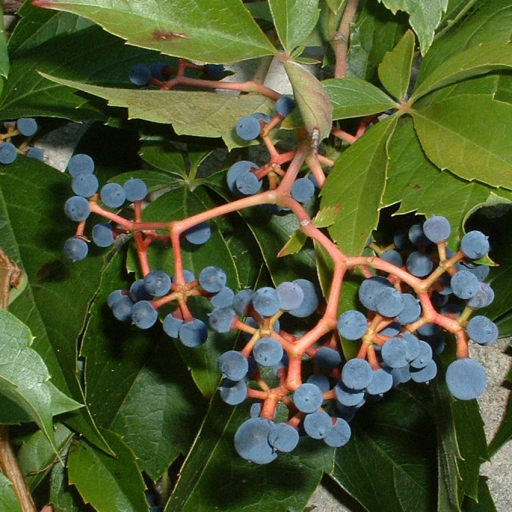
Plant Overview
Often called the "Wall-Painter" of the botanical world, the Parthenocissus genus—which includes the famous Virginia Creeper and Boston Ivy—is celebrated for turning drab brickwork into tapestries of crimson and gold. While they are sometimes unfairly confused with Poison Ivy, these vigorous climbers are actually distant relatives of the grapevine. They are nature’s cleverest architects, scaling heights using specialized biological "suction cups" rather than invasive roots.
🔍 How to Identify
- 🖐️ Leaf Structure: Most common species feature compound leaves with five distinct leaflets radiating from a central point, though some varieties (like Boston Ivy) may have three-lobed leaves.
- 👣 Adhesive Disks: Unlike many vines that wrap around objects, these plants have tendrils tipped with tiny, circular pads that act like suction cups to stick to smooth surfaces.
- 🍇 Late-Season Fruit: In late summer and fall, the plant produces small, hard, dark blue-black berries that hang from vibrant red stems, appearing almost like miniature grapes.
🏡 In Your Garden
- 🧱 Masonry Safe: Because they use adhesive pads rather than burrowing aerial roots, Parthenocissus is generally safer for brickwork than English Ivy. It provides excellent natural insulation, cooling buildings in the summer.
- ✂️ Space Management: This is a high-speed grower. It requires a firm hand and regular pruning to prevent it from creeping into gutters, covering windows, or "strangling" slower-growing garden plants.
⚠️ Safety & Toxicity
- 🚫 Toxic Berries: The berries contain high concentrations of oxalic acid. While birds love them, they are highly toxic to humans, dogs, and cats, and can cause severe kidney damage if ingested.
- 🧤 Skin Irritation: The sap contains needle-like crystals (raphides) that can cause a localized rash or "burning" sensation for some people. It is always wise to wear gloves when pruning or handling the vines.
✨ Fun Fact
The name Parthenocissus is derived from the Greek words parthenos (virgin) and kissos (ivy). This is a direct botanical translation of its common name, "Virginia Creeper," which was named after the Virginia colony in America.

Detailed Care Instructions

Place in a window with dappled sun or a spot in the middle of a room. Or directly in a window facing west or east.

To water this plant, one should wait until the top inch of the soil is dry before applying water. When watering, it is important to apply water slowly and thoroughly, allowing the water to soak deep into the soil. Avoid letting the soil become waterlogged, as this can lead to root rot. During periods of hot weather or low humidity, the plant may require more frequent watering. Alternatively, during cooler or less humid periods, the plant may require less water. It is also a good idea to occasionally mist the leaves to increase humidity and prevent the plant from drying out.
The ideal soil for Parthenocissus plants should be well-draining, with good aeration capacity, and a slightly acidic to neutral pH level. It should contain a mix of organic matter such as compost, well-rotted manure or peat moss, and a good quality loamy or sandy soil. The soil should be rich in nutrients, particularly nitrogen and phosphorus, which are essential for the plant's growth and development. It is also important to ensure that the soil is not too heavy or compacted, as this can impede root growth and cause drainage problems. Additionally, the soil should be kept consistently moist but not waterlogged, with adequate drainage to prevent root rot. It is recommended to avoid using soils with high salinity or clay content, as these can negatively affect the plant's health and growth.







