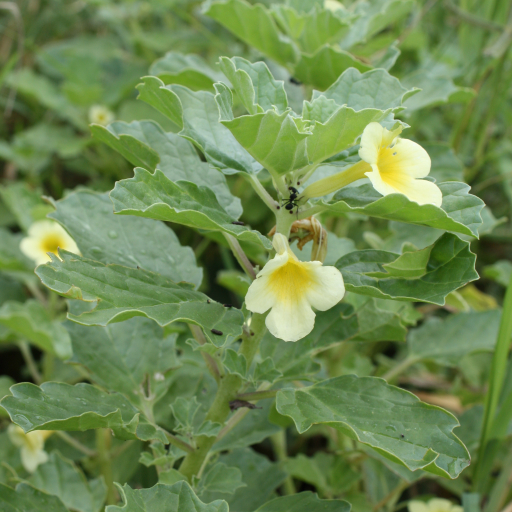
Plant Overview
Known widely as "Bara Gokhru" or the "Large Caltrops," Pedalium murex is a resilient survivor that thrives where other plants wither. This succulent-like herb is a staple in traditional Ayurvedic medicine and is legendary in rural folklore for its strange ability to turn plain water into a thick, jelly-like substance. Often found hugging the coastlines, it is as hardy as it is curious.
🔍 How to Identify
- 🍃 Fleshy Leaves: The leaves are bright green, slightly succulent, and oval-shaped with wavy or coarsely toothed margins that look like miniature ruffles.
- 🌼 Trumpet Blooms: It produces small, delicate, pale-yellow flowers that are shaped like narrow funnels, appearing tucked away where the leaf meets the stem.
- ⚔️ Spiny Fruits: The most distinct feature is its woody, pyramid-shaped fruit, which sports four sharp, spreading spines at the base designed to hitch a ride on passing animals.
🏡 In Your Garden
- 🏖️ Sand Specialist: This plant is a "psammophyte," meaning it specifically craves sandy soil and salty coastal air. If you try to grow it in heavy clay, its roots will likely suffocate and rot.
- ☀️ Sun Seeker: Because it naturally grows in open waste-lands and beaches, it requires intense, direct light. It uses its thickened, succulent leaves to store moisture, allowing it to endure long periods of heat without drooping.
⚠️ Safety & Toxicity
- 🩹 Physical Hazard: While the plant is not chemically toxic to humans, the dried fruits are "caltrops"—meaning they are sharp enough to puncture bicycle tires or thin-soled shoes.
- 🐾 Paw Protection: It is best kept away from high-traffic areas for pets. The sharp spines on the seed pods can easily become embedded in paws or fur, leading to painful irritation or secondary infections.
✨ Fun Fact
The "Magic" Thickener: If you swirl a fresh branch of Pedalium murex in a glass of water for just a minute, the water becomes incredibly thick and viscous, almost like liquid gelatin, due to the high mucilage content in the plant's cells!

Detailed Care Instructions
To grow Pedalium murex (also known as Gokhru or Goat's head), you can follow these steps:
- Obtain seeds: Purchase Pedalium murex seeds from a reputable supplier or collect seeds from mature fruits. Ensure the seeds are viable and have not been damaged.
- Germination: Soak the seeds in water for about 24 hours to soften their hard outer shell. This will facilitate germination. Alternatively, you can scarify the seeds by lightly scratching or cutting the outer shell to enable moisture absorption.
- Planting: Prepare a well-draining potting mix by combining equal parts of garden soil, compost, and sand. Fill a seed tray or small pots with this mixture and sow the seeds about 1-2 cm deep. Plant a single seed per pot or space them 5-10 cm apart in a seed tray.
- Watering: Keep the soil moist but avoid overwatering. Pedalium murex prefers slightly dry conditions and excessive moisture can lead to root rot. Water the plants sparingly, allowing the top inch of soil to dry out before watering again.
- Light and temperature: Place the pots or trays in a sunny location, as Pedalium murex requires full sun for healthy growth. Ensure the plants receive at least 6-8 hours of direct sunlight daily. The plant thrives in warm temperatures between 60-90°F (15-32°C).
- Transplanting: Once the seedlings have grown to a reasonable size and developed a few true leaves, they can be transplanted into larger pots or directly into the ground. Choose a location with well-drained soil and enough space for the plant to spread.
- Care and maintenance: Regularly monitor the plants for pests and diseases. Prune any damaged or dead branches to promote healthy growth. Fertilize the plants with a balanced liquid fertilizer every 2-4 weeks during the growing season to provide essential nutrients.
- Harvesting: Pedalium murex bears small fruits that turn yellow when ripe. You can harvest the fruits when they are fully mature and dry. Collect the seeds from the fruits and use them for future planting or as desired.
Remember that Pedalium murex is a thorny plant, so handle it with care while planting and maintaining it. Also, check if it is legal to grow this plant in your region, as some areas might have restrictions.
To ensure proper growth and health of this plant, it is important to water it regularly and appropriately. It is recommended to water the plant deeply, but infrequently, ensuring that the soil is moist but not waterlogged. One way to determine if the plant needs water is to check the soil moisture level by touching the soil surface with your finger. If the soil feels dry, watering is needed, but if it feels moist, then watering can be postponed for a day or two. Additionally, it is important to avoid watering the leaves of the plant, focusing the water on the soil around the base of the plant instead. Over-watering can lead to root rot and other issues, so care should be taken not to water the plant too frequently.
To fertilize this plant, use a balanced fertilizer that has equal amounts of nitrogen, phosphorus, and potassium. Apply the fertilizer at the base of the plant during the growing season, which is from spring to fall. Be sure to follow the instructions on the fertilizer package carefully, as over-fertilization can damage the plant. Additionally, it is recommended to water the plant before fertilizing to prevent fertilizer burn.
Pedalium Murex plants thrive in well-drained soil that is rich in nutrients. The ideal soil mixture should be a blend of composted organic matter, sand, and topsoil. The pH level of the soil should be slightly acidic, between 6.0 and 7.0. This allows the plant to efficiently uptake important nutrients from the soil.
It is essential to avoid soils that are heavy or poorly drained, as this may lead to root rot and other diseases. Additionally, soils that are too alkaline or too acidic can negatively affect the plant's growth and overall health.
When planting Pedalium Murex, ensure that the soil is moist, but not waterlogged, as this can also lead to root rot. It is also recommended to fertilize the plant with a balanced, slow-release fertilizer to provide it with the necessary nutrients to grow and thrive.
One method to propagate the plant species is through seed propagation. Gather fresh seeds from mature and healthy plants and carefully remove any fleshy coatings surrounding the seeds. Sow the seeds in a well-draining soil mix and keep the soil moist and warm. Germination may take several weeks to occur.
Another method is through stem cuttings. Choose a healthy stem with several nodes and make a clean cut with a sharp knife or scissors. Remove the leaves from the lower half of the stem and dip the cut end in rooting hormone. Plant the cutting in a well-draining soil mix and keep the soil moist. Place the cutting in a warm, humid environment and provide bright, indirect light. Roots should begin to form within a few weeks.
Layering is also a possible method of propagation. Choose a low-hanging branch and bend it down to the ground. Score the bark of the branch where it touches the soil to create a wound and cover it with soil. Anchor the branch to the soil with stakes or weights. Roots should begin to form at the wound site within a few weeks. Once the roots have established, the new plant can be carefully separated from the parent plant and transplanted.








