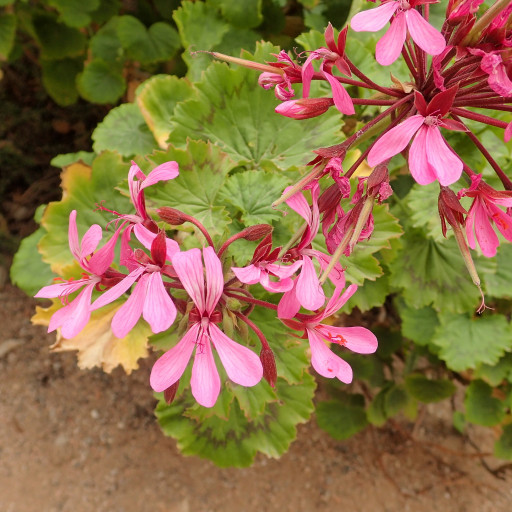
Plant Overview
Often called the "Horseshoe Geranium," this South African native is the undisputed king of the balcony garden. Its iconic circular leaves and vibrant flower clusters have decorated window boxes for centuries, symbolizing grace and domesticity. Despite its common name, it is technically a Pelargonium, prized for its rugged nature and ability to bloom tirelessly from spring until the first frost.
🔍 How to Identify
- 🍃 The Leaf "Zone": The most striking feature is the dark, C-shaped or horseshoe-like band that decorates the center of each velvety, scalloped leaf.
- 🌸 Umbel Blooms: Large, rounded flower heads (umbels) sit atop long, sturdy stems, available in a kaleidoscope of scarlet, salmon, pink, and pure white.
- 🌱 Semi-Succulent Stems: It grows as a bushy shrub with thick, fleshy stems that become woody at the base as the plant matures.
🏡 In Your Garden
- ☀️ The Light Craving: This plant is a sun-worshipper. If it starts to look "leggy" or stretched out with fewer flowers, it is likely protesting a lack of direct sunlight.
- 💧 Drought Defense: Because its stems store water, the Zonal Geranium hates "wet feet." It is much happier being slightly underwatered than sitting in soggy soil, which quickly leads to root rot.
- ✂️ The "Pinch" Technique: To encourage a bushy shape rather than a tall, lanky one, hobbyists "pinch" off the growing tips. Removing faded flowers (deadheading) is also essential to signal the plant to grow new buds.
⚠️ Safety & Toxicity
- 🐾 Pet Warning: Pelargoniums contain geraniol and linalool, which are mildly toxic to cats and dogs. Ingestion can cause vomiting, lethargy, or skin rashes.
- 👶 Skin Sensitivity: While generally safe for humans, the essential oils in the leaves can cause mild dermatitis or redness in individuals with highly sensitive skin.
✨ Fun Fact
In the late 18th century, a botanical mix-up occurred where these plants were grouped with the hardy "Cranesbill" Geraniums. Even though scientists corrected the error in 1789 by moving them to the Pelargonium genus, the world refused to stop calling them Geraniums—a naming habit that has lasted over 200 years!

Detailed Care Instructions
| Humidity | Normal |
| Lighting | Part Sun |
| Difficulty | Medium |
| Hibernation | Cold Period |
| Temperature | 15°C - 24°C |
| Hardiness Zones | 9B - 11B |
To successfully grow a Pelargonium Zonale plant, also known as a common geranium, follow these steps:
- Choose a suitable location: Pelargonium Zonale plants thrive in full sun to partial shade, so select a spot that receives at least 6-8 hours of sunlight each day. They prefer well-draining soil with a pH level between 6.0 and 7.0.
- Propagation: There are several methods of propagation you can employ, such as stem cuttings or division of the root ball. Stem cuttings are the most common method. Take a 4-6 inch cutting from a healthy, mature plant in spring or early summer. Remove lower leaves and dip the end in rooting hormone. Place the cutting in a pot with well-draining potting soil, water it, and keep it in a warm and humid environment until roots start to form.
- Planting or potting: Once the roots have developed, transplant the rooted cutting into a larger pot or directly into the ground. Ensure proper spacing, as Pelargonium Zonale plants can grow up to 1-3 feet tall and spread around 1-2 feet wide.
- Watering: Water the plant deeply, allowing the soil to dry slightly between waterings. Avoid overwatering, as it can lead to root rot. It is better to underwater than overwater these plants.
- Fertilizing: Apply a balanced, slow-release fertilizer once a month during the growing season (spring and summer). Alternatively, you can use a liquid fertilizer diluted to half strength every 2-3 weeks.
- Pruning: Regularly pinch back the tips of the stems to encourage bushier growth. Remove dead flowers and leaves to maintain a tidy appearance. This will also promote new blooms.
- Pests and diseases: Keep an eye out for common pests such as aphids, spider mites, and whiteflies. Use neem oil or insecticidal soap to treat infestations. Avoid overhead watering to prevent fungal diseases.
- Overwintering: Pelargonium Zonale plants are typically grown as annuals in regions with colder winters. However, they can be overwintered indoors in a cool, bright location. Reduce watering and fertilization during this period, and trim back the plant if necessary. Resume regular care in spring.
By following these steps, you should be able to successfully grow a Pelargonium Zonale plant and enjoy its vibrant flowers throughout the growing season.

Place in a window with dappled sun or a spot in the middle of a room. Or directly in a window facing west or east.

Pelargonium Zonale plant should be watered regularly but not over watered. A good rule of thumb is to water the plant when the top 1-2 inches of soil feels dry to the touch. When watering, aim to give the plant a thorough soaking but avoid letting it sit in standing water. Drain excess water from the saucer or pot to prevent root rot. Use room temperature water and avoid getting water on the foliage, as this can cause damage or encourage fungal growth. In general, Pelargonium Zonale plants require more watering during the growing season (spring/summer) and less in the dormant season (winter).
To fertilize this plant, use a balanced fertilizer with equal amounts of nitrogen, phosphorus, and potassium. Apply the fertilizer every two to three weeks during the growing season. Be sure to dilute the fertilizer according to the package instructions to avoid damaging the plant's roots. Additionally, water the plant thoroughly after fertilizing to help distribute the nutrients throughout the soil.
Pelargonium Zonale plants require a well-draining soil mixture that is rich in nutrients. The soil should be slightly acidic with a pH level between 5.5 and 6.5. It should be a mixture of peat moss, perlite, vermiculite, sand, and compost. The peat moss will retain moisture, while the perlite, vermiculite, and sand will ensure good drainage. The compost will provide the necessary nutrients that the plant needs to grow and thrive. It is important to ensure that the soil is not too dense, as this can cause root rot and other issues. Additionally, Pelargonium Zonale plants prefer soil that is slightly damp, but not waterlogged, so be sure to water appropriately.
Pelargonium zonale is a type of plant that can be propagated through various methods. One way to propagate this plant is through stem cuttings. To do this, take a cutting of a healthy stem that is 3-4 inches long. Make sure the cutting includes a node (where a leaf is attached) and remove any flowers or buds. Dip the cut end of the stem into rooting hormone and then place it into a pot filled with moist soil. Keep the soil consistently moist and mist the cutting regularly. Within a few weeks, roots should start to grow and new growth should appear above the soil.
Another way to propagate this plant is through division. This method is best done in spring or early summer when the plant is actively growing. Carefully dig up the plant and separate it into several smaller sections, making sure each section has its own roots. Replant the sections into separate pots filled with fresh soil and keep them well-watered and in a shady location until they have established themselves.
Lastly, Pelargonium zonale plants can also be propagated through seeds. Collect the seeds from the plant and plant them in soil-filled pots. Keep the soil consistently moist and the pots in a warm location. Within a few weeks, sprouts should appear and new growth should appear above the soil.
Common pests of the horseshoe geranium include Spider mites, fungus gnats, aphids, whiteflies. Make a habit of checking your horseshoe geranium frequently for pests so that any infestations can be caught and managed early.








