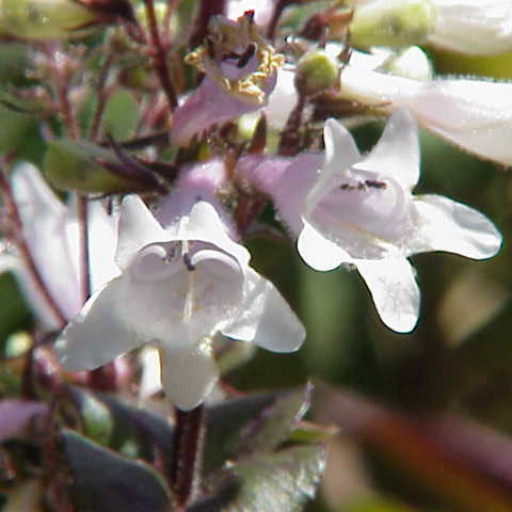
Plant Overview
Often called the Foxglove Beardtongue, this native North American powerhouse bridges the gap between wild meadow charm and refined garden elegance. While its flowers resemble the classic, towering Foxglove, this plant is far hardier and more forgiving of difficult soils. It is a legendary "bridge" plant for gardeners, providing a transition between spring blooms and the heat of midsummer.
🔍 How to Identify
- 🌸 Flower Shape: Clusters of white to soft pink, trumpet-shaped blooms that look like tiny hanging bells arranged in airy spires.
- 👅 The "Beardtongue": If you peek inside a flower, you’ll see a single sterile stamen covered in fine, golden hairs—this "fuzzy tongue" is the plant's namesake.
- 🍃 Leaf Structure: Smooth, deep green, lance-shaped leaves that grow opposite each other along sturdy, upright stems. In autumn, the foliage often transitions to a beautiful deep burgundy.
🏡 In Your Garden
- 💪 Soil Adaptability: This is one of the few perennials that can handle heavy clay soil and "wet feet" in the spring while remaining impressively drought-tolerant once the summer heat kicks in.
- 🐝 Pollinator Magnet: It serves as a vital landing pad for bumblebees, who have to "muscle" their way inside the tubular flowers. It is also a top-tier nectar source for returning hummingbirds.
- ✂️ Low Maintenance: Because it has a deep taproot, it hates being moved once established. It’s best to plant it where you want it to stay for years to come.
⚠️ Safety & Toxicity
- ✅ Pet & Human Safe: Unlike the "True Foxglove" (Digitalis), which is highly toxic, Penstemon digitalis is generally considered non-toxic to humans, dogs, and cats.
- 🚜 Livestock Caution: In large-scale agricultural settings, some Penstemons can accumulate selenium from the soil. While rarely an issue for home pets, it is something to watch if you have grazing livestock like horses or sheep.
✨ Fun Fact
The species name digitalis was chosen because the flowers look strikingly similar to the unrelated Foxglove genus. However, unlike the short-lived Foxglove, this Penstemon is a long-lived perennial that can survive even the harshest North American winters!

Detailed Care Instructions
| Humidity | High |
| Lighting | Full Sun |
| Difficulty | Easy |
| Hibernation | Cold Period |
| Hardiness Zones | 3 - 8 |
To grow Penstemon digitalis, also known as Foxglove Beardtongue, you can follow these steps:
- Soil Requirements: Ensure that you have well-draining soil with a pH level between 6.0 and 8.0. The soil should be rich in organic matter and slightly alkaline.
- Location: Choose a sunny spot for planting the Penstemon digitalis. It prefers full sun to part shade. Make sure the location is sheltered from strong winds.
- Planting: Plant Penstemon digitalis in the spring or fall. Dig a hole twice as wide and deep as the plant's root ball. Place the plant in the hole, making sure the crown is level with the soil surface. Backfill the hole with soil, pressing gently to eliminate air pockets.
- Watering: Water the plant thoroughly after planting and continue to water regularly. Penstemon digitalis prefers consistently moist soil but avoid overwatering, as it can lead to root rot. Allow the top inch of soil to dry out before watering again.
- Mulching: Apply a layer of organic mulch, such as wood chips or straw, around the base of the plant to help retain moisture and suppress weeds.
- Fertilization: Penstemon digitalis does not typically require regular fertilization. However, you can apply a balanced slow-release fertilizer in the spring to promote healthy growth.
- Pruning: Deadhead the faded flowers to encourage more blooms throughout the growing season. Cut back the plant to the ground in late fall or early spring to prepare it for new growth the following season.
- Pests and Diseases: Penstemon digitalis is generally pest-resistant. However, it can sometimes be susceptible to powdery mildew. To prevent this, ensure good air circulation around the plant and avoid overhead watering.
By following these tips, you should be able to successfully grow Penstemon digitalis in your garden.

Place in a window with dappled sun or a spot in the middle of a room. Or directly in a window facing west or east.

Penstemon Digitalis plant prefers to be watered regularly but not excessively. The soil around the plant should be kept consistently moist, but not water-logged. It is important to avoid letting the plant dry out completely, as this can cause damage to its roots and stunt its growth. When watering, it is best to water deeply and slowly to allow the water to penetrate the soil and reach the roots. This can be done using a watering can or hose with a gentle flow. It is important to avoid getting water on the leaves of the plant, as this can increase the risk of fungal diseases. It is also recommended to water the plant in the morning, as this allows time for any excess water to evaporate before nightfall.
For best results, fertilize your plant with a balanced, slow-release fertilizer in early spring before new growth appears. Apply according to package instructions and water thoroughly after application. During the growing season, you can provide additional nutrients through weekly applications of a water-soluble fertilizer. Be sure to follow package instructions carefully and avoid over-fertilizing, as this can lead to weak growth and reduced flowering. Finally, in autumn, discontinue fertilizing and allow the plant to enter dormancy naturally.
The recommended type of soil to use for Penstemon Digitalis plants is a well-draining and fertile soil that is moist but not waterlogged. It should have a pH level of neutral to slightly acidic. The soil should also be free from any contaminants or pollutants that may harm the plant. Adding organic matter to the soil before planting can help improve its texture and nutrient content. This can include compost, leaf mold, or well-rotted manure. The plant should be placed in a location that receives full or partial sun and protected from strong winds. Regular watering is necessary to keep the soil moist but not saturated. Overwatering can lead to root rot.
Penstemon digitalis is a flowering perennial plant that can be propagated by several methods, including division, stem cuttings, or seed.
Dividing the plant is a common way to propagate it. This is done by digging up the plant and gently separating the roots into sections, each with a few shoots and roots attached. Each division can then be replanted in a new location.
Stem cuttings can also be taken from the plant in the summer or fall. Cuttings should be taken from healthy stems that are not flowering, and should be about 4-6 inches long. Remove the bottom leaves of the cutting and dip the cut end into rooting hormone before planting in moist soil. Keep the soil moist and the cutting in a bright but not too hot location until roots begin to form.
Penstemon digitalis can also be grown from seed sown in the fall or early spring. Seeds can be sown directly into the soil or started indoors and transplanted later. Sow seeds on the surface of moist soil and press them in lightly. Keep the soil moist until seeds germinate, which can take up to three weeks.








