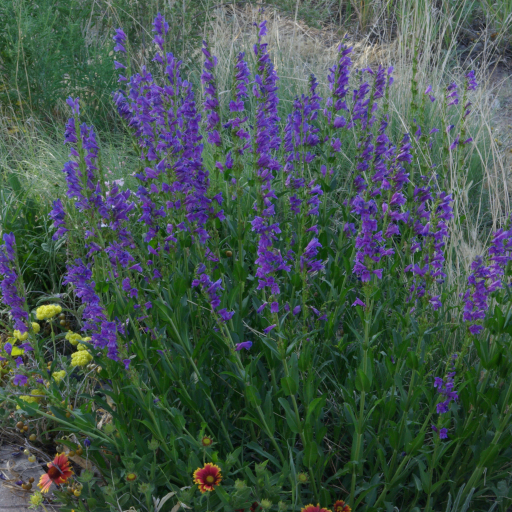
Plant Overview
Often called the Rocky Mountain Penstemon, this hardy perennial is a true showstopper of the American West. Known for its ability to paint entire mountain meadows in shades of electric blue and violet, it has earned the nickname "Beardtongue" due to the fuzzy, tongue-like stamen hidden within its throat. It is a favorite for high-altitude gardeners and those looking to add a vertical "pop" of color to a water-wise landscape.
🔍 How to Identify
- 🌸 Tubular Blooms: Vibrant violet-blue flowers shaped like trumpets, which typically grow along one side of the tall, stiff stems.
- 🍃 Lance-Shaped Leaves: Smooth, narrow, dark green leaves that grow in opposite pairs. The foliage at the base forms a thick, evergreen mat that persists even in winter.
- 🧔 The "Beard": Inside the flower, you will find a sterile fifth stamen covered in fine hairs, giving it its distinctive "beardy" appearance.
🏡 In Your Garden
- ⛰️ The Hardiness Hero: This plant thrives on neglect. It prefers lean, rocky, or sandy soil and will actually become weak and "floppy" if given too much fertilizer or rich organic matter.
- 💧 Drainage is Key: While it is incredibly drought-tolerant, its biggest enemy is "wet feet." It requires excellent drainage to survive the winter; planting it on a slope or in a rock garden is ideal to prevent root rot.
- 🐝 Pollinator Runway: The tubular shape is a specialized evolution for long-tongued visitors. You will frequently see bumblebees crawling entirely inside the flowers and hummingbirds hovering nearby for a nectar snack.
⚠️ Safety & Toxicity
- 🐾 Non-Toxic: Penstemon strictus is generally considered safe and non-toxic for cats, dogs, and horses.
- 🌱 Skin Sensitivity: While not poisonous, the stems and leaves can be slightly coarse. Some sensitive gardeners might experience mild skin irritation after heavy pruning, so gloves are recommended.
✨ Fun Fact
The name Penstemon comes from the Greek words "penta" (five) and "stemon" (stamen). While most members of its plant family have only four stamens, this genus is unique for having a fifth, sterile stamen that evolved specifically to help brush pollen onto the backs of visiting bees!

Detailed Care Instructions
To grow Penstemon Strictus, also known as Rocky Mountain Penstemon or Rocky Mountain Beardtongue, you can follow these steps:
- Soil preparation: Choose a well-draining soil with a pH range of 6.5 to 7.5. Amend the soil with organic matter, such as compost, to improve fertility and drainage.
- Location: Select a location that receives full sun to partial shade. Penstemon Strictus prefers at least 6 hours of direct sunlight per day.
- Planting: Dig a hole twice the width and depth of the plant's container. Place the plant in the hole, ensuring that the crown (where the roots meet the stem) is level with or slightly above the soil surface. Backfill the hole with soil and gently firm it around the roots.
- Watering: Water the plant thoroughly after planting. Penstemon Strictus requires regular watering during its first growing season to establish a strong root system. Afterward, it is generally drought-tolerant and requires less frequent watering.
- Mulching: Apply a layer of organic mulch, such as wood chips or straw, around the base of the plant to help conserve moisture and suppress weed growth. Keep the mulch a few inches away from the stem to prevent rot.
- Fertilizer: Penstemon Strictus generally does not require excessive fertilization. However, you can apply a balanced, slow-release fertilizer in early spring to promote healthy growth.
- Pruning: Remove spent flower spikes after flowering to encourage additional blooming. In late fall or early spring, you can cut back the foliage to 6 inches above the ground to rejuvenate the plant.
- Pests and Diseases: Penstemon Strictus is generally resistant to pests and diseases. However, it can occasionally be affected by aphids or powdery mildew. Monitor your plants regularly and control any infestations promptly.
- Propagation: You can propagate Penstemon Strictus through seeds or dividing established plants. Collect seeds after the flowers have faded and popped open. Sow seeds in seed trays in early spring or autumn, keeping them in a well-lit area. Transplant the seedlings outdoors once they are well-established. To divide the plant, carefully dig it up in early spring or fall, and separate the clumps into smaller sections, ensuring each section has roots and shoots before replanting.
By following these care guidelines, you can successfully grow Penstemon Strictus and enjoy its vibrant blooms in your garden.

Place in a bright room that is sun drenched almost all day. Or directly in a south-facing window.

To water this particular plant, it is best to avoid overhead watering and water the soil around the base of the plant instead. The plant prefers well-draining soils, so be sure not to over-water. Water deeply once a week, allowing the soil to dry out slightly between waterings. In hot and dry climates, increase watering frequency. Mulching around the base of the plant can help retain moisture in the soil. Avoid watering during the dormant phase of the plant, usually during the winter months. It is important to monitor the plant's growth and adjust watering accordingly.
To fertilize this particular plant, it is recommended to use a slow-release, balanced fertilizer with equal proportions of nitrogen, phosphorus, and potassium. Apply the fertilizer around the base of the plant in the early spring, before new growth emerges. Be sure to water the plant well after fertilizing to allow the nutrients to penetrate the soil. Avoid over-fertilizing or using high-nitrogen fertilizers, as this can cause excessive foliage growth at the expense of flowers.
Penstemon Strictus is a type of perennial plant that requires well-draining soil that is fertile and rich in organic matter. It is best to avoid using heavy or compact soils that do not allow water to pass easily through the roots. The plant prefers a slightly acidic to neutral pH level, usually between 6.0 to 7.5. Adding sand or perlite to the soil mixture can help improve drainage and prevent waterlogging, which can lead to root rot. In general, a good soil mixture for Penstemon Strictus should be loose, friable, and able to hold moisture without becoming waterlogged. Avoid clay-heavy soils and soils with high levels of salts, which can be harmful to the plant.
To propagate this plant, you should begin by selecting healthy stems that have not yet flowered. Then, cut off small, woody sections of around 8cm in length. After that, remove the lower leaves to avoid rotting and plant the stems in a propagation tray filled with fertile compost. Make sure to keep the soil moist but not overly wet, and cover the tray with a plastic bag or a propagator lid to retain moisture. Place the tray in a warm and bright location but away from direct sunlight. After a few weeks, the stems should start producing new roots. At this point, you can transplant the new plants into individual pots and keep them indoors until they are strong enough to be planted in the garden.
Common pests of the rocky mountain penstemon include Spider mites, aphids, whiteflies. Make a habit of checking your rocky mountain penstemon frequently for pests so that any infestations can be caught and managed early.








