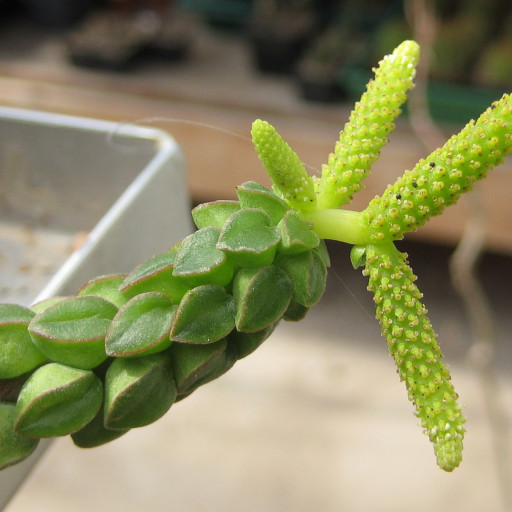
Plant Overview
Known by many as the "Columnar Peperomia," this architectural gem looks less like a plant and more like a collection of tiny emerald scales stacked into a tower. Hailing from the steep cliffs of the Peruvian Andes, it is one of the most distinct succulents in the Peperomia genus. It is a favorite for collectors who want a plant that looks like a prehistoric artifact or a dragon's tail.
🔍 How to Identify
- 🐍 Sturdy Columns: The plant grows in upright, clumping stems that can reach about 8 inches in height before they begin to lean or trail slightly.
- 🍃 Fenestrate Leaves: If you look closely at the tips of the tiny, horseshoe-shaped leaves, you’ll see translucent "windows." These allow sunlight to penetrate deep into the leaf's interior.
- 🏗️ Geometric Pattern: The leaves are arranged in a tight, mathematical spiral around the stem, creating a textured, reptilian appearance that is cool to the touch.
🏡 In Your Garden
- ⛰️ Cliffside Roots: Because it naturally grows on rocky Peruvian ledges, it requires incredibly gritty, well-draining soil. It is much more susceptible to root rot than other Peperomias, so think of it as a cactus rather than a tropical houseplant.
- ☀️ Sun Seeker: Unlike its shade-loving cousins, Peperomia columella craves bright light. If it doesn't get enough sun, the columns will "stretch," causing the beautiful leaves to gap and ruining its compact, scaly look.
⚠️ Safety & Toxicity
- 🟢 Safe Assessment: This plant is generally considered non-toxic and safe for a variety of environments.
- 🐾 Pet Friendly: Like most members of the Piperaceae family, it is non-toxic to cats and dogs. It’s a great choice for a low-altitude coffee table where curious pets might sniff around.
- 👶 Gentle Nature: It lacks thorns, spines, or irritating saps, making it a "touch-friendly" plant for households with children.
✨ Fun Fact
The "windows" on the tips of the leaves are a sophisticated survival adaptation; by funneling light into the center of the leaf, the plant can perform photosynthesis while keeping most of its surface area protected from the drying Andean winds!

Detailed Care Instructions
| Color | No Flowers; Ornamental Foliage |
| Soil Ph | 6 To 6.6 |
| Humidity | Normal |
| Lighting | Part Sun |
| Toxicity | Non-Toxic |
| Soil Type | A Loose, Well-Drained, Very Rich Potting Mix |
| Bloom Time | Year-Round |
| Difficulty | Medium |
| Plant Type | Tropical Perennials |
| Mature Size | Depends On The Type. Typical Plants Can Grow To About 12 Inches High And 8 Inches Across. |
| Native Area | Tropical Regions Of Central And South America |
| Temperature | 18°C - 27°C |
| Sun Exposure | Moderate Light |
| Hardiness Zones | 10 To 12 |
To grow Peperomia Columella plant, follow these steps:
- Choose a suitable pot: Select a pot with drainage holes at the bottom to avoid waterlogging. The pot should be slightly larger than the plant's root ball.
- Soil: Use well-draining soil or a potting mix designed specifically for succulents. This will ensure proper moisture retention without causing the roots to rot.
- Planting: Fill the pot with soil, leaving enough space for the roots. Gently remove the plant from its nursery pot and place it in the new pot, ensuring the top of the root ball is level with the soil surface.
- Light: Peperomia Columella prefers bright, indirect light. Find a location near a window where the plant receives bright, filtered sunlight for a few hours a day. Avoid direct sunlight, as it can scorch the leaves.
- Temperature and humidity: The ideal temperature range for Peperomia Columella is between 60-75°F (15-24°C). It prefers average to high humidity levels, but it can tolerate lower humidity.
- Watering: Water the plant thoroughly when the top inch of soil feels dry to the touch. Allow the excess water to drain away completely and never let the plant sit in standing water. Avoid overwatering, as it can lead to root rot.
- Fertilization: Feed your Peperomia Columella with a balanced houseplant fertilizer once a month during the growing season (spring and summer). Follow the instructions on the fertilizer packaging for dosage.
- Pruning: Trim any yellowing or damaged leaves with clean scissors or pruning shears to maintain the plant's appearance. Regular pruning also helps to promote new growth.
- Repotting: As the plant grows, you may need to repot it into a slightly larger container. Repotting is usually done every 1-2 years to provide fresh soil and more growing space for the plant.
- Pests and diseases: Peperomia Columella is generally resistant to pests and diseases. However, occasionally it may face issues with mealybugs, spider mites, or fungal infections. Inspect the plant regularly and treat any infestation promptly with appropriate insecticides or fungicides.
Remember to monitor the plant closely and adjust the care routine as needed. With proper care and attention, your Peperomia Columella plant should thrive and grow.

Place in a bright room that is sun drenched almost all day. Or directly in a south-facing window.

Peperomia Columella is a plant that requires moderate watering. It is important to let the top two inches of soil dry out before watering, as overwatering can lead to root rot. When watering, thoroughly soak the soil and allow any excess water to drain out of the bottom of the pot. This plant prefers to be watered from the bottom (i.e., by placing the pot in a dish of water) rather than from the top. It is also important to avoid getting water on the leaves or stem, as this can lead to fungal growth. In general, watering once a week should be sufficient for Peperomia Columella, but this may vary depending on the environment and the size of the pot.
To fertilize the Peperomia Columella plant, use a balanced fertilizer with equal amounts of nitrogen, phosphorus, and potassium. Dilute the fertilizer to half-strength and apply it once a month during the growing season, which is typically from spring to summer. Avoid fertilizing during the dormant season from autumn to winter. Mix the fertilizer in water and apply it to the soil around the base of the plant, taking care not to get any on the leaves. Water the plant thoroughly after fertilizing to prevent fertilizer burn.
The ideal soil for Peperomia Columella should be well-draining and contain a mix of organic matter such as peat moss, compost, or coconut coir. The soil should be slightly acidic with a pH of around 6.0 to 7.0. It should be loose and airy, which promotes healthy root growth. The soil should also be moist but not waterlogged as these plants are susceptible to root rot. It is recommended to avoid using heavy soils or ones that are too compacted. Adding perlite or sand can improve drainage and aeration. It is essential to allow the soil to dry out slightly between watering to avoid overwatering, which can lead to root rot and other problems.
Peperomia columella can be propagated through stem cuttings or leaf cuttings.
To propagate through stem cuttings:
- Select a healthy stem with several leaves on it.
- Cut the stem with a clean sharp pair of scissors or pruning shears.
- Remove the lower leaves, leaving only a couple of leaves at the top.
- Dip the cut end of the stem into rooting hormone powder.
- Plant the stem cutting in well-draining soil.
- Water the cutting sparingly and keep it in a warm and humid environment.
- Within a few weeks, roots should begin to develop, and new growth should appear.
To propagate through leaf cuttings:
- Select a healthy leaf and gently remove it from the plant.
- Cut the leaf in half with a clean sharp pair of scissors or pruning shears.
- Lay the cut end of the leaf on top of well-draining soil.
- Lightly press the cut end into the soil.
- Water the soil lightly and cover the leaf with plastic wrap or a plastic bag, creating a mini greenhouse effect.
- Keep the soil and leaf cutting in a warm and humid environment, out of direct sunlight.
- After a few weeks, roots should start to develop, and new growth should appear from the base of the leaf.
Once the new plant has developed roots and new growth, it can be transplanted into a new pot with well-draining soil.
Common pests of the columnar peperomia include Mealybugs, fungus gnats. Make a habit of checking your columnar peperomia frequently for pests so that any infestations can be caught and managed early.








