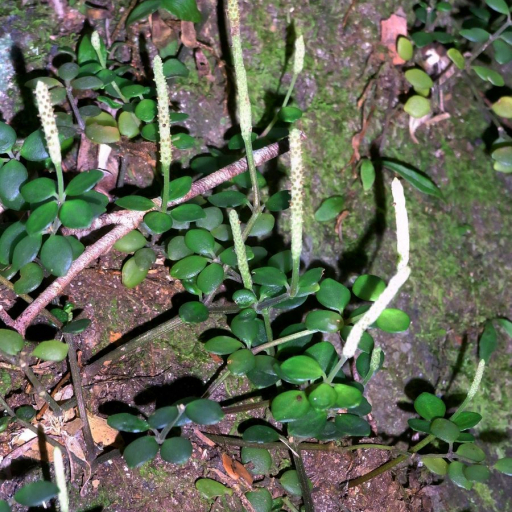
Plant Overview
Often called the "Hope Peperomia" or "Acorn Peperomia," this charming succulent-like trailer is a favorite for minimalist indoor gardens. Originally hailing from tropical regions across South America and Africa, it lives life as an epiphyte, often found "hitching a ride" on mossy tree branches. Its thick, coin-like leaves give it a sturdy, sculptural look that feels more like a piece of living art than a typical houseplant.
🔍 How to Identify
- 🍃 The Leaves: Small, perfectly round, and incredibly thick. They have a semi-succulent texture and a deep forest-green hue with faint, lighter stripes.
- 🌿 The Arrangement: Leaves typically grow in "whorls" of four along the stem—this is actually what its botanical name tetraphylla (four-leaved) refers to.
- 🌱 The Stems: Fleshy, reddish-tan stems that trail elegantly downward or creep across the soil surface.
🏡 In Your Garden
- 🪵 Epiphytic Roots: Because it grows on trees in the wild, its root system is small and sensitive. It hates "wet feet," so it thrives best in a chunky orchid bark or perlite-heavy mix rather than heavy potting soil.
- 💧 Drought Strategy: Those thick leaves act as water storage tanks. If the leaves feel firm, the plant is hydrated; if they start to feel slightly soft or "bendy," it’s time for a deep drink.
- ☀️ Light Nuance: While it loves bright, filtered light, direct afternoon sun can actually scorch the leaves, turning them a dull, yellowish color.
⚠️ Safety & Toxicity
- ✅ Status: Non-toxic and Pet-Safe.
- 🐾 Details: This is a "worry-free" plant for households with curious cats, dogs, or toddlers. While it isn't meant for snacking, it won't cause harm if a leaf is accidentally nibbled.
✨ Fun Fact
The Peperomia 'Hope' is actually a hybrid cross between Peperomia deppeana and Peperomia quadrifolia. It was bred specifically to be extra hardy and to maintain that iconic, perfectly round leaf shape that hobbyists adore!

Detailed Care Instructions
| Color | Green, Brown |
| Soil Ph | Acidic |
| Lighting | Full Sun |
| Soil Type | Moist But Well-Drained |
| Bloom Time | Spring, Summer |
| Plant Type | Perennial |
| Mature Size | 8 In. Wide, 12 In. Tall |
| Native Area | Central America, South America |
| Sun Exposure | Partial |
| Hardiness Zones | 10-12 |
To grow Peperomia Tetraphylla plant, follow these steps:
- Choose the right location: Peperomia Tetraphylla prefers bright but indirect light. Avoid direct sunlight as it can scorch the leaves. East or west-facing windows are ideal.
- Provide optimal temperature and humidity: The plant thrives in temperatures between 65-75°F (18-24°C). It also prefers higher humidity levels, so misting the leaves or placing a tray with water nearby can help maintain humidity.
- Use well-draining soil: Peperomia Tetraphylla prefers soil that is well-draining. A combination of peat moss, perlite, and sand or a commercially available potting mix suitable for succulents works well.
- Watering: Allow the soil to dry out partially between waterings, but do not let it completely dry out. Overwatering can lead to root rot, so it's crucial to ensure proper drainage. Water the plant more during the growing season and reduce the frequency during winter when growth slows down.
- Fertilize sparingly: Peperomia Tetraphylla does not require much fertilizing. You can feed it with a balanced, water-soluble houseplant fertilizer at half the recommended strength once a month during the growing season.
- Propagation: Peperomia Tetraphylla can be propagated through stem or leaf cuttings. Simply take a cutting from a healthy plant, allow it to dry for a day or two, and then plant it in moist soil or water until roots form.
- Pruning: Prune the plant as needed to maintain its shape and size. Pinch off leggy growth or remove damaged leaves.
- Protect from pests: Peperomia Tetraphylla is generally resistant to pests, but occasionally, it may be affected by mealybugs, spider mites, or aphids. If you notice any infestation, treat it with appropriate organic insecticides or wipe the affected areas with a damp cloth.
Remember to monitor your plant's growth, adjust care routines accordingly, and enjoy the beautiful foliage Peperomia Tetraphylla has to offer.

Place in a window with dappled sun or a spot in the middle of a room. Or directly in a window facing west or east.

To water this plant, fill a watering can with room temperature water and slowly pour the water onto the soil, taking care not to get water on the leaves. Water until the soil is moist but not soaking wet. Allow the top inch of soil to dry out before watering again, as overwatering can cause root rot. Additionally, make sure to use well-draining soil in a pot with drainage holes to prevent water from pooling at the bottom of the pot.
To fertilize this plant, use a balanced liquid fertilizer that is diluted to half strength. Feed the plant every two weeks during the growing season (spring and summer) and once a month during the dormant season (fall and winter). Avoid over-fertilizing as it can burn the plant's roots and cause damage. Always water the plant thoroughly before and after fertilizing.
Peperomia Tetraphylla plant thrives in a well-draining soil mix that is moist but not waterlogged. The ideal soil would be a combination of peat moss, perlite, and sand that provides good aeration and drainage. It should have a pH level of 6.0 to 7.5 and be rich in nutrients. The soil should be fertile enough to provide the plant with essential nutrients while still allowing excess water to drain away. It is important to avoid using heavy clay or compacted soil as it can lead to root rot and other plant diseases. Additionally, the soil should be slightly acidic in order to support healthy growth. It is essential to avoid overwatering the plant and to ensure that the soil doesn't stay wet for too long as it can lead to the plant dying quickly.
To propagate this plant, you will need to carefully take stem cuttings from a healthy adult plant. Use a sharp, clean pair of scissors or pruning shears to make a clean cut just below a node or leaf joint. Remove any lower leaves from the stem, leaving only a few pairs of leaves at the top.
Prepare a suitable rooting medium such as a mixture of peat moss and perlite or vermiculite, or a water-filled container. Dip the cut end of the stem in rooting hormone powder, if desired, and gently press it into the rooting medium. Make sure the bottom of the cutting is in contact with the medium or submerged in water, but avoid burying the entire stem.
Cover the cutting with a clear plastic bag or a plastic dome to create a humid environment and prevent moisture loss. Place the container or tray in a bright, warm area with indirect sunlight, but avoid direct sun exposure or extreme heat. Mist the cutting or water the medium periodically to keep it moist, but do not overwater or let it dry out.
After a few weeks to a month, the cutting should develop roots and new growth. You can then transplant it into a suitable potting mix and care for it as a mature plant.








