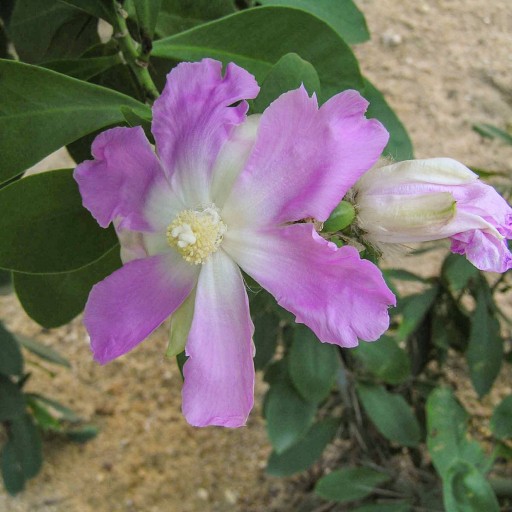
Plant Overview
Often called the Rose Cactus, Pereskia sacharosa is a fascinating evolutionary bridge. While most cacti traded their leaves for spines millions of years ago to survive the desert, this South American native kept both. It looks more like a traditional flowering shrub than a cactus, making it a "living fossil" that adds a prehistoric charm to any plant collection.
🔍 How to Identify
- 🌿 The Foliage: Lush, lance-shaped green leaves that are slightly succulent but surprisingly thin and pliable compared to other cacti.
- 🌸 The Blooms: Showy, rose-like flowers that range from pale pink to deep magenta, featuring a cluster of yellow stamens at the center.
- 🌵 The Armor: Long, needle-like spines that emerge in clusters (areoles) along the woody, brown stems, often hidden beneath the leaves.
🏡 In Your Garden
- 💧 The Water Paradox: Unlike typical desert cacti, Pereskia likes regular watering. It prefers its soil to stay slightly moist during the summer, though it still needs excellent drainage to prevent root rot.
- ☀️ Sun & Scarcity: It thrives in bright, dappled sunlight. In its native Andean habitat, it grows as a scrambling shrub or small tree, so it appreciates a sturdy trellis or plenty of vertical space to climb.
- ✂️ Pruning & Growth: It is a fast grower. You can prune it heavily to maintain a bushy shape, but always wear thick leather gloves to protect yourself from the sharp, woody spines.
⚠️ Safety & Toxicity
- 🌵 Physical Danger: The primary risk is mechanical injury. The spines are very sharp and can cause painful punctures or skin irritation.
- 🐾 Pets & Children: While not known for high chemical toxicity, the spines pose a significant risk to curious pets and toddlers. It is best kept in the back of a garden bed or in a restricted area.
✨ Fun Fact
- 📜 Pereskia is considered the most "primitive" genus of the cactus family. By studying this plant, botanists have been able to piece together how cacti evolved from leafy forest plants into the leafless, water-storing pillars we see in the desert today!

Detailed Care Instructions
To grow Pereskia Sacharosa, also known as the Barbados Gooseberry or Peruvian Gooseberry, follow these steps:
- Climate: Pereskia Sacharosa grows best in tropical or subtropical climates. Ensure that the temperatures are consistently warm throughout the year, ideally between 65-85°F (18-29°C). It is not frost-tolerant.
- Soil: Use a well-draining soil mix with a pH level of 6.0-7.0. A mix of equal parts potting soil, perlite, and organic compost works well. The soil should be rich in organic matter.
- Pot: Choose a pot that is at least 12 inches (30 cm) in diameter with drainage holes at the bottom. The container should be large enough to accommodate the plant's root system.
- Propagation: Pereskia Sacharosa can be propagated through stem cuttings or seeds. Using stem cuttings is the most common and easiest method. Take a 6-8 inch (15-20 cm) cutting from a mature plant, remove the bottom leaves, and let it dry for a few days. Plant the cutting about 2-3 inches (5-8 cm) deep into moist soil and keep it in a warm, bright location. It should develop roots in 3-4 weeks. If using seeds, sow them in a seed-starting mixture and keep them consistently moist until germination.
- Light: Place the plant in a location that receives bright, indirect sunlight for at least 6 hours a day. Avoid exposing it to direct sunlight, especially during the hottest hours of the day, as it can scorch the leaves.
- Watering: Pereskia Sacharosa prefers moderate watering. Water the plant when the top inch (2.5 cm) of soil feels dry to the touch. Provide enough water to thoroughly saturate the soil, but ensure that excess water drains out. Overwatering can lead to root rot.
- Fertilizer: Feed the plant with a balanced fertilizer every 2-3 months during the growing season (spring and summer). Follow the instructions on the fertilizer packaging for proper dosage.
- Pruning: Regularly prune Pereskia Sacharosa to control its growth and shape. Pinch off the stem tips to encourage bushier growth and remove any dead or damaged branches.
- Support: As the plant grows, you may need to provide support in the form of stakes or a trellis to help it climb. Pereskia Sacharosa is a vining plant that can reach heights of 6-10 feet (2-3 meters).
With proper care and attention to its specific needs, your Pereskia Sacharosa plant should thrive and grow into a beautiful specimen.
To water this plant, you should determine the amount of water it needs based on factors such as its size, environmental humidity, and exposure to sunlight. Use a watering can or a hose to gently moisten the soil around the plant, ensuring that the water seeps through to the roots. Avoid overwatering, as this can cause the roots to rot and the plant to wilt. Additionally, it is important to allow the soil to dry out slightly between waterings. This plant prefers a well-draining soil, so make sure the container has adequate drainage holes and does not hold excess water.
To fertilize this plant, use a balanced fertilizer with equal amounts of nitrogen, phosphorus, and potassium. Apply the fertilizer once a month during the growing season, which is typically spring and summer. Do not fertilize during the winter months when the plant is dormant. Water the plant thoroughly before applying the fertilizer and use a half-strength solution to prevent fertilizer burn. Spread the fertilizer evenly around the base of the plant and then water it in again to help the roots absorb the nutrients.
To propagate this particular plant, you will first need to identify a healthy mother plant with strong roots and stems. Once you have identified a suitable plant, carefully remove a stem cutting with a sharp and sterile knife or scissors. Ideally, the cutting should be around six inches in length and should have at least two to three sets of leaves.
Remove the lower two sets of leaves from the stem cutting and allow it to dry for a few hours to prevent rotting. Afterward, dip the cut end of the stem into a rooting hormone, which can be bought at most gardening stores. Plant the stem cutting into a well-draining soil mixture. Carefully water the soil and place a plastic bag over the pot, creating a greenhouse-like environment.
Place the pot in a bright location but not in direct sunlight. Ensure that the soil stays moist but not overly wet, and mist the stem cutting every few days. After around four to six weeks, you should start to see signs of roots forming. Continue to care for the new plant until it has established roots and can be planted in a larger pot or outside.








