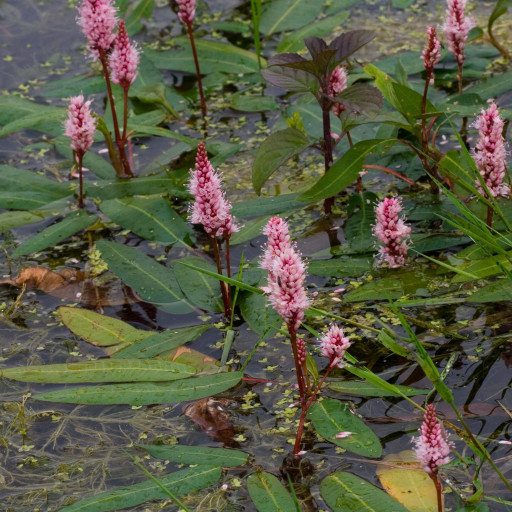
Plant Overview
Often called the Amphibious Bistort or Water Knotweed, this plant is nature’s ultimate shape-shifter. It is one of the few species capable of living two entirely different lives: one as a floating aquatic plant and the other as an upright land dweller. Found across the Northern Hemisphere, it bridges the gap between muddy banks and deep water with ease.
🔍 How to Identify
- 🌸 The Bloom: Look for dense, upright spikes of tiny, bubble-gum pink flowers. These cylindrical clusters resemble miniature bottle brushes and typically appear from mid-summer to early autumn.
- 🍃 Variable Leaves: This plant changes its "outfit" based on its home. In water, the leaves are smooth, waxy, and float flat on the surface. On land, the leaves become narrower, more pointed, and develop fine, velvety hairs.
- 🎋 "Knotty" Stems: As a member of the buckwheat family, its stems feature distinct, swollen joints (nodes) wrapped in a thin, papery sheath known as an ocrea.
🏡 In Your Garden
- 💧 The Ultimate Marginal: This is a top-tier choice for pond edges or "bog gardens." It thrives where other plants drown, using its long rhizomes to anchor itself in saturated mud or creep out into open water.
- 🚧 Growth Control: Because it spreads via vigorous underground (or underwater) runners, it can be quite assertive. If you have a small garden pond, it is best to plant it in a submerged container to prevent it from staging a takeover of the entire water feature.
⚠️ Safety & Toxicity
- ✅ Low Risk: Persicaria amphibia is generally considered non-toxic to humans and common household pets.
- 👅 Oxalates: Like many of its relatives (such as Rhubarb), the plant contains small amounts of oxalic acid. While not dangerous in passing, it should not be consumed in large quantities by pets or livestock, as it can interfere with calcium absorption.
✨ Fun Fact
The "amphibious" nature of this plant is so convincing that early botanists were frequently fooled. For years, the land-growing version and the water-floating version were classified as two completely different species until researchers realized they were looking at the exact same plant simply reacting to its environment!

Detailed Care Instructions
To grow Persicaria Amphibia, also known as water smartweed, follow these steps:
- Choose a suitable location: Persicaria Amphibia is an aquatic plant, so it needs to be grown in a water garden or submerged in a container filled with water. Ensure that the location receives full to partial sun.
- Prepare the planting container: Use a wide and shallow container or a pond for planting. Fill it with aquatic soil or a mix of clay, loam, and sand.
- Obtain the plant: Purchase Persicaria Amphibia plants from a local nursery or plant seeds, if available. It is easier to establish the plant with transplants.
- Planting: If using transplants, gently remove the plants from their containers and place them in the prepared planting container, ensuring the roots are fully submerged in water. If using seeds, scatter them over the soil and press them lightly.
- Watering: Keep the container filled with water at all times, maintaining a depth of around 2-6 inches. Ensure that the plant is always submerged, especially during hot weather when water levels can evaporate quickly.
- Maintenance: Persicaria Amphibia is relatively low-maintenance. Regularly check the water levels and refill if necessary. Remove any dead or yellowing leaves to maintain plant health. Also, be aware of invasive growth and remove any excess plants to prevent overcrowding.
- Fertilization: Fertilizing is typically not necessary for Persicaria Amphibia. However, if you notice poor growth or pale leaves, consider using a slow-release aquatic fertilizer according to the package instructions.
- Overwintering: In colder regions, Persicaria Amphibia may die back during winter. If you want to keep the plants growing, move them to a frost-free location, or bring them indoors in a container and provide sufficient lighting.
Remember to research and understand any regulations regarding the introduction of invasive species or potential harm to local ecosystems before growing Persicaria Amphibia.

Place in a bright room that is sun drenched almost all day. Or directly in a south-facing window.

This particular plant thrives in wetland environments, so it requires a significant amount of moisture to thrive. It is important to keep the soil around the plant consistently moist but not waterlogged. When watering, make sure to water deeply so the water reaches the roots. It is important to avoid getting water on the leaves and the stem, as this can lead to fungal diseases. To ensure proper drainage, the plant should be planted in soil that is rich in organic matter and has good drainage. Additionally, this plant can be sensitive to chemical fertilizers, so it is recommended to use organic fertilizers instead.
To fertilize this plant, first ensure that the soil is moist. Then, using a balanced, slow-release fertilizer, apply a small amount to the soil around the base of the plant. Be careful not to apply too much fertilizer, as this can burn the plant roots. Finally, water lightly and monitor the plant's growth to ensure it is receiving enough nutrients.
The ideal soil for the Persicaria Amphibia plant should be moist and well-draining. It should be loamy in texture and rich in organic matter. The pH of the soil should be neutral to slightly acidic. The plant prefers to grow in soil that is clay-rich and has a good amount of essential nutrients, such as nitrogen, potassium, and phosphorus. Additionally, the soil must have excellent water retention capacity as the Persicaria Amphibia plant requires a lot of moisture to thrive. To ensure healthy growth of the plant, it is recommended to add compost or organic fertilizer to the soil periodically.
To propagate this aquatic plant, you will need to take stem cuttings. First, select a healthy stem from the parent plant that is at least 4 inches in length. Next, cut the stem just below a node, which is where the leaves emerge. Remove any leaves from the bottom half of the stem, leaving only a few at the top. Dip the bottom end of the stem in rooting hormone powder to promote root growth.
Prepare a small pot with nutrient-rich soil and make a hole in the center. Insert the stem cutting into the hole, being careful not to crush it. Gently press the soil around the cutting to help it stay upright. Water the cutting well and place it in a bright, warm location but out of direct sunlight.
Keep the soil moist, but not waterlogged, and within a few weeks, you should start to see new roots and foliage emerging from the stem cutting. Once the roots are well-established and the plant has grown significantly, you can transplant it to a larger pot or into an outdoor pond or water feature.








