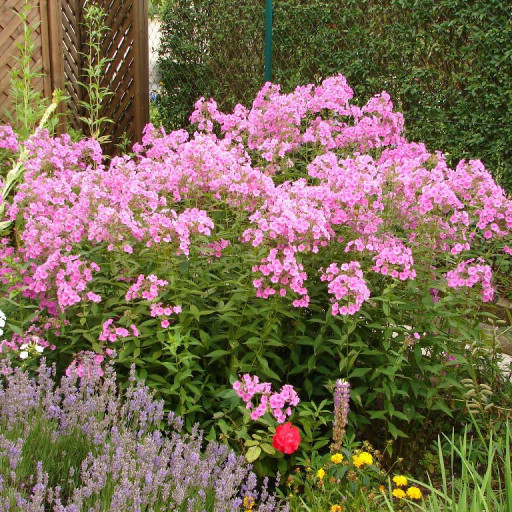
Plant Overview
Often called the "Summer Phlox" or the "Queen of the Border," Phlox paniculata is the backbone of the classic cottage garden. Known for its heavy, honey-sweet scent and towering stems topped with massive flower clusters, it brings a splash of vintage charm to any landscape. It has been a favorite of pollinators and gardeners alike for centuries, offering vibrant colors just as other summer blooms start to fade.
🔍 How to Identify
- 🌸 Floral Clusters: Large, cone-shaped groups (panicles) of five-petaled flowers that often feature a distinct "eye" of a different color in the center.
- 🍃 Leaf Structure: Pointed, lance-shaped leaves that grow opposite one another along stiff, perfectly upright stems.
- 📏 Stature: A tall, clumping perennial that typically reaches 2 to 4 feet in height, making it an ideal "back-of-the-border" plant.
🏡 In Your Garden
- 🌬️ Breathe Easy: This plant is famous for its susceptibility to powdery mildew; always leave plenty of space between plants to ensure air circulates freely around the foliage.
- 💧 Drink from the Base: To keep the leaves green and healthy, water at the soil level rather than overhead, as wet leaves are an open invitation for fungal spotting.
- ✂️ Deadheading Rewards: Removing faded flower heads doesn't just keep the plant looking tidy—it prevents the plant from dropping seeds (which often grow into less colorful "wild" versions) and can encourage a second flush of blooms.
⚠️ Safety & Toxicity
- ✅ Safe Status: Phlox paniculata is non-toxic to humans, cats, and dogs, making it a worry-free choice for family-friendly landscapes.
- 🦋 Pollinator Paradise: While safe for pets, it is "dangerously" attractive to butterflies and hummingbirds, who can't resist the deep, nectar-rich tubes of the flowers.
✨ Fun Fact
The name "Phlox" is derived from the Greek word for "flame," a reference to the intense, fiery colors of the original wild species found across North America.

Detailed Care Instructions
| Humidity | Normal |
| Lighting | Full Sun |
| Difficulty | Medium |
| Hibernation | Cold Period |
| Native Area | Native To Eastern North America |
| Temperature | 10°C - 25°C |
| Sun Exposure | Full To Partial Sun |
| Hardiness Zones | 3 To 8 |
To grow Phlox Paniculata plants, follow these steps:
- Choose a suitable location: Phlox Paniculata plants prefer full sun to partial shade. Ensure that the location has well-drained soil.
- Prepare the soil: Phlox Paniculata plants thrive in slightly acidic to neutral soil. Amend the soil with organic matter, such as compost, to improve fertility and drainage.
- Planting: Dig a hole that is slightly larger than the root ball of the plant. Place the plant in the hole, ensuring that the top of the root ball is level with or slightly above the soil surface. Backfill the hole and gently press the soil around the plant.
- Watering: Give the plant a thorough watering after planting to help settle the soil around the roots. Afterward, water regularly to keep the soil consistently moist but not waterlogged.
- Mulching: Apply a layer of organic mulch, such as wood chips or straw, around the base of the plant. This helps retain moisture and suppress weed growth.
- Fertilizing: Phlox Paniculata plants typically do not require frequent fertilization. However, you can apply a balanced, slow-release fertilizer in the spring to provide nutrients.
- Pruning: To encourage bushy growth and prolong blooming, pinch back the stems by around one-third in late spring or early summer. Also, deadhead spent flowers regularly to prevent the plant from setting seed.
- Pests and diseases: Monitor the plants for common pests like aphids or powdery mildew. If necessary, treat with insecticidal soap or a suitable fungicide according to the instructions.
- Division: Every two to three years, divide the plants in early spring or fall to control their size and improve vigor. Dig up the clump and separate it into smaller sections, replanting them at the desired spacing.
- Winter care: In colder regions, provide a layer of mulch around the base of the plants to protect the roots from freezing temperatures.

Place in a bright room that is sun drenched almost all day. Or directly in a south-facing window.

To properly water this plant, it is important to ensure that the soil is moist but not waterlogged. This can be achieved by watering deeply, but infrequently, allowing the soil to dry out slightly between waterings. It is also important to avoid getting water on the plant's leaves, as this can increase the risk of fungal diseases. It is recommended to water early in the morning or in the evening to prevent water evaporation during the day. Additionally, if the plant is in a pot, ensure that there are drainage holes to allow excess water to escape.
To fertilize this perennial plant, combine a high-nitrogen fertilizer with a slow-release fertilizer. Apply the mixture evenly around the base of the plant, making sure to avoid getting any on the leaves or stem. Water the plant thoroughly after fertilizing to help the nutrients soak into the soil. Repeat this process every 6-8 weeks throughout the growing season to encourage healthy growth and vibrant blooms.
The ideal soil to use for Phlox Paniculata plant is a well-draining, moist, and fertile soil. It should be slightly acidic with a pH range of 5.5 to 7.5. The soil should be rich in organic matter and have good aeration. A mixture of organic compost, peat moss, and sand or perlite can be added to improve soil structure and drainage. The soil should be kept consistently moist but not waterlogged to prevent root rot. Regular fertilization with a balanced fertilizer can also help promote healthy growth and flowering of the plant.
Phlox Paniculata plants can be propagated through division. The first step is to identify an established plant that has several stalks emerging from the base. After selecting the plant, dig around the edges of the root system with a garden fork or spade, being careful not to damage the roots. Once the plant has been loosened from the soil, gently lift it out of the ground and shake off any excess soil.
Inspect the plant and identify any areas where the stalks emerge from the root crown. Using a sharp knife or garden pruners, cut the stalks away from the root system, being sure to include a portion of the root crown with each new plant.
Once the new plants have been separated, replant them in a new location, being sure to provide adequate spacing and plenty of sunlight. Water the new plants thoroughly, and continue to monitor them for several weeks to ensure they are establishing properly. With proper care, your new Phlox Paniculata plants will thrive and provide beautiful blooms for years to come.
Common pests of the garden phlox include Spider mites, aphids, larvae. Make a habit of checking your garden phlox frequently for pests so that any infestations can be caught and managed early.








