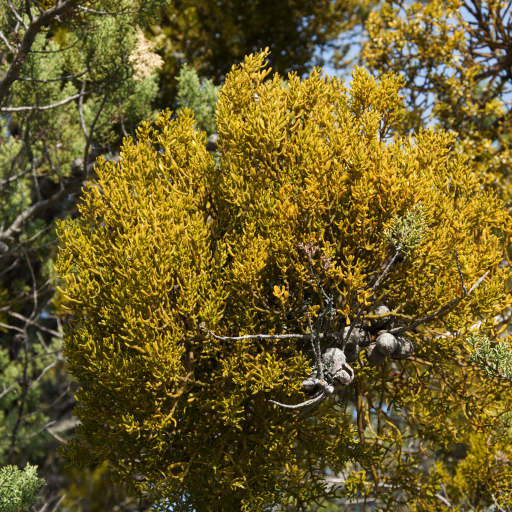
Plant Overview
Often called the Cypress Mistletoe, this resilient evergreen is a master of survival in the arid regions of the Southwestern United States and Mexico. Unlike the broad-leaved mistletoe associated with holiday traditions, this species is a rugged specialist that makes its home exclusively on evergreens. It is a "hemiparasite," meaning it creates its own energy through photosynthesis but "borrows" water and minerals from its host tree.
🔍 How to Identify
- 🍃 Small, Fleshy Leaves: The leaves are remarkably tiny, thick, and scale-like or oval, designed to retain moisture in dry climates.
- 🪵 Woody Bunches: It grows in dense, rounded clusters that can reach about 1 to 2 feet in diameter, appearing like a "witch’s broom" tucked into the host's branches.
- 🍒 Pearly Berries: During the cooler months, it produces small, translucent berries that are typically white or a soft, pearly pink.
🏡 In Your Garden
- 🌳 The Host Connection: You won’t find this plant in a nursery pot or garden bed. It is entirely dependent on its host—primarily Junipers and Cypresses. It uses specialized "sinker" roots called haustoria to penetrate the bark and tap into the tree's plumbing.
- 🕊️ Wildlife Support: While it can stress a tree during a drought, it is an ecological powerhouse. It is a primary food source for the Phainopepla (a sleek, black desert bird) and provides critical nesting sites for various woodland species.
⚠️ Safety & Toxicity
- 🚫 Toxic if Ingested: All parts of the Cypress Mistletoe, especially the berries, are considered toxic to humans and domestic animals.
- 🐾 Pet & Child Safety: Ingestion can lead to blurred vision, stomach cramps, and a slowed heart rate (bradycardia). Keep children and pets away from any fallen clumps or berries after a storm.
✨ Fun Fact
The name Phoradendron is derived from the Greek words phor, meaning "thief," and dendron, meaning "tree." It literally translates to "Tree Thief," a perfectly descriptive name for this botanical bandit!

Detailed Care Instructions

Some plants require more regular watering than others, which should be done every few days. It's critical to maintain the soil moist all of the time. The water requirements of the same plant placed in pots with varying sizes will differ. Because the water in the smaller pot evaporates faster than the water in the larger pot, it will require more watering. Regardless of pot size, the surface should constantly be maintained moist.








