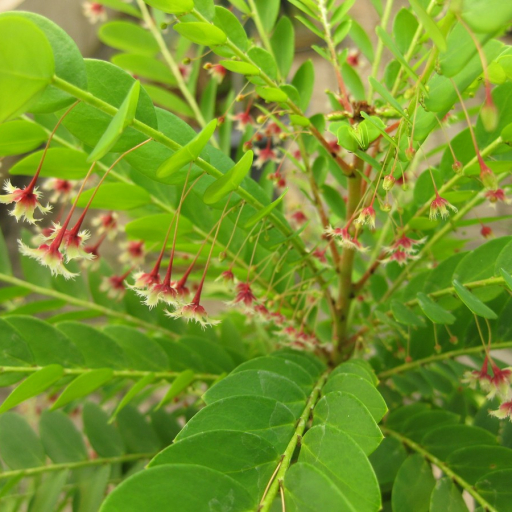
Plant Overview
Often called the Tropical Leaf-flower or Naga Buana, Phyllanthus pulcher is a botanical masterpiece of symmetry and precision. This Southeast Asian native is frequently mistaken for a delicate fern, but it is actually a hardy woody shrub with a flair for the dramatic. In traditional folklore, it is often treated with reverence, believed to hold protective qualities for the home.
🔍 How to Identify
- 🍃 The "Leaf-on-Leaf" Look: What look like individual leaflets are actually simple leaves arranged in two perfectly neat rows along thin branchlets, creating a feathery, fern-like appearance.
- 🎈 Under-Leaf Flowers: One of its most charming traits is that tiny, star-shaped, reddish-green flowers dangle from the undersides of the leaves on thin, thread-like stalks.
- 🪵 Distinctive Branching: The plant typically grows as a small, upright shrub with reddish or dark-tinted stems that contrast sharply against the bright green foliage.
🏡 In Your Garden
- 🌤️ Dappled Light Specialist: Unlike many tropical plants that crave direct sun, Phyllanthus pulcher is an understory plant. It prefers partial shade, making it a perfect candidate for spots under larger trees or bright indoor corners.
- 💧 Humidity Lover: It is highly sensitive to dry air. If you notice it dropping its branchlets (a process called cladoptosis), it is likely a sign that the environment is too dry or the plant is stressed by a sudden temperature change.
- 🌱 Rich, Airy Soil: It thrives in organic-rich soil that stays moist but never soggy. It has a sensitive root system that dislikes being moved once established, so choose its "forever home" carefully.
⚠️ Safety & Toxicity
- 🐾 Pet Sensitivity: While not listed as highly toxic like some lilies or ivies, the Phyllanthus family contains various tannins and phytochemicals. It is best kept out of reach of curious cats and dogs to avoid digestive upset.
- 👶 Sap Irritation: Like many members of the Euphorbiaceae family, the sap can occasionally cause mild skin irritation or "itchiness" in children or those with sensitive skin.
✨ Fun Fact
The name Phyllanthus literally translates to "Leaf-flower" from Greek. This is because the plant produces its flowers and even its fruit directly along the margins or undersides of its leaf-like branches, a fascinating botanical trait that makes it look like the leaves themselves are blooming!

Detailed Care Instructions
To grow Phyllanthus pulcher, also known as the princess flower or Malaysian orchid tree, follow these steps:
- Climate: Phyllanthus pulcher thrives in tropical and subtropical climates. Make sure the plant will receive adequate sunlight, preferably in a location that receives full sun to partial shade.
- Soil: This plant prefers well-draining soil. Sandy or loamy soil with good organic matter content is ideal. Ensure the pH level of the soil is slightly acidic to neutral (around 6.0-7.0).
- Watering: Although Phyllanthus pulcher is a drought-tolerant plant, it appreciates regular watering during the active growing season. Water the plant deeply, allowing the soil to dry out slightly between watering sessions. Overwatering can lead to root rot, so be cautious not to water excessively.
- Fertilizer: Apply a balanced, slow-release fertilizer during the growing season (spring to fall) to promote healthy growth and blooming. Follow the instructions on the fertilizer packaging for proper dosage.
- Pruning: Regular pruning helps maintain a compact and bushy shape for Phyllanthus pulcher. Prune off any dead or diseased branches and shape the plant as desired after the blooming period.
- Propagation: Phyllanthus pulcher can be propagated through seeds or stem cuttings. Seeds require stratification (cold treatment) before sowing. Stem cuttings should be taken from a healthy parent plant and placed in a well-draining rooting medium.
- Pests and Diseases: Monitor the plant for any signs of pests such as aphids, mealybugs, or spider mites. Treat infestations with appropriate insecticides or soapy water. Phyllanthus pulcher is generally disease-resistant, but watch out for root rot if overwatered.
- Support: As the plant grows, provide support with stakes or trellises if necessary to prevent sprawling.
Remember to check for any specific growing requirements for Phyllanthus pulcher in your particular region, as environmental factors may vary.
To properly water this plant, it is important to understand its watering needs. The plant prefers to be kept consistently moist but not waterlogged. Checking the top inch of soil regularly is a good way to determine when to water.
When watering, it is important to give the plant a thorough drink, allowing water to soak through the soil and drain out of the bottom of the pot. It is important not to let the plant sit in standing water as this can lead to root rot.
The frequency of watering will depend on environmental factors such as temperature, humidity, and light levels. During the warmer months, the plant may require more frequent watering than during the cooler months.
It is also important to adjust the watering schedule based on the specific container the plant is growing in. Plants grown in terracotta pots will dry out faster than those grown in plastic pots.
Overall, consistency is key when watering this plant. It is important to avoid letting the soil dry out completely between watering while also avoiding overwatering.
To fertilize this plant, apply a balanced fertilizer once a month during the growing season (spring and summer). Use a water-soluble fertilizer mixed at half strength. Be sure to saturate the soil well with water before and after fertilizing. Avoid over-fertilizing, as this can lead to excess growth and weaker stems.
Phyllanthus Pulcher plant prefers a rich, well-draining soil that is slightly acidic with a pH range of 6.0 to 6.5. A mixture of sandy loam, peat moss, and perlite could be suitable to provide the plant with the necessary moisture retention, aeration, and nutrient availability. It's also important to avoid overwatering the plant as it can cause root rot and other fungal diseases. Therefore, it is recommended to use a soil mix that provides good drainage and allows excess water to drain out easily. Additionally, adding some organic matter like compost or aged manure to the soil can enhance its fertility and support a healthy growth of the plant.
To propagate this plant, you will need to take stem cuttings from an existing healthy plant. Make sure the cutting is at least 6 inches long and has several leaves on it. Remove the bottom leaves and dip the cut end of the stem in rooting hormone. Then, plant the cutting in a well-draining soil mix and keep it moist. Cover the pot with a plastic bag to create a humid environment and place it in indirect sunlight. After a few weeks, roots should start to form and new growth should appear. Once the plant has established a strong root system, it can be moved to a larger pot or planted in the ground.








