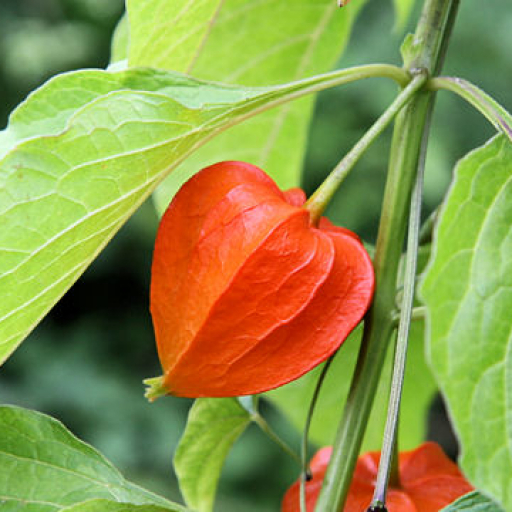
Plant Overview
Commonly known as the Chinese Lantern or Winter Cherry, this plant is a showstopper in the autumn garden. Famous for its papery, neon-orange husks that resemble miniature glowing lamps, it has been cultivated for centuries across Asia and Europe. In Japan, its seeds are used as part of the Obon festival to help guide the spirits of the deceased back home.
🔍 How to Identify
- 🏮 The Lanterns: The most striking feature is the inflated, heart-shaped calyx that protects the fruit. It starts green and transforms into a brilliant, fiery orange-red in late summer.
- 🍃 Foliage: The leaves are mid-green, heart-shaped, and slightly fuzzy, growing on upright stems that can reach about 2 feet in height.
- 🌼 Flowers: Before the lanterns appear, the plant produces small, unassuming creamy-white flowers that are often tucked away under the broad leaves.
🏡 In Your Garden
- 🏃 A Persistent Runner: This plant spreads via underground rhizomes (runners). While beautiful, it can be invasive in small garden beds. Many hobbyists prefer growing it in sunken containers to prevent it from "taking over" the entire yard.
- ✂️ Floral Decor: It is a favorite for dried arrangements. If you cut the stems when the lanterns are fully orange and hang them upside down in a dark place, they will retain their vibrant color and papery texture for months.
⚠️ Safety & Toxicity
- 🚫 Nightshade Warning: Like its cousins the tomato and potato, this plant is a member of the Solanaceae family. All green parts of the plant and the unripe berries are toxic.
- 🐾 Pets & Children: Ingestion of the leaves or green fruit can cause stomach upset, vomiting, and labored breathing in cats, dogs, and humans. While the fully ripe red berry inside the husk is technically edible, it is often quite bitter and generally not recommended for consumption without expert knowledge.
✨ Fun Fact
As the winter progresses, the orange "skin" of the lantern can weather away, leaving behind a delicate, lace-like skeleton of veins that perfectly preserves the shape of the lantern with the berry still visible inside. This is often called a "Skeleton Lantern."

Detailed Care Instructions
No, it contains solanine, a toxic glycoalkaloid that causes poisoning in humans and animals even when consumed in small amounts and may be fatal. Unlike tomatillos, the paper husks of the Chinese lantern turn bright orange when the berries mature which helps to identify the plant.
Do Chinese lantern plants come back every year?
As a perennial, it comes back every year, however, that is not always a welcome occurrence because Chinese lantern easily becomes invasive.
Is Chinese lantern a vine?
With a mature height of only two feet, it is not a vine, and it does not require any support.
| Humidity | Normal |
| Lighting | Full Sun |
| Toxicity | Poisonous |
| Difficulty | Medium |
| Hibernation | Cold Period |
| Temperature | 14°C - 21°C |
| Hardiness Zones | 6 - 9 |
To grow Physalis Alkekengi, also known as Chinese lantern or winter cherry, follow these steps:
- Select a suitable location: Choose a sunny spot in your garden or a container with well-draining soil. Physalis Alkekengi prefers full sun but can tolerate partial shade.
- Planting seeds: Sow the seeds in early spring, indoors 6-8 weeks before the last frost date or directly in the garden after the danger of frost has passed. If starting indoors, use seed-starting mix and keep the soil moist until germination occurs (typically within 2-3 weeks).
- Transplanting: Once the seedlings have developed a few sets of true leaves, transplant them into larger containers or into the garden, spacing them 2-3 feet apart. Make sure to harden off the seedlings by gradually exposing them to outdoor conditions before transplanting.
- Soil and watering: Physalis Alkekengi prefers well-draining, fertile soil. Keep the soil consistently moist but not waterlogged. Water regularly during dry periods but avoid over-watering, as it may cause root rot.
- Mulching: Apply a layer of organic mulch around the plants to help retain moisture and suppress weed growth.
- Support: Place stakes or a trellis near the plant to provide support as they grow, as Physalis Alkekengi can reach a height of around 2-3 feet.
- Pruning and training: Physalis Alkekengi can spread vigorously, so occasional pruning may be necessary to control its growth. You can also train the plant to spread in a desired direction by carefully tying the stems to the support structure.
- Fertilizing: Use a balanced, slow-release fertilizer or organic compost during the growing season to promote healthy growth and flower production.
- Pests and diseases: Physalis Alkekengi is typically resistant to most pests and diseases. However, watch out for aphids, slugs, and snails. Regularly inspect the plant and treat as needed with organic pest controls.
- Harvesting: Physalis Alkekengi produces decorative, lantern-like orange-red fruits that are edible but not very flavorful. The fruits are typically harvested in late summer or early fall once they have turned papery and dried on the plant. Use the dried fruits for decorative purposes or in floral arrangements.
By following these steps and providing the appropriate care, you can successfully grow Physalis Alkekengi plants in your garden or containers.

Place in a bright room that is sun drenched almost all day. Or directly in a south-facing window.

The first step to watering this plant is to ensure that it has been placed in a well-draining soil that is able to absorb water quickly. In order to prevent overwatering, it is important to only water when the soil is dry to the touch. To do this, place your finger about an inch below the soil surface and check if it is dry or moist.
When watering, it is best to use a watering can or a hose with a gentle flow to avoid washing away soil and damaging the plant's roots. Water at the base of the plant rather than on the foliage to prevent the development of fungal diseases.
As the plant grows and matures, it may require more frequent watering in hotter and drier weather. However, it is important to avoid overwatering, as wet soil can encourage root rot and other fungal diseases. A general rule of thumb is to water deeply once or twice a week, depending on the environmental conditions.
In addition to providing sufficient water, it is also important to ensure that the plant is receiving enough sunlight, nutrients and appropriate pruning to maintain its overall health and vigor.
To fertilize this plant, apply a slow-release granular fertilizer that is high in phosphorus and potassium in early spring before new growth begins. Alternatively, a weekly application of liquid fertilizer diluted to half-strength can be applied during the growing season. Be sure to water the plant well before and after fertilizing.
Physalis Alkekengi plant grows best in well-draining soil that is rich in nutrients and organic matter. The ideal soil pH range is between 6.0 and 7.5. It is important to avoid using heavy or compacted soils, as they can impede the plant's root growth and development. To enhance the soil quality, it is recommended to mix in compost or well-rotted manure. Additionally, it is important to ensure that the soil has good aeration and moisture retention to facilitate healthy plant growth. The soil should also be free of any weed seeds or pathogens that can cause damage to the plant.
Physalis Alkekengi is a plant that can be propagated through various methods such as seed germination, stem or root cutting, and plant division.
Seed germination is the simplest way of propagating this plant. The seeds can be collected from mature fruits and sown in nursery pots filled with well-draining soil. The seeds should be covered with a thin layer of soil and kept moist by regular watering. Germination usually takes about 2 to 3 weeks, after which the seedlings can be transplanted into individual pots.
Stem cutting is another viable way to propagate this plant. The stem cuttings should be taken from healthy, disease-free plants, preferably in the spring or early summer. The cuttings should be about 10cm long with 2 to 3 nodes and planted in well-draining soil. The soil should be kept moist, and the cutting should be placed in a shaded area until they root. Once the cutting shows signs of new growth, it can be transplanted into the ground.
Root cutting is a slightly more complicated way to propagate. The roots should be cut into small sections, each with a node or two, and planted in soil. The soil should be kept moist, and the cuttings should be placed in a shaded area until they root. Once the cutting shows signs of new growth, it can be transplanted into the ground.
Plant division is also a practical way of propagating Physalis Alkekengi. The plant should be dug up, and the root system should be divided into small sections with a sharp knife. Each section should have some roots and foliage. The division should be planted in well-draining soil, kept moist, and placed in a shaded area until they start to grow.
Common pests of the japanese-lantern include Aphids. Make a habit of checking your japanese-lantern frequently for pests so that any infestations can be caught and managed early.








