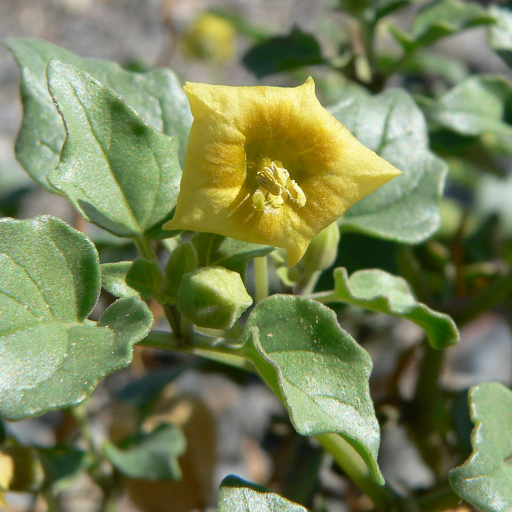
Plant Overview
Known by the whimsical name Yellow Nightshade Groundcherry, this desert native is a master of disguise. Often found tucked away in the rocky washes and sandy canyons of the Mojave and Sonoran deserts, it protects its precious fruit inside a delicate, paper-thin "lantern." It is a resilient survivor that brings a splash of gold and unique geometry to arid landscapes.
🔍 How to Identify
- 🔔 The Lantern: The most striking feature is the inflated, bladder-like calyx (the outer shell) that turns papery and veiny as it matures, completely enclosing the berry like a miniature pendant.
- 🍃 Thick Foliage: True to its scientific name (crassifolia means "thick-leaf"), the leaves are fleshy, somewhat heart-shaped, and often covered in fine, sticky hairs that help the plant retain moisture.
- 🌼 Bell Flowers: Look for small, nodding, bell-shaped flowers that are pale yellow. They often feature five dark smudges or "nectar guides" at the center to direct bees.
🏡 In Your Garden
- 🏜️ Desert Resilience: This plant thrives on "tough love." Because it originates from harsh, rocky slopes, it requires exceptionally sharp drainage. In a garden setting, it is best suited for rock gardens or xeric landscaping where water is sparse.
- ☀️ Heat Shield: The thick, succulent-like leaves aren't just for show—they are a survival mechanism. They allow the plant to store water and endure intense Southwestern heat that would cause most traditional garden plants to scorch and wither.
⚠️ Safety & Toxicity
- 🚫 Nightshade Family: As a member of the Solanaceae family, this plant should be handled with caution. While the ripe fruit of some Physalis species is edible, many wild groundcherries can be bitter or toxic.
- 🐾 Pet & Child Risk: The foliage and unripe green berries contain solanine, a toxic alkaloid. Ingestion can cause stomach pain, vomiting, and lethargy in pets and humans. It is best treated as an ornamental plant rather than a food source.
✨ Fun Fact
The papery "lantern" isn't just for decoration; it acts as a tiny greenhouse! It creates a microclimate around the developing fruit, keeping it slightly warmer during cold desert nights and providing a physical barrier against hungry insects.

Detailed Care Instructions
To grow Physalis Crassifolia, also known as Ground Cherry or Tomatillo, follow these steps:
- Climate: Physalis Crassifolia thrives in warm climates with full sun exposure. Ensure the temperature remains above 50°F (10°C) throughout the growing season.
- Soil preparation: The plant prefers well-draining soil with a slightly acidic pH level (around 6.0-7.0). Amend the soil with well-rotted organic matter, such as compost, to promote fertility and moisture retention.
- Sowing seeds: Start by germinating the seeds indoors, around 6-8 weeks before the last expected frost date. Sow the seeds in small pots or seed trays, lightly covering them with a shallow layer of soil. Keep the soil consistently moist.
- Transplanting: Once the seedlings have developed at least two sets of true leaves and the threat of frost has passed, transplant them into larger pots or directly into the garden. Space the plants around 2-3 feet (60-90 cm) apart to allow sufficient room for growth.
- Watering: Physalis Crassifolia appreciates regular watering to keep the soil evenly moist. Be cautious not to water excessively, as the plant may be susceptible to root rot.
- Mulching: Apply mulch around the base of the plant to help conserve moisture, suppress weeds, and maintain an even temperature in the soil.
- Supporting the plant: As the Physalis Crassifolia grows, it may benefit from support. Consider placing stakes or cages around the plants to provide stability as they become taller.
- Pruning: Prune any weak or damaged branches and remove excessive foliage to ensure adequate air circulation. This helps prevent disease and promotes healthy growth.
- Fertilization: Apply a balanced organic fertilizer once or twice during the growing season to provide essential nutrients. Follow the product instructions for dosage and frequency.
- Harvesting: Physalis Crassifolia will produce small lantern-like husks that turn from green to brown when ripe. Harvest them when the husks are dry and papery, and the fruit inside is golden yellow. You can store the harvested fruits in a cool, dry place for a few weeks.
With proper care and cultivation, your Physalis Crassifolia plant should grow well, producing an abundance of delicious fruit.

Place in a bright room that is sun drenched almost all day. Or directly in a south-facing window.

To properly water this plant, you must first check the soil moisture levels around the roots. This can be done by inserting a finger or testing device into the soil to see if it feels dry. If the soil is dry, water the plant generously until the soil is evenly moist. However, it is important not to overwater this plant, as it can lead to root rot. Make sure that the excess water is able to drain out of the pot or soil to prevent waterlogging. As the plant grows, adjust the watering frequency and amount as needed based on its specific needs and environmental conditions such as temperature and humidity.
To fertilize this plant, apply a balanced fertilizer with equal parts nitrogen, phosphorus, and potassium every four to six weeks during the growing season. Apply the fertilizer evenly around the base of the plant, being careful not to apply too much directly onto the plant's stem. Water the plant thoroughly after fertilizing to help distribute the nutrients throughout the soil. Avoid fertilizing during the plant's dormant season.
The optimal soil for this particular plant should be nutrient-rich and well-draining. The soil pH should be slightly acidic to neutral, with a range between 6.0 and 7.0. It is important to avoid heavy or compacted soil, as this can limit the plant's root growth and oxygen intake. A mixture of peat moss, compost, and sand can help to create an ideal soil composition for this plant. Additionally, adding organic matter such as leaf mold or aged manure to the soil can provide important nutrients for growth and help to maintain moisture levels.
To propagate this plant, you will need to collect ripe fruit and extract the small seeds inside. These seeds can be sown directly into seed trays or pots filled with well-draining, moist soil. The trays or pots should be placed in a warm, bright location, and watered regularly to keep the soil moist.
Once the seedlings have grown to a size where they can be easily handled, they can be transplanted into larger pots or directly into the garden. It is important to ensure that the soil is well-draining and that the new plants receive adequate water and sunlight.
Alternatively, cuttings can be taken from mature plants and rooted in water or moist soil. This is best done in the spring or summer when the plant is actively growing. The cuttings should be taken from healthy, disease-free stems and placed in a rooting hormone solution for several hours before being planted.
Overall, propagating this plant is relatively easy and can be accomplished through either seed or cutting propagation methods.








