Plant Overview
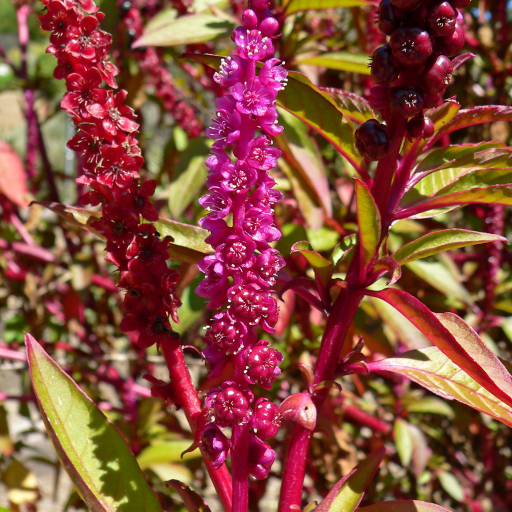
Known as the Mexican Pokeweed, Phytolacca icosandra is a bold, architectural plant that commands attention with its vibrant magenta stems and clusters of deep, ink-black berries. While it looks like it belongs in a high-end tropical botanical garden, it often appears as a surprise guest in warm-climate landscapes, spreading its seeds far and wide with the help of local birds.
🔍 How to Identify
- 🎨 Neon Stems: The stalks are succulent and transition from a bright lime green to a brilliant, neon pink or deep burgundy as the plant matures.
- 🍇 Jewel-Like Berries: Small, flattened globes grow in dense, upright spikes; they turn from a hard green to a dark, glossy purple-black when ripe.
- 🍃 Broad Foliage: The leaves are large, smooth, and lance-shaped, providing a lush, leafy backdrop that can make the plant look like a substantial shrub.
🏡 In Your Garden
- 🌱 Stubborn Roots: This plant develops a massive, fleshy taproot very quickly. If you decide you don't want it in a specific spot, you must dig it up early; otherwise, it becomes nearly impossible to "pull" by hand.
- 🦜 Bird Buffet: While the plant is often considered a weed by gardeners, it serves as a vital food source for birds, who are immune to the toxins that affect mammals.
- ☀️ Opportunistic Grower: It thrives in disturbed soil and full sun, often "volunteering" in garden beds where the soil has been recently turned or enriched.
⚠️ Safety & Toxicity
- 🚫 High Toxicity: All parts of the Mexican Pokeweed—including the roots, leaves, and berries—are toxic to humans and most domestic animals.
- 🐾 Pet & Child Risk: The berries are particularly dangerous because they look like edible grapes or blackberries. Ingestion can lead to severe stomach pain, vomiting, and more serious systemic issues.
- 🧤 Skin Sensitivity: Some individuals may experience skin irritation (dermatitis) just by handling the crushed leaves or stems, so wearing gloves is recommended during pruning.
✨ Fun Fact
🖋 The Ink Plant: The dark juice from the berries is so pigment-rich that it was historically used as a natural dye for fabrics and as a primitive ink. It is said that many letters written during the American Civil War were penned using the dark purple "blood" of its cousin, the common pokeweed!

Detailed Care Instructions
Growing Phytolacca icosandra, or red ink plant, can be done using the following steps:
- Choose a suitable location: Phytolacca icosandra prefers full sun exposure but can tolerate partial shade. Ensure the location provides well-drained soil.
- Prepare the soil: Before planting, improve the soil by adding organic matter such as compost. This will enhance drainage and nutrient content.
- Sow the seeds: Phytolacca icosandra can be grown from seeds. Sow the seeds directly into the soil at a depth of around ¼ inch (6 mm). Space each seed about 8 to 12 inches apart.
- Water regularly: Keep the soil evenly moist. Water the plants regularly to prevent drying out. However, avoid overwatering to prevent root rot.
- Mulch the area: After planting, apply a layer of organic mulch around the base of the plants. This will help retain moisture and suppress weed growth.
- Provide support: As the plant grows, it may require support due to its height. Install stakes or other support structures to prevent bending or breaking.
- Fertilize periodically: Phytolacca icosandra benefits from regular fertilization. Apply a balanced fertilizer every four to six weeks during the growing season.
- Control pests and diseases: Monitor the plants regularly for signs of pests or diseases. Common issues include aphids, powdery mildew, and leaf spot. Treat any issues promptly using organic pest control methods or appropriate fungicides.
- Harvest and prune: In late summer or early fall, the plant produces clusters of dark purple berries. Harvest the berries if desired, or leave them for birds to feed on. Prune the plant in early spring to remove dead or damaged portions.
- Winter care: Phytolacca icosandra is generally hardy in zones 5-9. In colder areas, provide winter protection by applying a layer of mulch around the base of the plant. This will help insulate the roots during freezing temperatures.
By following these steps, you should be able to successfully grow Phytolacca icosandra.

Place in a bright room that is sun drenched almost all day. Or directly in a south-facing window.

To water this plant, it is important to ensure that the soil is thoroughly moistened but not waterlogged. It is recommended to water deeply, allowing the water to penetrate the soil and reach the roots. The frequency of watering will depend on several factors such as the temperature, humidity, and amount of sunlight the plant receives. It is important to monitor the soil moisture level regularly and adjust the watering schedule accordingly. Overwatering can lead to root rot and other issues, so it is important to use well-draining soil and avoid leaving water sitting in the saucer or pot for extended periods of time.
The plant should be fertilized with a balanced fertilizer once a month during the growing season. Use a slow-release granular fertilizer or a liquid fertilizer diluted to half strength. Be sure to water the plant well before and after fertilizing to avoid burning the roots. Avoid fertilizing during the winter months when the plant is dormant.
When growing Phytolacca Icosandra plant, it is important to use soil that is nutrient-rich and well-draining. The ideal soil pH range for this plant is between 6.0 and 7.5. The soil should be loose and well-aerated to allow for healthy root development. Organic matter such as compost or well-rotted manure can be mixed into the soil to improve its structure and fertility. When planting, make sure that the soil is moist but not waterlogged, and avoid compacting the soil around the plant roots. It is also important to ensure that the soil does not dry out completely between watering.
Phytolacca Icosandra is a perennial plant species that belongs to the Phytolaccaceae family. It is predominantly propagated through the process of seed germination. The following are steps that can be followed to propagate Phytolacca Icosandra:
- Collecting the seeds: Ensure that mature seeds are collected from fully grown plants or from the market.
- Preparing the seed bed: The soil quality in the seed bed should be optimum to ensure a conducive environment for germination to take place. The soil should be loose, well-drained, and adequately fertilized.
- Sowing the seed: The seeds should be sowed at least an inch deep in the soil bed and adequately spaced apart to enhance growth.
- Watering: Regular watering of the seeds is necessary to ensure adequate moisture retention in the soil bed. However, avoid over-watering as this could lead to rotting of the seeds.
- Providing adequate sunlight: Phytolacca Icosandra plant species require an average of 4-5 hours of direct sunlight daily. This should be factored in when positioning the seed bed.
- Transplanting: When sprouting starts, the seedlings can be transplanted to their final locations or bigger pots to enhance steady growth in fertile soil.
By following the above-outlined steps, one can propagate Phytolacca Icosandra successfully.








