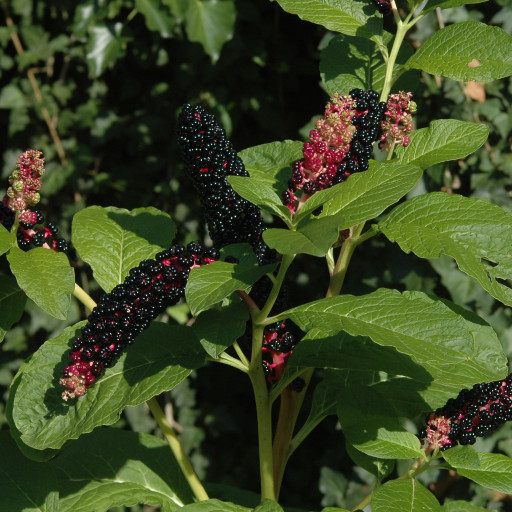
Plant Overview
Often called Pokeweed, Inkberry, or American Nightshade, Phytolacca is a striking giant of the botanical world that commands attention with its vivid, neon-colored stems. While it often appears uninvited in gardens like a weed, it has a deep history in American folklore, used for everything from "Poke Salad" to Civil War-era writing ink. Despite its beauty, it is a plant that demands respect and caution due to its potent chemistry.
🔍 How to Identify
- 🌿 The Stems: Smooth, hollow, and exceptionally thick, turning a brilliant, almost fluorescent magenta or reddish-purple as the plant matures.
- 🍇 The Fruit: Long, drooping clusters of berries that transition from green to a glossy, deep purple-black, resembling miniature bunches of grapes.
- 🍃 The Leaves: Large, lance-shaped green leaves with a smooth texture that can grow up to a foot long, arranged alternately along the stalk.
🏡 In Your Garden
- 🌱 Growth Habit: This is a "pioneer species" that thrives in disturbed soil. It grows with incredible speed, often reaching 8 to 10 feet in a single season, giving it the appearance of a small, herbaceous tree.
- 🧤 The Taproot: If you wish to remove it, do so early. Phytolacca develops a massive, fleshy white taproot that can grow several feet deep, making it extremely difficult to extract once it is established.
- 🐦 Wildlife Value: While it may be a nuisance to gardeners, it is a five-star restaurant for birds. Bluebirds, Cardinals, and Cedar Waxwings crave the berries and are responsible for "planting" the seeds across your landscape.
⚠️ Safety & Toxicity
- 🚫 Status: Highly Toxic. All parts of the Phytolacca plant are poisonous to humans and most mammals, especially the roots and mature berries.
- 🐾 Risk Level: Ingestion can lead to severe gastrointestinal distress, rapid heartbeat, and respiratory issues. Keep children away from the tempting "grape-like" berries. Always wear gloves when handling the plant, as the sap can cause skin irritation (dermatitis) in sensitive individuals.
✨ Fun Fact
🖋️ The Soldier’s Pen: During the American Civil War, the dark, staining juice of the berries was frequently used as a substitute for ink. Many letters sent home by soldiers were written using "Pokeberry ink," which is why the plant is still sometimes called Inkberry today!

Detailed Care Instructions
To grow a Phytolacca plant, also known as pokeweed or inkberry, you can follow these steps:
- Choose a suitable location: Phytolacca plants prefer full sun but can tolerate partial shade. Select a spot in your garden or patio that receives at least 6 hours of direct sunlight per day.
- Prepare the soil: Phytolacca plants grow well in fertile, well-draining soil. Improve the soil quality by incorporating organic matter like compost or well-rotted manure before planting. Ensure the soil pH is slightly acidic to neutral (pH 6.0-7.0).
- Start with seeds: Phytolacca plants are typically grown from seeds. Start seeds indoors in late winter or early spring, about 8-10 weeks before the last frost date in your area. Sow the seeds in a seed-starting mix, covering them lightly with soil. Keep the soil consistently moist and maintain a temperature of around 70°F (21°C) until germination, which usually takes 2-3 weeks.
- Transplanting: Once the seedlings have developed a few sets of true leaves, they can be transplanted outdoors. Wait until all danger of frost has passed and the soil has warmed up. Space the plants about 2-3 feet apart, as Phytolacca plants can grow up to 10 feet tall and spread out.
- Watering and maintenance: Phytolacca plants require regular watering, especially during dry periods. Keep the soil evenly moist but not waterlogged. Water at the base of the plant to avoid wetting the leaves, which can lead to fungal diseases. Mulching around the plants can help retain moisture and suppress weed growth.
- Fertilization: Apply a balanced, slow-release fertilizer in early spring to provide essential nutrients to the plant. Follow the manufacturer's instructions for application rates.
- Pruning and staking: Phytolacca plants can grow quite tall and may need staking for support. Stake the main stem or provide a trellis to prevent it from falling over. Prune the plants in late winter or early spring to remove dead or damaged branches and promote new growth.
- Watch out for pests and diseases: Phytolacca plants are generally not heavily affected by pests or diseases. However, occasionally, they can be attacked by aphids, spider mites, or powdery mildew. Monitor your plants regularly and take appropriate measures, such as spraying insecticidal soap or using organic fungicides if necessary.
Remember to exercise caution while handling Phytolacca plants, as they contain toxic compounds. Avoid ingesting any part of the plant, especially the berries, as they can cause harmful effects if consumed.

To properly water the Phytolacca plant, it is advisable to follow these guidelines:
1. Assess the moisture level in the soil: Before watering, check the soil's moisture by inserting your finger about an inch deep into the soil. If the soil feels dry at this depth, it's an indication that watering is needed.
2. Choose the right watering method: To avoid overwatering, which can lead to root rot, always water from the base of the plant rather than overhead. Using a watering can or a slow-release irrigation system works best.
3. Water deeply: When watering, make sure to thoroughly moisten the soil around the plant's roots. Slowly pour water at the base of the plant until it begins to seep out from the bottom drainage holes. This helps ensure that the roots receive adequate moisture.
4. Allow proper drainage: Once the soil has been thoroughly watered, it's crucial to allow any excess water to drain away. Empty the tray or saucer beneath the plant to prevent water from sitting, which can also lead to root rot.
5. Observe watering frequency: The frequency of watering will vary depending on factors such as temperature, humidity, and soil type. As a general rule, it is better to water less frequently but deeply, allowing the soil to partially dry out between waterings.
6. Consider environmental conditions: Be mindful of the environment in which the plant is located. If it is exposed to direct sunlight or placed near a heater or vent, it may require more frequent watering due to increased evaporation.
7. Use room temperature water: To prevent shocking the plant's roots, it's best to use room temperature water. Cold water straight from the tap can be detrimental to the plant's overall health.
Remember, these instructions are general guidelines and may vary depending on the specific variety and growing conditions of the Phytolacca plant. It is always advisable to monitor the plant closely for signs of underwatering or overwatering and adjust the watering routine accordingly.
To fertilize the Phytolacca plant, use a balanced and water-soluble fertilizer with a 10-10-10 or 20-20-20 NPK ratio. Dilute the fertilizer according to the package instructions. Apply the diluted fertilizer to the soil around the base of the plant, avoiding direct contact with the leaves or stems. Water the plant after fertilizing to ensure proper absorption. Repeat the fertilization process once every 3-4 weeks during the growing season, typically spring through fall. Adjust the frequency and amount of fertilizer based on the plant's response and growth. Remember to always follow the instructions provided by the fertilizer manufacturer.
The ideal soil for the Phytolacca plant should be well-draining and have an average amount of nutrients. It should have a pH of around 6.0-7.0. The soil should be loose and airy to allow for easy root growth and penetration. A good mix for the soil would be a combination of sand and loam, with the addition of organic matter such as compost or peat moss to improve soil structure. It is important to avoid using heavy clay soils as they retain too much moisture and can cause root rot. The plant also prefers a sunny location with ample water and good air circulation.
Phytolacca plants can be propagated through various methods such as seed propagation, division, and stem cuttings. Here are the details on how to propagate Phytolacca plants:
- Seed Propagation:
- Collect mature seeds from the Phytolacca plant when they have turned fully black or dark purple.
- Soak the seeds in water for about 24 hours before planting.
- Fill a nursery tray or seedling pots with a well-draining soil mix.
- Press the seeds gently into the soil, ensuring they are covered lightly with a thin layer of soil.
- Place the tray or pots in a warm location with indirect sunlight.
- Keep the soil evenly moist but not waterlogged.
- It usually takes around 2-4 weeks for the seeds to germinate.
- Once seedlings have developed a few pairs of true leaves, they can be transplanted into larger pots or directly into the garden.
- Collect mature seeds from the Phytolacca plant when they have turned fully black or dark purple.
- Division:
- Select a mature Phytolacca plant with multiple stems.
- Dig around the base of the plant, ensuring not to harm the roots.
- Carefully lift the plant out of the ground and gently separate the root ball into smaller sections using a sharp and clean knife.
- Each section should ideally have a few stems and a healthy root system.
- Plant the divided sections immediately into prepared soil or pots.
- Water the newly planted divisions thoroughly and keep the soil consistently moist until they establish.
- Select a mature Phytolacca plant with multiple stems.
- Stem Cuttings:
- Select a healthy Phytolacca stem, preferably a non-flowering one, and cut a 4-6 inch section just below a node (the joint on the stem where leaves emerge).
- Remove the lower set of leaves, leaving 2-3 pairs of leaves at the top.
- Dip the cut end of the stem in a rooting hormone, which can aid in root development.
- Fill a small pot with a well-draining soil mix and make a hole using a pencil or similar object.
- Insert the cutting into the hole, ensuring that at least one set of leaf nodes is buried in the soil.
- Gently firm the soil around the cutting to provide stability.
- Place the pot in a warm and humid environment, preferably with bright indirect light.
- Mist the cutting regularly to maintain humidity and keep the soil moist.
- It generally takes several weeks for the cutting to develop roots.
- Once roots have formed and the cutting has established new growth, it can be transplanted into a larger pot or the garden.
Remember to provide the appropriate care and maintenance to the propagated Phytolacca plants, including regular watering, adequate sunlight, and proper soil conditions to ensure their healthy growth and development.
- Select a healthy Phytolacca stem, preferably a non-flowering one, and cut a 4-6 inch section just below a node (the joint on the stem where leaves emerge).







