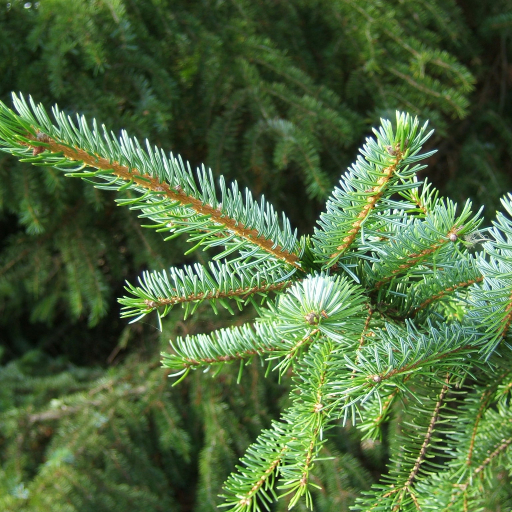
Plant Overview
Often hailed as the "King of Spruces," the Serbian Spruce is one of the most elegant and resilient conifers in the world. Originally discovered in 1875 within the steep limestone cliffs of the Drina River valley, this living relic from the Ice Age has become a favorite for modern landscapers. Its slender, graceful silhouette makes it look like a shimmering spire, especially when the wind catches its bicolored needles.
🔍 How to Identify
- 🌲 Growth Habit: It maintains a remarkably narrow, columnar-pyramidal shape with drooping branches that arch upward at the tips, creating a "sweeping" look.
- 🪡 Bicolor Needles: Unlike many spruces, the needles are flat. They are glossy dark green on top but feature two distinct bright white bands underneath, giving the tree a silvery-blue "glow" from a distance.
- 🍦 Small Cones: It produces petite, egg-shaped cones that start as a stunning deep purple or bluish-black before maturing into a warm cinnamon brown.
🏡 In Your Garden
- 🏙️ Urban Resilience: This spruce is famous for its "city toughness." Unlike the picky Blue Spruce, the Serbian Spruce is highly resistant to air pollution and can tolerate various soil types, including slightly alkaline ones.
- ❄️ Snow Specialist: Its naturally slim profile and flexible, downward-sloping branches are an evolutionary masterpiece designed to shed heavy snow easily without snapping, making it perfect for cold northern climates.
⚠️ Safety & Toxicity
- ✅ Safe Status: Picea omorika is considered non-toxic to humans, dogs, and cats. It is a very safe choice for family backyards and public parks.
- 🌵 Physical Irritation: While not poisonous, the needles are relatively stiff and pointed. They can cause minor skin irritation or mechanical injury if a child or pet runs blindly into the lower branches.
✨ Fun Fact
The Serbian Spruce is known as a "Glacial Relic." Thousands of years ago, it covered vast areas of Europe, but as the climate changed, it retreated to a tiny, 60-square-mile pocket in the Balkan Peninsula, where it survived undisturbed until its scientific discovery in the late 19th century.

Detailed Care Instructions
| Soil Ph | Not Fussy About Soil Ph; Can Be Grown With A Soil Ph Ranging From 5.6 To 9 |
| Soil Type | Well-Drained |
| Plant Type | Coniferous, Needled, Evergreen Tree |
| Mature Size | 40 To 60 Feet; Commonly 100 Feet In The Wild |
| Native Area | Balkans |
| Sun Exposure | Full Sun To Partial Shade |
| Hardiness Zones | 4-7 |
To grow Picea Omorika (Serbian spruce), you can follow these steps:
- Climate and site selection: Picea Omorika thrives in USDA hardiness zones 4-7. Choose a site with well-draining soil, full sun to partial shade, and protection from strong winds.
- Soil preparation: Ensure the soil is well-draining and slightly acidic with a pH level between 5.5 and 6.5. Amend heavy or clay soil by mixing in organic matter such as compost or peat moss.
- Planting: Dig a hole that is slightly wider and deeper than the root ball of the Picea Omorika. Place the plant in the hole and gently backfill with soil, ensuring the root ball is covered but the stem remains above ground level.
- Watering: Keep the soil consistently moist but not overly saturated. Water deeply and regularly, especially during the first year after planting to establish the roots. Avoid letting the soil dry out completely.
- Mulching: Apply a layer of organic mulch, such as wood chips or bark, around the base of the plant. This will help retain moisture, regulate soil temperature, and prevent weed growth.
- Fertilizing: Picea Omorika typically doesn't require much fertilization. You can apply a slow-release, balanced fertilizer specifically formulated for evergreen trees in early spring.
- Pruning: Minimal pruning is needed for Picea Omorika. Remove any dead, damaged, or diseased branches as well as any branches that are crossing or in close proximity to allow for proper air circulation.
- Threats and pests: Keep an eye out for pests such as aphids, mites, and spruce budworm. Treat infestations promptly using insecticidal soap or horticultural oil, if necessary.
- Winter protection: Picea Omorika is generally hardy but may benefit from winter protection in extreme cold climates. Protect the plant with a burlap screen or windbreak to shield it from harsh winds and ice damage.
By following these care instructions, you can successfully grow Picea Omorika and enjoy its beautiful foliage for years to come.

Place in a bright room that is sun drenched almost all day. Or directly in a south-facing window.

Picea Omorika is a type of coniferous tree that requires regular watering to thrive. When watering, it is important to give the plant a deep, slow drink rather than a shallow watering. This allows the water to penetrate deeply into the soil and reach the tree's roots.
The frequency of watering depends on several factors such as the temperature and humidity in the environment, soil type and depth, and the age and size of the plant. Generally, young trees require more frequent watering than mature trees.
One way to determine when to water is to check the soil moisture level. Stick your finger into the soil up to your knuckle. If the soil feels dry, it is time to water. If it is damp, then wait a few days and check again.
When watering, avoid getting water on the tree's foliage. Instead, aim for the soil around the base of the tree. Use a garden hose with a gentle flow or a watering can to water slowly and deeply. Allow the water to soak into the soil for several minutes and repeat as necessary.
During periods of hot, dry weather, Picea Omorika may require additional watering. Mulching around the base of the plant can help to retain moisture in the soil and reduce the need for frequent watering.
First, choose a slow-release fertilizer specifically designed for evergreen trees or shrubs. Next, apply the fertilizer in the early spring before new growth begins. Scatter the granules evenly around the base of the tree, making sure not to get any on the foliage. Water the tree thoroughly after fertilizing to help the nutrients penetrate the soil. Avoid fertilizing during droughts or excessively hot weather, as this can damage the tree's roots. Finally, follow the manufacturer's instructions for the recommended amount of fertilizer to use and how often to apply it.
The Picea Omorika plant prefers well-drained soil that is slightly acidic and has a moderate to high organic content. The soil should be moist but not waterlogged, as the plant does not tolerate standing water. It also prefers soil that is rich in nutrients, particularly nitrogen, phosphorus, and potassium. Compost or other organic matter can be added to the soil to improve its quality. Additionally, the Picea Omorika plant is susceptible to root rot, so soil with good drainage is essential.
To propagate this plant, you can start with taking a cutting from a healthy parent plant. The cutting should be taken from the current year's growth and should be about 4-6 inches long, with at least two sets of needles. Remove the needles from the bottom half of the cutting to expose the stem.
Next, prepare a pot with a mixture of soil and perlite. Dip the cut end of the cutting into rooting hormone powder to encourage root growth and insert it into the soil. Water the cutting and cover it with a plastic bag to create a humid environment. Keep the cutting in a bright, indirect light location.
Check the cutting every few days to ensure that it stays moist and doesn't dry out. In about 4-6 weeks, the cutting should have formed roots and can be transferred to a larger pot or moved outside if the weather permits.
It's important to note that propagating this plant can be difficult, so patience and careful attention to the process is necessary.
Common pests of the serbian spruce include Scale insect, spider mites, aphids. Make a habit of checking your serbian spruce frequently for pests so that any infestations can be caught and managed early.








