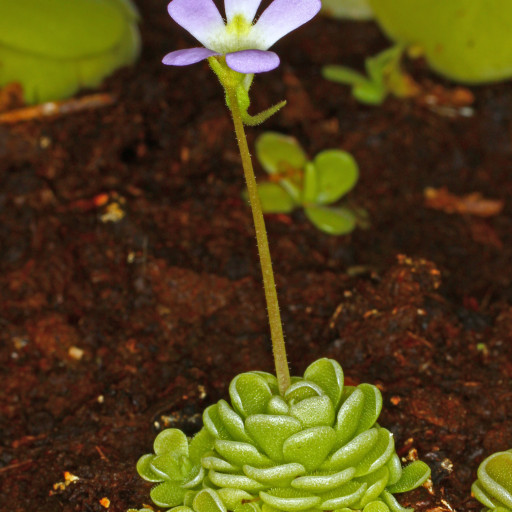
Plant Overview
Often mistaken for a tiny gemstone or a delicate desert succulent, Pinguicula esseriana is actually one of nature’s most effective "living flypapers." Hailing from the rugged limestone cliffs of Mexico, this miniature marvel is a favorite for indoor gardeners battling pesky fungus gnats. Its dainty, porcelain-like appearance hides a predatory appetite that helps keep your plant shelf buzzing-free.
🔍 How to Identify
- 🍃 The Rosette: It grows in a tight, perfectly symmetrical circle that looks remarkably like a miniature Echeveria. It is quite small, rarely exceeding an inch or two in diameter.
- ✨ Sticky Sheen: If you look closely at the leaves under a light, they sparkle with thousands of microscopic "dew" droplets. This is the mucilage used to trap unsuspecting gnats.
- 🌸 The Bloom: It sends up a disproportionately long, slender stalk topped with a single, elegant flower. The petals are usually a soft violet or pale pink with a distinct "spur" at the back.
🏡 In Your Garden
- 💧 Seasonal Shape-Shifters: This plant is a "heterophyllous" species, meaning it changes its look! In summer, it has wide, sticky carnivorous leaves. In winter, it shrinks into a tight, non-sticky succulent rosette to survive drier conditions. You must reduce watering during this winter "rest" phase to prevent rot.
- 🪨 The "Limey" Life: Unlike many carnivorous plants that require pure peat, P. esseriana loves mineral-heavy soil. Mixing in extra perlite, pumice, or even a bit of crushed coral mimics its natural limestone habitat and keeps its delicate roots happy.
⚠️ Safety & Toxicity
- 🐾 Pet & Child Safe: Pinguicula esseriana is non-toxic to cats, dogs, and humans. It is a much safer alternative to chemical pesticides for controlling indoor gnats.
- 🪰 Gnat Predator: While safe for your furry friends, it is "deadly" to small winged insects. It doesn't snap shut like a Venus Flytrap; instead, it slowly digests its prey right on the surface of its leaves.
✨ Fun Fact
The name "Pinguicula" is derived from the Latin word pinguis, which means "fat." This refers to the buttery, greasy texture of the leaves, which is why these plants are affectionately known worldwide as "Butterworts."

Detailed Care Instructions
To grow Pinguicula Esseriana, also known as the Mexican butterwort, you can follow these steps:
- Soil and container: Choose a well-draining soil mix with a high organic content, such as a blend of peat moss and perlite or sand. The container should have drainage holes.
- Watering: Pinguicula Esseriana prefers to be constantly moist but not waterlogged. Water the plant by either placing the pot in a tray of water and allowing it to soak up moisture or using the tray method by filling a tray with water and placing the pot on top of it, making sure the bottom of the pot is not submerged in water. The soil should be kept moist, but not overly wet.
- Lighting: Pinguicula Esseriana requires bright, indirect sunlight or partial shade. Place the plant in a location that receives bright, filtered light, such as an east or west-facing window. Avoid direct sunlight, as it can scorch the leaves.
- Temperature and humidity: Pinguicula Esseriana prefers moderate temperatures between 65-85°F (18-29°C) during the day and around 50-65°F (10-18°C) at night. It can tolerate higher temperatures for short periods, but prolonged exposure to overly hot conditions can harm the plant. Humidity levels between 50-60% are ideal, but they can adapt to lower humidity levels as long as the soil is kept moist.
- Feeding: Pinguicula Esseriana is insectivorous and derives nutrients from capturing and digesting insects. It is best not to feed the plant directly, but allow it to catch its own prey. Small flying insects, such as fruit flies or gnats, can be attracted to the plant using a sticky trap or by placing the pot near a bright light source.
- Maintenance: Remove any dead or decaying leaves from the plant. Pinguicula Esseriana is a perennial plant, so it will go through periods of dormancy during winter. During this time, reduce watering and provide cooler temperatures to allow the plant to rest. In spring, new leaves will emerge, and growth will resume.
Remember to research specific care guidelines for the Pinguicula Esseriana species, as they can vary slightly from the general care outlined here.

Place in a bright room that is sun drenched almost all day. Or directly in a south-facing window.

Pinguicula Esseriana is a plant that requires moderately moist soil to thrive. It is important not to water the plant too frequently, as it is vulnerable to root rot if the soil becomes too damp. Additionally, the plant prefers to be watered from below, as this allows the roots to absorb water without becoming too inundated with moisture. To water Pinguicula Esseriana, immerse the plant's pot in several inches of water, allowing the soil to absorb the water for a few minutes before removing it from the water source. It is best to water Pinguicula Esseriana when the soil is dry to the touch, ensuring that the plant's soil is not constantly saturated with moisture.
To fertilize this plant, dissolve a balanced fertilizer in water at half strength and feed it once a month during the growing season. Avoid fertilizing during the dormant period. Additionally, do not allow the fertilizer to touch the leaves as it may burn them.
When caring for the plant species commonly referred to as Pinguicula Esseriana, it is important to choose a soil that is well-draining and has a high proportion of organic matter. This type of soil will allow for good air circulation around the roots, which is essential for this plant as it has very small roots. Additionally, the soil should be able to hold onto some moisture, but not become waterlogged as this can lead to root rot. Ideally, the pH of the soil should be slightly acidic to neutral, between 6.0 and 7.0, as this is the optimal range for Pinguicula Esseriana's growth. It is important to note that Pinguicula Esseriana is a carnivorous plant, meaning that it obtains some of its nutrients from the insects it traps and consumes. However, it still requires a healthy growing medium for its roots to anchor and absorb water and nutrients.
Pinguicula Esseriana is a plant that can be propagated through vegetative cuttings. To do this, you will need to carefully select a healthy stem that has at least two to three leaves on it. Then, gently cut the stem below the leaves, using a sharp, sterile pair of scissors or pruning shears.
Once you have your cutting, you will need to remove the lower leaves, leaving only one or two at the top. This will help to prevent the cutting from losing too much moisture as it takes root.
Next, dip the cut end of the stem into rooting hormone. This will help to stimulate the growth of new roots. Then, place the cutting into a small pot filled with a well-draining soil mix. Make sure to keep the soil moist but not too wet, as excess moisture can cause the cutting to rot.
After a few weeks, you should start to see new growth and roots forming on the cutting. At this point, you can transfer it to a larger pot or plant it directly into your garden.
To ensure the success of your propagation, it's important to keep the cutting in a warm, humid environment until it has established roots. This can be achieved by covering the pot with a clear plastic bag or placing it in a terrarium.








