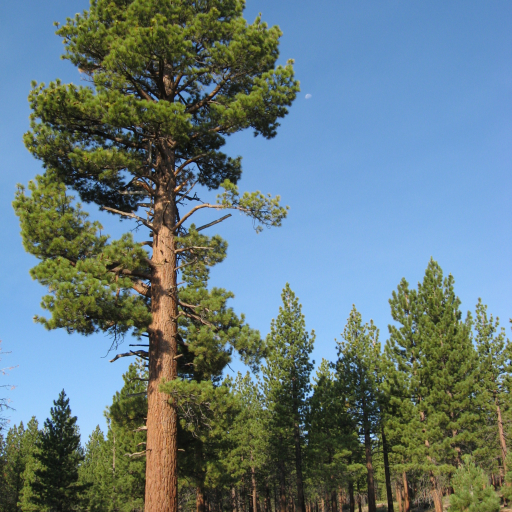
Plant Overview
Known as the "Butterscotch Pine" or "Gentle Jeffrey," Pinus jeffreyi is a majestic giant of the high-altitude American West. While it looks like a classic mountain conifer, it hides a sensory surprise: on a warm day, the deep cracks in its bark smell exactly like vanilla, butterscotch, or even pineapple. It is a symbol of resilience, often found clinging to rugged, rocky slopes where other trees fear to grow.
🔍 How to Identify
- 🍦 The Scent Test: This is the most famous identifier. If you press your nose into the deep furrows of the dark bark, you will encounter a sweet, dessert-like aroma.
- 🧶 Needle Clusters: The needles are long (up to 10 inches) and grow in bundles of three. They have a distinct blue-green or "glaucous" tint compared to the bright green of its cousins.
- 🦉 Gentle Cones: The large, heavy cones are 5–10 inches long. Unlike the Ponderosa pine, the "prickles" on the scales of a Jeffrey Pine cone point inward, making them smooth and "gentle" to handle.
🏡 In Your Garden
- 🏔️ High-Altitude Hero: This tree is incredibly hardy and thrives in cold, dry climates. It is particularly valued for its ability to grow in "serpentine" soils—nutrient-poor ground where most other plants cannot survive.
- 🌬️ Deep Roots: Because it develops a massive taproot very early in life, it is extremely wind-resistant. However, this means it hates being transplanted; choose its "forever home" in your landscape carefully to avoid root shock.
- 💧 Low-Water Resident: Once established, it requires almost no supplemental watering, making it an ideal candidate for large-scale xeriscaping or wilder, low-maintenance areas of a property.
⚠️ Safety & Toxicity
- 🐾 Non-Toxic: The Jeffrey Pine is generally considered safe for pets and livestock. It is not listed as a poisonous species.
- 🌲 Resin & Needles: While not toxic, the needles are tough and can cause mild digestive upset if a curious dog swallows a large amount. Additionally, the sap is incredibly sticky and can be a hassle to clean off of fur or skin.
✨ Fun Fact
Hikers often use the rhyme "Gentle Jeffrey, Prickly Ponderosa" to distinguish between the two similar-looking trees. If you squeeze a pine cone and it doesn't hurt your hand, you're holding a Jeffrey!

Detailed Care Instructions
There are two ways you can distinguish these two large trees from each other.First, by the cones: The cones of the ponderosa pine have scale barbs pointing outwards. The cones of the Jeffrey pine, on the other hand, have their scale barbs pointing inward, so they are much more pleasant to the touch.Second, by the bark: When you break off a piece of the deeply furrowed, flaky, cinnamon-colored bark of the Jeffrey pine during the growing season, it exudes an aromatic smell that is compared to lemon, vanilla, pineapple, violet, or butterscotch.
How long can Jeffrey pine live?
A life span of 150 years and beyond is not unusual. The most famous Jeffrey pine grew on Sentinel Dome in Yosemite Park in solid granite without soil. The seed was probably dropped there by a bird, and the tree rooted in a crack of the granite rock. Carleton Watkins photographed the Jeffrey pine in 1867, and Ansel Adams immortalized the tree in his famous photograph from 1940. When the tree died during a severe drought in 1976 and 1977 and finally fell over in 2003, it was supposedly more than 400 years old.
Can Jeffrey pine grow indoors?
Surprisingly, given the Jeffrey pine is a very large tree, it makes a good specimen for bonsai. If you intend to use your Jeffrey pine as a bonsai, expect to keep it indoors, and train it regularly to keep a compact, unique shape.
How did this tree get its common name?
Jeffrey pine is named for discoverer John Jeffrey, a 19th century Scots botanist who found the tree in the Shasta Valley of California.
| Color | Inconspicuous |
| Soil Ph | 5-7 |
| Toxicity | Non-Toxic |
| Soil Type | Loamy, Sandy |
| Bloom Time | June To July |
| Plant Type | Evergreen Tree |
| Mature Size | 60 To 130 Feet Height, 20 To 30 Feet Width |
| Native Area | Oregon, California, Baja, Mexico |
| Sun Exposure | Full Sun To Part Shade |
| Hardiness Zones | 5-9 |
To grow Pinus jeffreyi, commonly known as Jeffrey pine, follow these steps:
- Climate and location: Jeffrey pine tree is native to the western United States, particularly in mountains and foothills. It thrives in regions with a cold winter and a warm summer. Choose a location in your garden or yard that receives full sunlight and has well-draining soil.
- Soil preparation: Jeffrey pine prefers slightly acidic soil with a pH between 5.5 and 7.0. Prepare the soil by loosening it and removing any weeds or grass. Add organic matter like well-rotted compost to improve soil texture and fertility.
- Seed sowing or nursery-grown sapling: You have two options to grow Jeffrey pine: from seeds or a nursery-grown sapling.
a. From seeds: Collect fresh seeds from mature Jeffrey pinecones. Seeds are typically released in autumn. Soak the seeds in water for 24 hours to aid germination. Sow the seeds in pots or containers filled with a well-draining potting mix. Cover the seeds lightly with soil and provide consistent moisture. Place the pots in a warm location, such as a greenhouse or sunny windowsill. Seeds may take several weeks to months to germinate. Once the seedlings are 6-12 inches tall, transplant them into larger pots or directly into the ground.
b. Nursery-grown sapling: Purchase a nursery-grown Jeffrey pine sapling from a reputable garden center or online nursery. Select healthy, sturdy saplings with a well-developed root system. Ensure the sapling is suitable for your climate and region.
- Planting: Dig a hole in the ground that is slightly wider and deeper than the root ball of the sapling. Place the sapling in the hole, ensuring the top of the root ball is level with the ground surface. Backfill the hole with soil, gently firming it around the roots. Water thoroughly to settle the soil.
- Watering: Jeffrey pine prefers moist, but not waterlogged, soil. Water deeply once or twice a week, providing enough water to saturate the root zone. Adjust watering frequency based on the local climate, rainfall, and soil moisture content.
- Mulching and weed control: Apply a layer of organic mulch, such as wood chips or bark, around the base of the tree. Mulch helps conserve soil moisture, suppress weeds, and regulate soil temperature. Keep the area around the tree free from weeds, as they can compete for nutrients and water.
- Pruning and maintenance: Prune the tree only as necessary, such as to remove dead, diseased, or crossing branches. Avoid heavy pruning that could disrupt the tree's natural shape or lead to stress. Provide regular maintenance like fertilizing with a slow-release, balanced fertilizer formulated for evergreen trees.
- Protection: Protect young Jeffrey pine trees from pests, such as rodents, by installing wire mesh or fencing around the base of the tree trunk. Monitor for common tree pests and diseases in your area and take appropriate actions.
Remember, growing a tree is a long-term commitment. Provide ongoing care and patience as your Jeffrey pine tree grows into a majestic addition to your landscape.

Place in a bright room that is sun drenched almost all day. Or directly in a south-facing window.

Pinus Jeffreyi is a species of coniferous tree that requires proper care and maintenance to thrive well. When it comes to watering this plant, you need to follow some essential guidelines to ensure its healthy growth. Here are some details on how to water Pinus Jeffreyi plant without mentioning its common names:
1. Watering frequency: Pinus Jeffreyi plant requires moderate watering in its initial growing phase. Generally, it needs to be watered every week or two until the roots establish well. Once the plant grows and establishes its roots, reduce the watering frequency to once a month or as per the climatic conditions.
2. Watering method: The best way to water Pinus Jeffreyi plant is to provide deep and thorough watering. Water the plant slowly, allowing the water to soak deep into the soil and reach the roots. Avoid spraying water on the foliage as it can cause damage.
3. Soil conditions: Pinus Jeffreyi plant prefers well-draining soil that can retain moisture but does not become overly wet. Before watering the plant, make sure the top layer of soil feels dry to the touch. Do not water the plant if the soil is already moist.
4. Climate: The watering frequency of Pinus Jeffreyi plant can vary depending upon the climate and temperature. During hot and dry weather, the plant may require more frequent watering, while during cold and wet weather, the frequency can be reduced.
5. Pot size: If you are growing Pinus Jeffreyi plant in a container, ensure that it has proper drainage holes to avoid waterlogging. The size of the pot should be according to the size of the plant, and it must have enough space for the roots to grow.
By following these guidelines, you can provide proper watering to your Pinus Jeffreyi plant and ensure its healthy growth.
To fertilize this plant, use a balanced fertilizer with equal parts of nitrogen, phosphorus, and potassium. Apply the fertilizer in late winter or early spring, before new growth appears. Use moderate amounts of fertilizer, avoiding excessive application as it may cause damage to the plant. Water the plant thoroughly after fertilization to ensure that the nutrients reach the roots. Repeat the application in late summer or early fall, as needed.
For the Pinus Jeffreyi plant, it is recommended to use well-draining soil that is slightly acidic. This type of soil will allow the plant's roots to receive adequate oxygen and will also help to prevent root rot. A mix of sand, perlite, and peat moss is ideal for this type of plant. Additionally, it is important to avoid compacting the soil around the plant, as this can hinder the plant's growth and development. Regular watering is also necessary to ensure that the soil stays moist but not waterlogged.
Here are the steps to propagate a Pinus Jeffreyi plant:
- Obtain seeds or cuttings from a mature Pinus Jeffreyi tree.
- If using seeds, soak them in water for 24-48 hours before planting.
- Choose a location with well-draining soil and plenty of sunlight.
- If using cuttings, remove a branch from the parent plant, and make sure it is at least 6 inches long and has a few healthy needles.
- Strip the needles from the bottom third of the cutting.
- Dip the cut end of the cutting in rooting hormone powder.
- Plant the seed or cutting in well-draining soil, making sure to water thoroughly.
- If planting seeds, plant them about 1 inch deep in the soil.
- Keep the soil consistently moist, but not waterlogged.
- Monitor the plant for signs of growth, such as new needles or green shoots.
- Once the plant has established roots and started to grow, it can be transplanted to its permanent location.
Common pests of the jeffrey pine include Scale insect, spider mites, aphids. Make a habit of checking your jeffrey pine frequently for pests so that any infestations can be caught and managed early.








