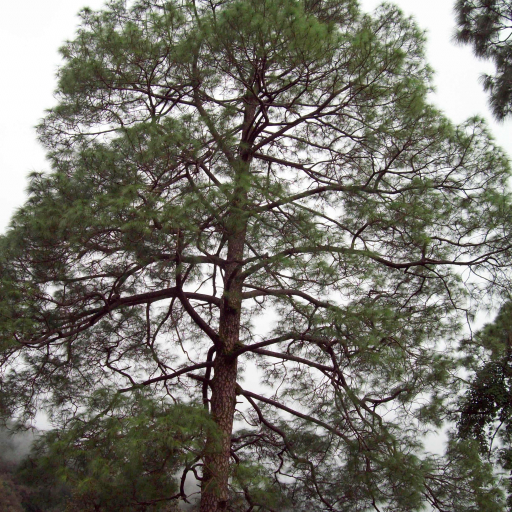
Plant Overview
Known as the "Chir Pine" or "Himalayan Longleaf Pine," Pinus roxburghii is the regal giant of the low-altitude Himalayas. Often seen clinging to steep mountain slopes, it creates a sweeping, needle-covered landscape that smells perpetually of fresh resin. In its native India and Nepal, it is celebrated not just for its stature but for its "tears"—the aromatic sap used for centuries to produce turpentine and incense.
🔍 How to Identify
- 🌲 The Needles: Look for exceptionally long, slender needles (up to 12 inches) that grow in distinct bundles of three. They have a graceful, drooping quality that gives the tree a soft, "shaggy" appearance from a distance.
- 🦉 The Bark: The trunk is wrapped in thick, deeply fissured bark that breaks into large, reddish-brown plates. This "armor" is an evolutionary gift that helps the tree survive mountain wildfires.
- 🍍 The Cones: It produces heavy, woody, ovoid cones that sit on short stalks. When they open, they reveal a beautiful symmetrical pattern, looking almost like carved wooden roses.
🏡 In Your Garden
- 🌱 Root Depth: This pine develops a massive, deep taproot early in life. Because of this, it absolutely hates being moved once planted. Choose its "forever home" carefully, ensuring there is plenty of vertical and horizontal space to grow.
- ☀️ Sun & Drainage: It is a sun-worshipper that thrives in rocky, well-draining soil. It is particularly useful for stabilizing slopes or preventing erosion in larger landscapes, as its root system acts like a natural anchor for the earth.
⚠️ Safety & Toxicity
- 🟢 General Safety: Pinus roxburghii is generally considered non-toxic to humans and common pets. It does not carry the same high levels of "pine needle toxicity" associated with Yew trees.
- 💧 Resin Irritation: The primary concern is the sticky resin (sap). It can be a skin irritant for some people and is incredibly difficult to wash out of fur or clothing.
- 🧤 Physical Hazards: The long needles and woody cones are sharp. Wear gloves when pruning or cleaning up fallen debris to avoid punctures.
✨ Fun Fact
The Chir Pine is a "pyrophyte," meaning it has adapted to live with fire. While most trees perish in forest fires, the thick bark of the Chir Pine protects its core, and the heat actually helps clear away competing vegetation, allowing its seeds to sprout in the nutrient-rich ash.

Detailed Care Instructions
| Humidity | Dry |
| Lighting | Full Sun |
| Toxicity | Poisonous |
| Difficulty | Easy |
| Hibernation | Cold Period |
| Hardiness Zones | 8 - 11 |
To grow Pinus Roxburghii (also known as the Chir Pine), you can follow these steps:
- Climate and soil requirements: Pinus Roxburghii thrives in a subtropical to temperate climate with a minimum temperature of -2°C (28°F) in the winter and a maximum of 38°C (100°F) in the summer. It can tolerate a variety of soil types, but it prefers well-draining sandy loam or clay loam soil.
- Seed selection and preparation: Obtain Pinus Roxburghii seeds from a reputable nursery or collect them from mature cones found on existing trees. Soak the seeds in water overnight and allow them to dry for a few days before planting.
- Planting seeds: Select a sunny spot with fertile soil to plant the seeds. Create small depressions or furrows about 1 cm deep and 10-15 cm apart. Place a single seed in each depression and cover it with soil.
- Watering: Water the planted seeds immediately after sowing and maintain moist soil until germination occurs. Too much water can cause the seeds to rot, so make sure the soil is well-drained.
- Germination: Germination typically occurs within 2-3 weeks, but it may take longer. Once the seedlings have emerged, reduce watering frequency but ensure the plants receive enough moisture to thrive.
- Transplanting: When the seedlings are 6-12 inches tall, they are ready for transplantation into a permanent location. Choose an area with good sun exposure and enough space for the tree to grow to its full size.
- Care and maintenance: Pinus Roxburghii requires minimal care once established. Regular watering during dry spells is recommended, especially in the first two years. Mulching can help retain soil moisture and suppress weed growth. Pruning is generally not necessary, except for removing dead or damaged branches.
- Protection from pests and diseases: Monitor for common pests like bark beetles and treat as necessary. Regular inspection and early detection can help prevent the spread of diseases such as blister rust, needle rust, and pine pitch canker.
Note: It's important to follow local regulations and consult with horticultural experts in your area for specific guidelines related to growing and caring for Pinus Roxburghii plants.

Place in a bright room that is sun drenched almost all day. Or directly in a south-facing window.

Pinus Roxburghii plants require a consistent and regular watering schedule to thrive. It is important to water deeply so that the soil is moist at least six inches deep. This encourages the growth of deep roots and allows the tree to access more water.
The amount of water needed will vary based on soil type, climate, and season. In general, the tree should be watered more frequently during hot, dry weather and less frequently during cooler, wet weather.
It is important to avoid overwatering as this can lead to root rot and other fungal diseases. To determine if the tree needs more water, check the soil moisture level by digging a small hole near the roots and feeling the soil. If the top inch of soil is dry, it is time to water.
When watering, direct the water towards the base of the tree and avoid getting water on the needles or foliage. Mulching around the base of the tree can help to retain moisture in the soil and reduce the need for frequent watering.
In addition to regular watering, it is important to ensure that the tree receives adequate drainage and does not become waterlogged. Adequate irrigation is essential for the healthy growth and development of Pinus Roxburghii plants.
The Pinus plant requires a nourishing blend of essential nutrients for optimal growth. Apply a balanced, slow-release fertilizer in the early spring season for best results. Spread the fertilizer evenly around the base of the plant, covering the root zone entirely. Avoid over-fertilization, as it can cause root burn or damage. Additionally, provide ample water to ensure proper dispersion of the nutrients throughout the soil. Regular fertilization will promote healthy growth, increase resistance to disease, and improve the overall appearance of the plant.
The ideal soil for the Pinus Roxburghii plant should have a neutral pH level and be well-draining. The soil should be rich in nutrients, including nitrogen, phosphorus, and potassium. A sandy loam soil with good drainage is suitable for this plant. The soil should be mixed with organic matter, such as compost, to improve its fertility and water retention ability. Avoid using heavy clay soils or soils with poor drainage. It is also recommended to amend the soil with sand or perlite to improve drainage if the soil is clayey or compacted.
- Collect mature cones that have opened and released their seeds.
- Separate the seeds from the cones and air dry them for a few days.
- Prepare a well-draining potting mix using a combination of sand, perlite, and peat moss.
- Fill a seed tray with the potting mix and sow the seeds on top, spacing them out evenly.
- Cover the seeds lightly with a thin layer of potting mix and water gently.
- Place the seed tray in a warm and sunny location, preferably with some shade during the hottest part of the day.
- Keep the potting mix moist but not waterlogged by watering with a spray bottle or misting regularly.
- After a few weeks, the seeds will begin to germinate. Once they have developed their first set of true leaves, they can be transplanted into individual pots filled with the same potting mix.
- Continue to water and care for the young seedlings, gradually acclimatizing them to outdoor conditions by exposing them to more sunlight and less shelter.
- After a year or two, the seedlings should be large enough to be planted out into their permanent location in the garden.








