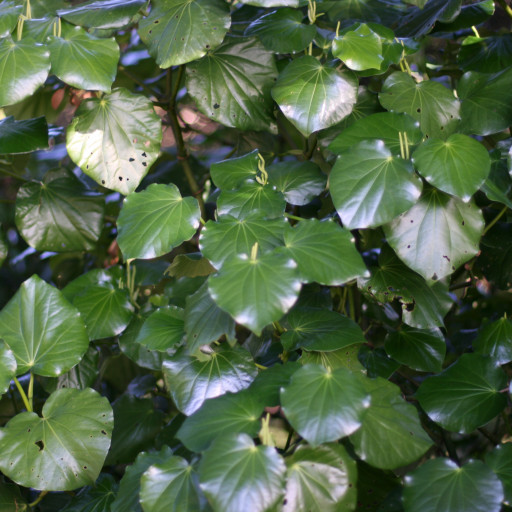
Plant Overview
Known throughout its native New Zealand as Kawakawa, Piper excelsum is often called the "Pepper Tree" due to its spicy, aromatic leaves. It is a cornerstone of traditional Māori medicine (Rongoā Māori) and is instantly recognizable by its lush, heart-shaped foliage. If you see a Kawakawa plant covered in tiny holes, don’t reach for the pesticide—in the world of Kawakawa, those holes are actually a sign of a plant brimming with life and medicinal potency.
🔍 How to Identify
- 🍃 Heart-Shaped Leaves: The leaves are broad, glossy, and shaped like perfect green hearts, often reaching the size of an open palm.
- 🎋 Jointed Stems: Look at the branches; they feature prominent, swollen "knuckles" at the nodes, giving the plant a distinctive zigzag growth pattern similar to bamboo.
- 🕯️ Candle-like Spikes: Instead of traditional petals, it produces tiny, upright flower spikes that look like yellowish-green candles. On female plants, these turn into bright orange, fleshy fruits that attract birds.
🏡 In Your Garden
- 🌳 The Understory Specialist: Kawakawa evolved to live beneath the giant forest canopies, meaning it is an absolute champion in deep shade. It’s the perfect solution for those dark corners of a garden where other plants struggle to survive.
- 🦋 Embrace the Holes: Most of these plants are nibbled on by the Kawakawa Looper moth caterpillar. Traditionally, it is believed that the plant produces more medicinal oils in response to being eaten, so those holes are often viewed as a badge of quality rather than a pest problem.
- ❄️ Frost Sensitivity: While it loves moisture and humidity, it is quite sensitive to hard frosts. If you live in a colder climate, it thrives best in a large pot that can be moved to a sheltered porch during the peak of winter.
⚠️ Safety & Toxicity
- 🍵 Safe for Humans: Kawakawa is widely used to make soothing herbal teas and topical balms for skin irritation. It has a unique numbing effect when chewed, often used historically for toothaches.
- 🐾 Pet Safety: It is generally considered non-toxic to cats and dogs. However, due to its high essential oil content and spicy nature, most pets will naturally avoid chewing on it. If a pet does ingest a large amount, it might cause mild stomach upset.
✨ Fun Fact
The Kawakawa Looper moth is the only creature that can eat the leaves without being deterred by the plant's strong chemical defenses. Because the plant concentrates its "peppery" healing compounds around the areas being eaten, Māori healers traditionally chose the leaves with the most holes, believing them to be the most powerful for medicine!

Detailed Care Instructions
To grow Piper excelsum (also known as Kawakawa), follow these steps:
- Climate: Make sure you are living in a suitable climate for this plant. It is native to New Zealand and thrives in a warm, subtropical climate.
- Sunlight: Find a location that receives full or partial sun, as Kawakawa prefers bright but indirect light.
- Soil: Prepare well-draining soil with good organic content. Kawakawa prefers slightly acidic to neutral soil. If needed, amend the soil with compost or organic matter to improve its fertility.
- Planting: Plant the Piper excelsum seeds or seedlings in late spring or early summer when the soil is warm and there is no risk of frost. Dig a hole slightly larger than the root ball and place the plant in the hole. Backfill with soil, firming it gently around the base of the plant.
- Watering: Water thoroughly after planting, and ensure the soil remains moist but not waterlogged. Once established, Kawakawa is somewhat drought-tolerant but still requires regular watering during dry spells or in hot climates.
- Pruning: Prune the plant to maintain shape and encourage bushiness. Remove dead or damaged branches to promote healthy growth.
- Fertilizer: Apply a balanced, slow-release fertilizer in spring and late summer to provide the necessary nutrients for growth. Follow the manufacturer's instructions for application rates.
- Pests and diseases: Kawakawa is generally resistant to pests and diseases. However, watch out for aphids or whiteflies, which can be controlled by using insecticidal soap or a gentle stream of water to knock them off the plant.
- Harvesting: After a year or two of growth, you can selectively harvest the leaves when needed. Gently pluck only the mature leaves, leaving the smaller ones attached to encourage continuous growth.
By following these steps, you can successfully grow Piper excelsum plants in your garden or outdoor space.

Place in a window with dappled sun or a spot in the middle of a room. Or directly in a window facing west or east.

To water this plant, it is important to consider the soil moisture level. Before watering, check the soil by touching it with your finger or a moisture meter. If the top inch of soil feels dry, it's time to water. Use a watering can or hose to water the soil around the plant until the water begins to flow out of the bottom of the pot or onto the ground. Avoid getting water on the leaves or stem as this can cause fungal diseases. Water the plant deeply but avoid overwatering, as this can lead to root rot. Depending on the temperature and humidity, it may need to be watered every few days or once a week. Adjust watering frequency as needed and be consistent to promote healthy growth.
To successfully fertilize the Piper Excelsum plant, follow these instructions:
- Select a well-balanced fertilizer with a ratio of nitrogen (N), phosphorus (P), and potassium (K) such as 10-10-10 or 20-20-20.
- Dilute the fertilizer according to the instructions on the package, usually around 1 teaspoon per gallon of water.
- Ensure the plant is well-watered before applying fertilizer to avoid any potential root damage.
- Slowly pour the diluted fertilizer around the base of the plant, avoiding direct contact with the leaves.
- Water the plant thoroughly after fertilizing to help distribute the nutrients to the roots.
- Repeat the fertilization process every 2-3 months during the growing season, typically spring and summer, while reducing or stopping fertilizing during fall and winter.
- Monitor the plant for signs of nutrient deficiencies or excesses, such as yellowing leaves or burnt leaf tips, and adjust the fertilization frequency or strength accordingly.
- Remember to always follow the instructions on the fertilizer packaging and use gloves or protective gear as needed.
- Finally, observe the plant's response to fertilization and make adjustments based on its growth and health.
The soil recommended for Piper Excelsum plant should be a well-draining soil that is loamy in texture and has good aeration. The pH of the soil should range from slightly acidic to neutral. It is recommended to add organic matter, such as compost or peat moss, to improve soil fertility and moisture retention. Avoid using heavy clay soils or soils with poor drainage. It is important to plant Piper Excelsum in a location that receives adequate sunlight and protection from extreme weather conditions. Regular watering and fertilization are also important for the healthy growth of the plant.
Propagation of Piper excelsum can be achieved through several methods including stem cuttings, air layering, and division.
- Stem Cuttings:
- Select a healthy stem from the parent plant that is free from any diseases or pests.
- Using a sharp and sterilized knife or shears, cut a 4-6 inch (10-15 cm) section of the stem just below a leaf node.
- Remove the lower leaves from the cutting, leaving only a few at the top.
- Dip the cut end of the stem into a rooting hormone powder or gel to enhance root development (optional).
- Prepare a well-draining propagation mix consisting of equal parts perlite and peat moss or coconut coir.
- Insert the cutting into the propagation mix, ensuring that at least one leaf node is buried in the mixture.
- Place the potted cutting in a warm and partially shaded area.
- Mist the cutting regularly to maintain humidity levels.
- After a few weeks, roots should start to develop and the cutting can be transplanted into a larger pot or the desired location.
- Select a healthy stem from the parent plant that is free from any diseases or pests.
- Air Layering:
- Locate a healthy and mature section of the plant with several nodes along a stem.
- With a clean knife or razor blade, make a small horizontal slit just below a node.
- Insert a toothpick or a small piece of stem into the slit, ensuring it remains in place and slightly propped open.
- Surround the exposed node and wound with damp sphagnum moss or a well-draining potting mix.
- Wrap the moss or potting mix in plastic wrap or a clear plastic bag to hold moisture and create a humid environment.
- Secure the plastic wrap or bag tightly above and below the wound to prevent moisture loss.
- Check the plant periodically to maintain moisture levels by misting or watering the moss/mix if required.
- After a few weeks or once roots have developed, carefully cut the new plant from the parent stem and plant it in a separate pot or desired location.
- Locate a healthy and mature section of the plant with several nodes along a stem.
- Division:
- Choose a mature Piper excelsum plant that has multiple stems.
- Gently remove the plant from its pot or the ground, being careful not to damage the roots.
- Inspect the plant for natural divisions such as separate stems or offshoots emerging from the main plant.
- Using a clean, sharp knife, carefully divide the plant, ensuring each divided section has its own set of roots and stems.
- Plant each divided section in separate pots or desired locations, ensuring they are watered adequately and placed in suitable lighting conditions.
- Provide proper care and maintenance for each division until they establish themselves as independent plants.
Remember to provide adequate care such as watering, proper lighting, and suitable growing conditions to promote successful propagation and the healthy growth of Piper excelsum plants.
- Choose a mature Piper excelsum plant that has multiple stems.
Common pests of the kawakawa include Mealybugs, spider mites, thrips. Make a habit of checking your kawakawa frequently for pests so that any infestations can be caught and managed early.








