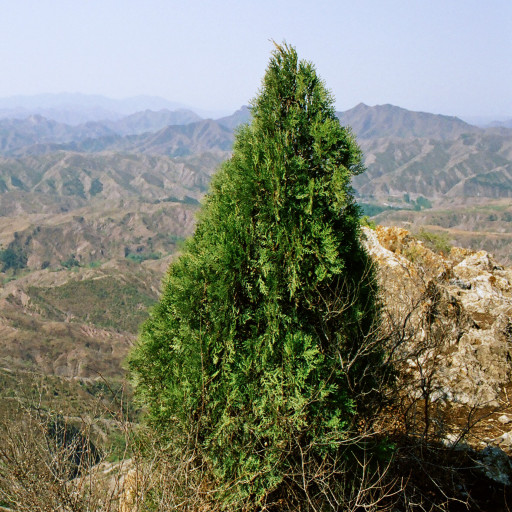
Plant Overview
Known as the "Tree of Life," the Platycladus orientalis is a resilient evergreen that has graced Chinese temple gardens for millennia. Unlike many conifers that sprawl, this tree grows in neat, vertical "fans," earning it a reputation for elegance and order. Its name, "Arborvitae," reflects its year-round greenery and legendary longevity in the face of harsh conditions.
🔍 How to Identify
- 🌿 Vertical Foliage: The most striking feature is the way its flat, scale-like leaves are arranged in vertical, book-like planes rather than horizontal sprays.
- 🫐 Beaked Cones: Before they turn woody and brown, the small cones are a distinctive waxy, bluish-green color and feature curved, horn-like hooks on each scale.
- 🌲 Symmetrical Form: It naturally maintains a tidy, egg-shaped or conical silhouette, often reaching skyward with multiple leading stems.
🏡 In Your Garden
- ☀️ Drought Warrior: Unlike its thirstier cousins, the Chinese Arborvitae is remarkably heat-tolerant. It is the "go-to" choice for sunny, dry spots where other evergreens might brown or wither.
- 🌱 Soil Sensitivity: While it isn't picky about pH, it absolutely demands drainage. It hates "wet feet," so avoid low spots in the yard where water pools, as this can lead to swift root rot.
- ✂️ Low Maintenance: Because of its slow growth and natural symmetry, it rarely requires heavy pruning. It’s perfect for those who want a formal look without the constant use of shears.
⚠️ Safety & Toxicity
- 🐾 Mildly Toxic: The foliage contains thujone, an essential oil that can cause digestive upset (vomiting or diarrhea) if ingested in large quantities by curious dogs, cats, or horses.
- 🧤 Skin Sensitivity: Some individuals may develop a mild contact dermatitis (itchy rash) when handling the branches. Wearing gloves during pruning is highly recommended for sensitive skin.
✨ Fun Fact
In ancient China, it was believed that the scent of the Platycladus wood helped promote long life. For this reason, it was traditionally planted around the tombs of emperors and within sacred temple grounds to provide an eternal, fragrant guardian.

Detailed Care Instructions
| Humidity | Normal |
| Lighting | Full Sun |
| Difficulty | Medium |
| Hardiness Zones | 6 - 11 |
To grow a Platycladus orientalis, commonly known as an Oriental Arborvitae or Chinese Thuja, follow these steps:
- Choose the appropriate location: Select a spot that receives full sunlight or partial shade. The soil should be well-drained, slightly acidic to neutral pH, and rich in organic matter.
- Prepare the soil: Before planting, loosen the soil and remove any weeds or grass. If the soil is heavy or clayey, amend it with compost or well-rotted manure to improve drainage and fertility.
- Planting: Dig a hole that is slightly wider and deeper than the plant's root ball. Place the tree in the hole and fill it with soil, gently firming it around the roots. Make sure the top of the root ball is level with the soil surface.
- Watering: Give the newly planted tree a thorough watering and keep the soil consistently moist for the first few weeks. After that, water the plant deeply once a week, especially during dry periods. Avoid overwatering, as it can lead to root rot.
- Mulching: Apply a layer of organic mulch around the base of the plant, a few inches away from the trunk. Mulching helps retain moisture, suppresses weeds, and regulates soil temperature. Ensure the mulch does not touch the trunk to prevent rot.
- Pruning: Oriental Arborvitae plants have a naturally pyramidal shape, but occasional pruning can help maintain a more compact and tidy appearance. Prune in late winter or early spring before new growth starts. Remove any dead, damaged, or crossing branches. Avoid excessive pruning, as it may cause the plant to become sparse or weaken.
- Fertilization: Apply a slow-release balanced fertilizer in early spring or late fall, following the instructions on the package. Also, periodically check the soil's pH and nutrient levels to ensure the plant's needs are met.
- Disease and pest control: Oriental Arborvitae is relatively resistant to disease and pests. However, pests like aphids, bagworms, or spider mites may occasionally affect the plant. Monitor the tree regularly and take appropriate action if any problems arise, such as using insecticidal soap or biological control methods.
- Winter protection: Young plants may need some winter protection, especially in colder climates. Apply a layer of mulch around the base and wrap the tree with burlap to shield it from harsh winds and frost.
By following these guidelines, you can successfully grow a Platycladus orientalis and enjoy its evergreen beauty.

Place in a bright room that is sun drenched almost all day. Or directly in a south-facing window.

Platycladus Orientalis is a type of plant that requires regular watering in order to survive and thrive. When watering this plant, it is important to take into account the type of soil it is planted in. The soil should be moist but not waterlogged, as too much water can cause root rot.
To water this plant, ensure that the soil is dry to the touch before watering. Once you are sure the soil is dry, water the plant slowly and evenly, making sure to saturate the root zone thoroughly. Avoid getting water on the foliage, as this can lead to disease.
Watering should be done regularly, but the frequency will depend on various factors such as the humidity in the environment, the temperature and weather conditions, and the type of soil. It is important to keep an eye on the plant and adjust the watering schedule accordingly.
In addition to regular watering, it is important to fertilize this plant every few months to ensure it has the proper nutrients it needs to grow and thrive. This can be done using a balanced fertilizer that is specifically formulated for this type of plant.
Overall, caring for Platycladus Orientalis requires attention to detail, but with proper watering and care, this plant can provide beauty and greenery to any space it grows in.
To fertilize this plant, use a water-soluble fertilizer with a balanced N-P-K ratio once per month during the growing season. Dilute the fertilizer according to the manufacturer's instructions and apply it to the soil around the base of the plant. Be careful not to over-fertilize as this can lead to burned roots and damage to the plant. Water the plant well after fertilizing to ensure proper absorption.
The ideal soil for the plant in question should be well-draining and acidic in nature. It should be rich in nutrients and have good aeration properties. The soil should be loamy with adequate water retention capacity and should not be too heavy or too sandy. It is recommended to use a potting mix that contains organic matter like peat moss, vermiculite, and perlite, as well as a slow-release fertilizer. The soil should be kept slightly moist but not overly wet, as the plant can suffer from root rot if it remains in standing water.
There are several methods to propagate this plant. One common method is to take semi-ripe cuttings from the parent plant in the summer. Cuttings should be taken from healthy, vigorous stems that are not too woody or too soft. The cuttings should be about 10-15 cm long and have a few sets of leaves on them. Remove the leaves from the bottom half of the cutting, leaving just a few at the top. Dip the cut end of the stem in rooting hormone powder, and then plant the cutting in a pot or tray filled with well-draining potting soil. Keep the soil moist, but not waterlogged, and place the pot in a warm, bright spot. In a few weeks, roots will begin to develop, and new growth will emerge from the top of the cutting. Once the new plant is established, it can be transplanted into its own pot.
Another method of propagation is by layering. Bend a lower branch of the parent plant down to the ground and pin it in place with a forked stick or wire U-pin. Cover the area where the branch touches the soil with mulch or soil, leaving just the tip of the branch exposed. Keep the soil moist, and roots will begin to form where the branch touches the soil. After a few months, the new plant can be separated from the parent plant by cutting the branch that connects them.
A third method is to collect seed from mature plants in the fall. The seed should be cleaned and dried, and then stored in a cool, dry place until spring. In the spring, the seed can be sowed in pots or directly in the ground. The soil should be kept moist until the seeds germinate and the seedlings are established.








