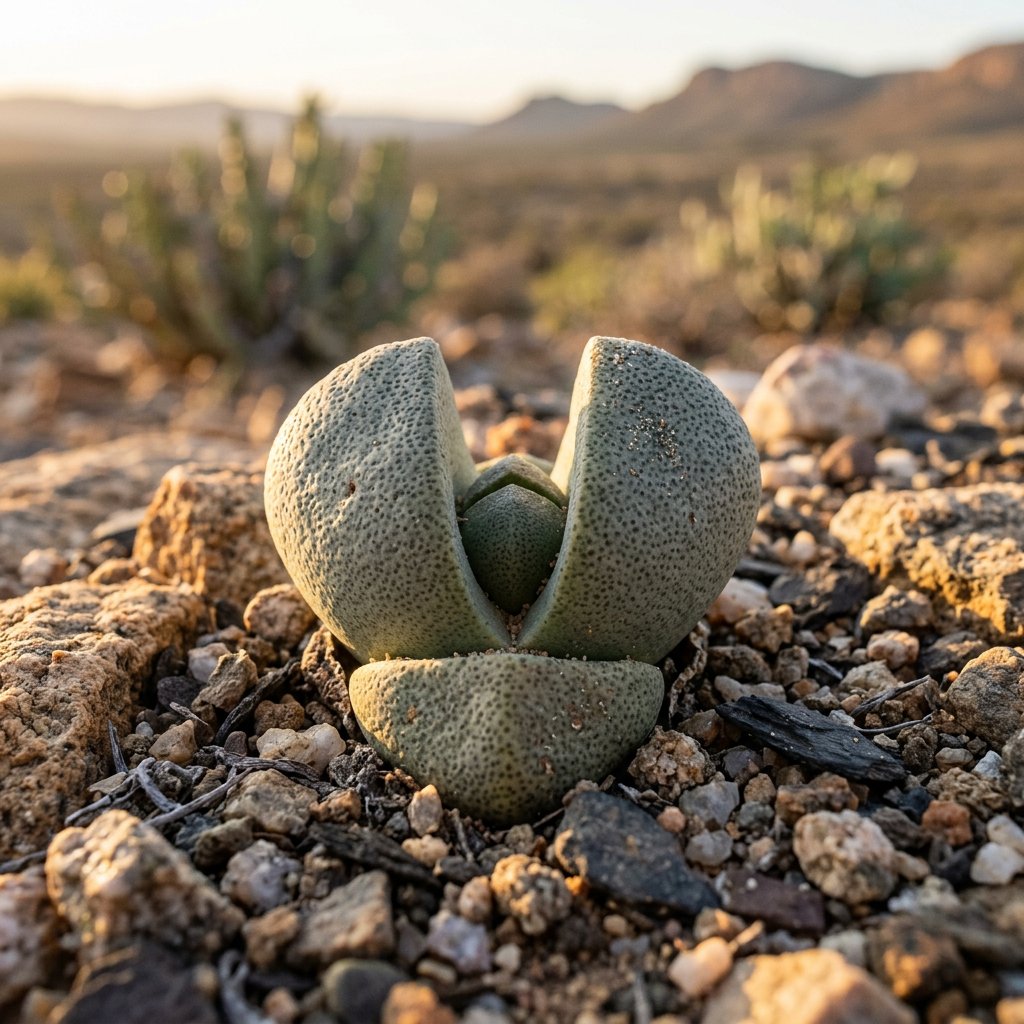
Plant Overview
Known widely as the "Split Rock" or "Living Granite," Pleiospilos nelii is a master of disguise hailing from the Karoo region of South Africa. This succulent has evolved to look exactly like the scattered pebbles of its native habitat to avoid being eaten by thirsty desert animals. It is a favorite for "slow-gardening" enthusiasts who appreciate its prehistoric, stone-like aesthetic.
🔍 How to Identify
- 🪨 The Body: It consists of two or four hemispherical, extremely thick leaves that grow in pairs, separated by a deep "cleft" or split down the center.
- 🌌 The Texture: The skin is a matte, grayish-green or brownish-purple, covered in thousands of tiny, dark green dots that look like flecks of mineral in a stone.
- 🌼 The Bloom: In early spring, a surprisingly large, daisy-like flower emerges from the center split, typically boasting vibrant shades of orange, yellow, or bronzed gold.
🏡 In Your Garden
- 🏜️ Watering Nuance: This plant follows a "one-in, one-out" rule. It naturally absorbs the moisture from its oldest pair of leaves to grow a new pair; watering it during this process can cause the plant to literally "burst" or rot from over-hydration.
- ☀️ Light and Gritty Soil: To maintain its compact, rock-like shape, it needs intense, direct light. It should be planted in a mix that is roughly 80% inorganic material (like pumice or crushed granite) to ensure the taproot stays dry and happy.
⚠️ Safety & Toxicity
- 🛡️ Safe Status: Pleiospilos nelii is considered non-toxic to humans, cats, and dogs.
- 💧 Indirect Risk: While the plant itself isn't poisonous, it is very susceptible to fungal rot if overwatered. Keep it out of reach of curious toddlers or pets simply because the leaves are brittle and can snap easily, which often leads to a fatal infection for the plant.
✨ Fun Fact
Those tiny dark spots on the plant's skin aren't just for camouflage—they act like tiny biological windows! They allow sunlight to penetrate through the thick, translucent leaf tissue to reach the chlorophyll deep inside, effectively acting as a "living solar panel."

Detailed Care Instructions
| Humidity | Dry |
| Lighting | Full Sun |
| Difficulty | Medium |
| Temperature | 18°C - 38°C |
| Hardiness Zones | 9B - 11B |
To grow a Pleiospilos nelii plant, also known as split rock plant or mimicry plant, you can follow these steps:
- Location: Choose a sunny spot for your plant, preferably with direct sunlight for at least 6 hours a day. Pleiospilos nelii thrives in warm temperatures, ideally between 70-85°F (21-29°C). Avoid extreme heat or cold.
- Soil: Use a well-draining soil mixture that is specifically formulated for succulents or cacti. Alternatively, you can create your own mix by combining regular potting soil with sand and perlite.
- Planting: Select a pot with drainage holes to prevent waterlogging. Fill the pot with the succulent soil mixture. Gently loosen the roots of your Pleiospilos nelii plant and place it in the pot, ensuring that it sits at the same depth as it was in its previous container. Lightly press the soil around the plant to secure it.
- Watering: Pleiospilos nelii is a drought-tolerant plant that is susceptible to root rot if overwatered. Allow the soil to dry out between watering sessions. During the growing season, which typically extends from spring to fall, water the plant sparingly, providing enough water to moisten the soil but avoid saturating it. In winter, reduce watering to once every 4-6 weeks or as needed.
- Fertilization: Pleiospilos nelii is not a heavy feeder. A light application of a balanced, slow-release fertilizer during the growing season can be beneficial. Follow the package instructions for proper dosage and frequency.
- Pruning: The split rock plant does not require much pruning. However, you can remove any dried or dead leaves or stems to maintain its appearance.
- Propagation: Propagate Pleiospilos nelii through seeds or by division. Collect seeds from mature plants, sow them in a well-draining soil mix, and keep them warm and moist until they germinate. To divide the plant, wait until it forms offsets, then carefully separate them from the main plant and replant them in their own pots.
- Pests and diseases: Pleiospilos nelii is relatively resistant to pests and diseases. However, monitor the plant for common succulent pests like aphids, mealybugs, or spider mites. If infested, treat with an appropriate insecticide or horticultural soap.
Remember, succulents like Pleiospilos nelii thrive on neglect, so it's better to underwater than overwater. Enjoy watching your plant grow and develop its unique, split rock appearance!

Place in a bright room that is sun drenched almost all day. Or directly in a south-facing window.

Pleiospilos Nelii is a succulent plant that is sensitive to overwatering. Therefore, it should be watered infrequently but thoroughly. To water the plant, it is important to first check the soil for dryness. This can be done by sticking your finger into the soil up to about an inch. If the soil feels dry, it's time to water.
To water the plant, first, remove it from its decorative pot and set it over a sink or basin. Then, slowly water the plant until the water starts to drain out from the drainage holes at the bottom of the pot. Once the water has stopped draining, place the plant back into its pot.
It is important not to water the plant again until the soil has fully dried out. Overwatering can lead to rotting of the roots and ultimately death of the plant. It is also important to avoid getting water on the leaves of the plant as this can lead to damage and discoloration.
To fertilize this plant, you can use a balanced liquid fertilizer with an NPK ratio of 10-10-10. Dilute the fertilizer according to the instructions on the label and apply it once a month during the growing season. During the dormant season, fertilizing can be skipped entirely. Be sure not to over-fertilize as it can cause damage to the plant.
The optimal soil type for this plant is a fast-draining mixture that consists of coarse sand or fine gravel and organic matter such as peat moss or coconut coir. The soil should be well-draining to prevent water retention and root rot. Additionally, the soil should have a slightly acidic to neutral pH level of around 5.8-7.5. It is also important to avoid using heavy soils such as clay or loam, which can cause problems with drainage. Adding perlite or pumice to the soil mixture can also be beneficial in improving drainage.
To propagate this plant, you will need to first collect its leaves and let them dry out for a few days until the cut ends have calloused over. Once this happens, you can plant the leaves in a well-draining soil mix and keep them lightly moist until new roots and shoots form. It's important to keep the soil on the drier side, as too much moisture can cause rot. Once the new plantlets have reached a decent size, you can carefully separate them from the parent leaf and pot them up individually. These new plants should be kept in a bright, sunny spot with good air circulation and watered sparingly, as too much water can cause the plant to rot. With proper care, these new plants should mature into lovely specimens, ready to produce their own new leaves and propagate further.








