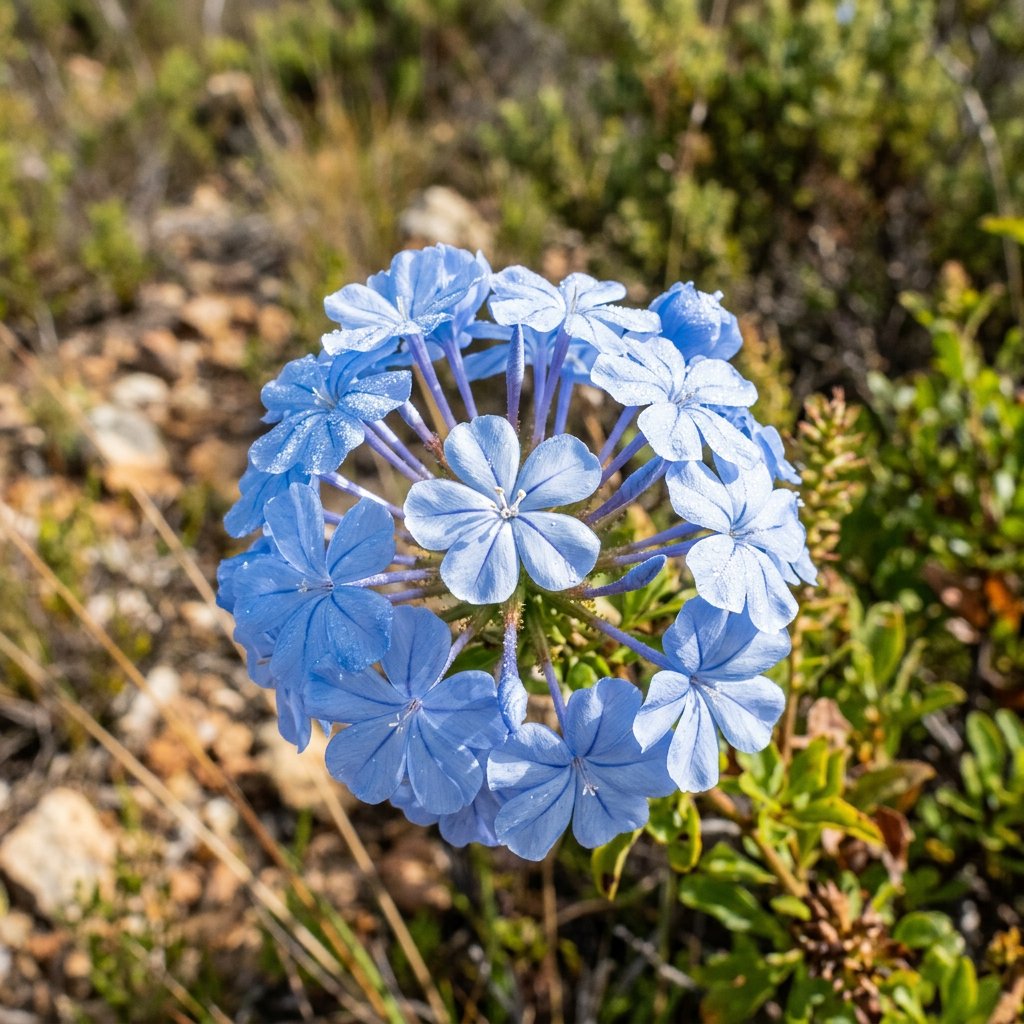
Plant Overview
Often called the "Cape Leadwort" or simply "Blue Plumbago," this South African native is a favorite for those seeking that rare, true-blue color in their landscape. Its sprawling, fountain-like habit creates a cascading waterfall of sky-blue petals that can turn a simple fence into a vibrant floral wall throughout the warmer months.
🔍 How to Identify
- 🌸 Flower Clusters: Features rounded clusters of five-petaled flowers that look remarkably like Phlox. While most are sky-blue, white-flowered varieties also exist.
- 🍃 Ear-Shaped Leaves: The light green leaves are thin and oblong, featuring a distinctive "ear-like" lobe at the base where they meet the stem (giving it the name auriculata).
- 🌿 Sticky Calyx: If you touch the base of the flower, you'll notice it is covered in tiny, sticky glandular hairs. These are "hitchhikers" designed to catch onto animal fur to spread seeds.
🏡 In Your Garden
- ✂️ Pruning Nuance: This plant is a "new wood" bloomer. To keep it from becoming a tangled, leggy mess, you should prune it back hard in late winter. This encourages a flush of fresh stems that will carry the next season's flowers.
- 🦋 Wildlife Value: It is a major hub for pollinators. In its native habitat and beyond, it serves as a critical host plant for the larvae of various "Blue" butterfly species.
- 🧱 Versatile Growth: Because it is a "scandent" shrub (it has long, flexible branches but no tendrils), it won't climb on its own. You’ll need to physically tie it to a trellis or fence if you want it to go vertical.
⚠️ Safety & Toxicity
- 🐾 Pet Safety: Plumbago is generally considered non-toxic to dogs and cats, making it a much safer choice for backyard landscapes than many other tropical flowering shrubs.
- 🤚 Skin Sensitivity: The sap and the sticky glands on the flowers contain plumbagin, which can cause mild skin irritation or a "plumbago itch" in sensitive individuals. It is best to wear gloves when doing heavy pruning.
✨ Fun Fact
- The name Plumbago is derived from the Latin word for lead (plumbum). In ancient times, people believed the lead-colored roots of the plant could cure lead poisoning. While the "cure" was a myth, the name has stuck for centuries!

Detailed Care Instructions
| Humidity | Normal |
| Lighting | Part Sun |
| Difficulty | Medium |
| Temperature | 18°C - 25°C |
| Hardiness Zones | 8A - 11B |
To grow Plumbago Auriculata, also known as Cape Plumbago or Skyflower, follow these steps:
- Climate and location: This plant thrives in warm climates and is native to South Africa. It requires full sun to partial shade. Choose a planting location with well-draining soil.
- Propagation: You can propagate Plumbago Auriculata through seeds or cuttings. Cuttings are preferred for faster results. Take 4-6 inch stem cuttings from a healthy and mature plant during spring or early summer. Remove the lower leaves and place the cuttings in a pot with moist, well-draining soil. Keep the soil slightly moist until the cuttings develop roots.
- Planting: Choose a location that offers at least 6 hours of direct sunlight. Dig a hole two times wider and the same depth as the root ball. Place the plant in the hole and backfill with soil, gently firming it around the roots. Water thoroughly after planting.
- Watering: Plumbago Auriculata prefers moderate watering. Water the plant deeply, allowing the soil to dry between waterings. Avoid overwatering, as it can cause root rot.
- Fertilizer: Apply a balanced, slow-release fertilizer in spring to promote healthy growth. Follow the package instructions for the correct application rate. Plumbago Auriculata generally doesn't require frequent fertilization.
- Pruning: Prune the plant in early spring to promote branching and maintain a desired shape. Remove dead, damaged, or diseased branches. Plumbago Auriculata responds well to regular pruning and can be shaped as a shrub or climber.
- Mulching: Apply a layer of organic mulch around the base of the plant to conserve moisture, suppress weed growth, and regulate soil temperature.
- Pests and diseases: Plumbago Auriculata is relatively resistant to pests and diseases. However, it can occasionally be affected by spider mites or powdery mildew. Monitor the plant regularly and take appropriate action if necessary, such as treating with organic insecticides or fungicides.
Remember, patience is key as Plumbago Auriculata may take some time to establish and start flowering. With proper care and suitable conditions, it will reward you with beautiful blue or white flowers and lush foliage.

Place in a bright room that is sun drenched almost all day. Or directly in a south-facing window.

To water this plant, you should first check the soil around the base of the plant by inserting your finger into the soil up to your second knuckle. If the soil feels dry, then it is time to water the plant. Use a watering can or hose with a gentle stream to moisten the soil evenly around the base of the plant. Avoid getting water on the leaves as this can encourage leaf spot or other fungal diseases. Once you have watered the plant thoroughly, let the soil drain for a few minutes before moving the plant back to its original location. It is important to not overwater this plant as it can lead to root rot and other issues. Water only when the soil feels dry but do not let the soil dry out completely.
To fertilize this plant, use a balanced fertilizer with equal amounts of nitrogen, phosphorus, and potassium. Apply the fertilizer in the spring and summer seasons every two to three weeks. Make sure to water the plant thoroughly before and after fertilizer application to ensure the nutrients are properly absorbed. Avoid over-fertilizing, as it can lead to burn on the leaves.
Plumbago Auriculata is best grown in a well-draining soil blend that is rich in organic matter. The soil should have a pH balance between slightly acidic to neutral (around 6.0 to 7.0). It also requires good soil aeration, which means it should not be too compact or heavy. Therefore, adding perlite or sand to the soil can help improve drainage and aeration. It is also recommended to use a high-quality potting mix if growing in a container. Avoid using soil blends that have high levels of clay content as they can hold excess water and lead to root rot. Additionally, Plumbago Auriculata prefers full sun to partial shade.
Plumbago Auriculata plant can be propagated through stem cuttings. To do this, select a healthy stem from the parent plant, and make a clean cut just below a node or leaf joint using a sharp and clean pair of scissors or pruning shears. Remove any leaves or buds from the lower half of the stem.
Dip the cut end of the stem into rooting hormone powder, which helps encourage root growth, and shake off any excess. Fill a small pot with moist potting soil and make a hole in the center using a pencil or your finger.
Insert the prepared stem into the hole, making sure that the lower half is buried into the soil. Press the soil gently around the stem to secure it in place. Water the pot well, and cover it with a plastic bag or dome to create a humid environment for the cutting.
Place the pot in a bright but indirect spot, and keep the soil consistently moist. After a few weeks, you should see new growth and roots forming from the buried part of the stem. Once the cutting has established roots, you can remove the plastic bag or dome and start to gradually acclimate the plant to its new environment.
Plumbago Auriculata plant can also be propagated through division, by separating the parent plant into smaller sections and repotting them individually. However, this method requires careful handling to avoid damaging the roots and stems.
Common pests of the cape leadwort include Spider mites, whiteflies. Make a habit of checking your cape leadwort frequently for pests so that any infestations can be caught and managed early.








