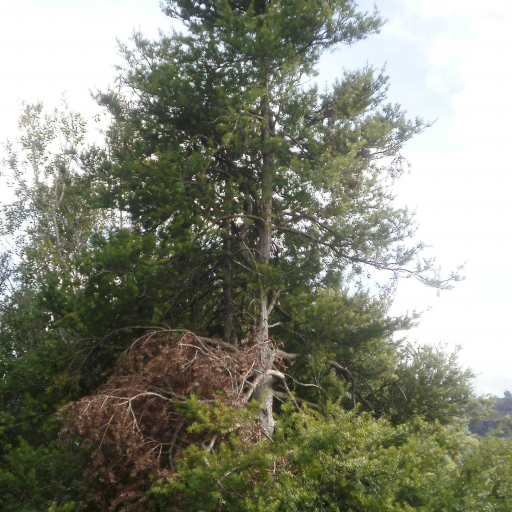
Plant Overview
Often called the Mountain Totara or Thin-bark Totara, Podocarpus laetus is a noble evergreen conifer hailing from the misty forests of New Zealand. While it looks like a classic ancient pine, it is actually a "living fossil" from a lineage that dates back to the Gondwanaland supercontinent. In a garden, it acts as a stoic, architectural backbone that transitions beautifully from a sleek juvenile to a gnarled, character-filled elder.
🔍 How to Identify
- 📜 The Bark: Its most distinguishing feature is the thin, papery, and flaky bark that peels away in long strips, distinguishing it from its cousin, the Common Totara, which has much thicker, cork-like skin.
- 🗡️ The Foliage: The leaves are stiff, leathery, and needle-like, usually arranged in a spiraling pattern. They have a distinct olive-to-deep-green hue and a sharp tip that feels prickly to the touch.
- 🍒 The "Fruit": While not a true fruit, it produces a bright red, fleshy succulent base (receptacle) with a hard seed sitting right on top, looking somewhat like a small berry wearing a hat.
🏡 In Your Garden
- 🛡️ Coastal & Cold Hardy: Unlike many ornamental plants that fuss over a breeze, this tree is incredibly resilient. It handles salt spray and frost with ease, making it a perfect windbreak or privacy screen for exposed properties.
- 🐦 A Bird Magnet: If you plant a Mountain Totara, expect visitors. Native birds are highly attracted to the sweet, red fleshy bases of the seeds. It acts as a natural bird feeder that requires zero maintenance from you.
⚠️ Safety & Toxicity
- 🐾 Low to Moderate Risk: While the red fleshy part of the "berry" is technically edible for birds, the actual seed and the foliage contain podocarpic acid, which can cause stomach upset if ingested.
- 👶 Keep Away from Curious Chewers: The sharp, needle-like leaves are a natural deterrent, but it is best to keep this plant away from areas where pets or small children might be tempted to nibble on the fallen red seeds.
✨ Fun Fact
The wood of the Totara is legendary for its durability and resistance to rot. In New Zealand's history, the bark of Podocarpus laetus was traditionally used by Māori to create "pōhā" (storage containers) for preserving birds in their own fat, acting as a natural, watertight Tupperware of the forest!

Detailed Care Instructions
Podocarpus laetus, also known as the yellow-wood or Bushman's Yellowwood, is a slow-growing evergreen tree native to South Africa. Here are some tips on how to grow and care for Podocarpus laetus:
- Climate: Podocarpus laetus prefers a cool, temperate climate with moderate rainfall. It can tolerate some drought once established, but it does best with consistent moisture.
- Sunlight: This tree thrives in full sun to partial shade. Plant it in a location where it will receive at least 6 hours of sunlight per day.
- Soil: Podocarpus laetus prefers well-draining, slightly acidic soil. Amend heavy clay or sandy soil with organic matter to improve drainage and fertility.
- Planting: Plant Podocarpus laetus in a hole that is twice as wide and deep as the root ball. Make sure the tree is planted at the same depth as it was in the nursery pot. Water the tree thoroughly after planting.
- Watering: Keep the soil consistently moist but not waterlogged. Water deeply and infrequently to encourage deep root growth.
- Fertilizing: Fertilize Podocarpus laetus with a balanced slow-release fertilizer in the spring. Follow the instructions on the fertilizer package for application rates.
- Pruning: Prune Podocarpus laetus to shape it and remove dead or damaged branches. Avoid pruning more than one-third of the tree's foliage at a time to prevent stress.
- Pests and diseases: Keep an eye out for pests like scale insects and spider mites, as well as common fungal diseases. Treat infestations promptly with appropriate insecticides or fungicides.
- Mulching: Mulch around the base of the tree to conserve moisture, suppress weeds, and improve soil quality. Keep the mulch several inches away from the trunk to prevent rotting.
By following these tips, you can successfully grow and care for Podocarpus laetus in your garden. Happy gardening!
Podocarpus Laetus should be watered deeply and thoroughly whenever the top inch of soil feels dry to the touch. It is important to water directly at the base of the plant to ensure that the roots receive adequate moisture. Avoid overhead watering to prevent fungal diseases. During the growing season, water more frequently, but reduce watering in the winter months when the plant is dormant. Additionally, make sure to provide good drainage to prevent waterlogging, as this can lead to root rot. Monitoring the soil moisture levels regularly and adjusting your watering routine accordingly will help to keep your Podocarpus Laetus healthy and thriving.
To fertilize the Podocarpus laetus plant, use a balanced fertilizer with equal parts of nitrogen, phosphorus, and potassium. Apply the fertilizer in early spring before new growth appears and again in mid-summer. Follow the instructions on the fertilizer package for proper dilution and application. Water the plant thoroughly after fertilizing to help the nutrients penetrate the soil and reach the plant's roots. Avoid over-fertilizing as this can cause nutrient burn and damage to the plant.
Podocarpus Laetus plants thrive in well-draining soil that is rich in organic matter. A mixture of sandy loam soil and peat moss is ideal for promoting healthy growth. Avoid using heavy clay soils, as they can lead to waterlogged conditions that may harm the plant. Adding perlite or coarse sand to the soil mix can further improve drainage. Additionally, a slightly acidic soil pH between 5.5 and 6.5 is preferable for optimal growth. Regularly amending the soil with compost or organic fertilizers can help maintain nutrient levels and support the plant's overall health.
Podocarpus Laetus can be propagated through several methods such as seed propagation, cutting propagation, and grafting.
For seed propagation, collect ripe seeds from the plant and sow them in a well-draining soil mix. Keep the soil consistently moist and provide warmth and indirect light for optimal germination.
Cutting propagation involves taking stem cuttings from healthy, mature plants and rooting them in a soilless medium. Dip the cut end of the stem in rooting hormone before planting it in the medium. Provide consistent moisture and indirect light until roots develop.
Grafting is another method of propagating Podocarpus Laetus, where a scion from the desired plant is grafted onto a rootstock of a related species. This method requires skill and knowledge of grafting techniques to ensure successful integration of the scion and rootstock.
Regardless of the propagation method used, it is important to provide the right environmental conditions such as proper lighting, temperature, and moisture levels to promote healthy growth and development of the new plants. Regular monitoring and care will also help increase the chances of successful propagation.








