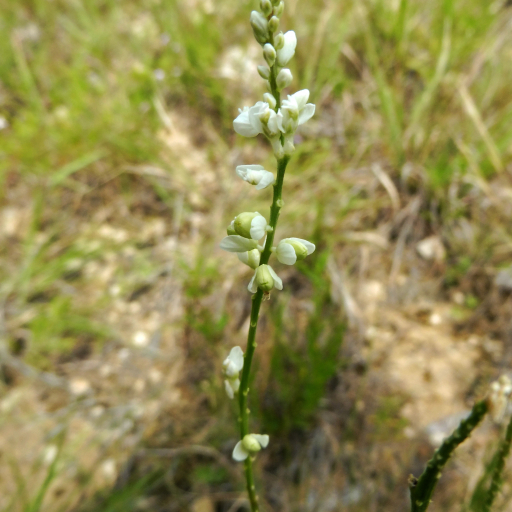
Plant Overview
Often called the White Milkwort, this slender wildflower is a delicate ghost of the North American prairies. Its genus name, Polygala, literally translates to "much milk," stemming from an ancient belief that livestock grazing on these plants would produce a more bountiful supply of milk. It is a resilient survivor, often found dancing in the wind on dry, rocky hillsides where few other flowers dare to grow.
🔍 How to Identify
- 🌸 Flower Spikes: The tiny, pea-like white flowers are crowded into tight, tapering spikes (racemes) at the ends of the stems, blooming from the bottom up.
- 🍃 Linear Leaves: Look for very narrow, alternate leaves that hug the stem, giving the plant a refined, almost grass-like silhouette.
- 🕊️ Hidden "Wings": What appear to be white petals are actually two large sepals that act as wings, shielding the true petals tucked neatly inside.
🏡 In Your Garden
- 🏜️ Drought Champion: This plant is an expert at surviving in poor, well-drained, or rocky soils. It is a fantastic candidate for xeric (water-wise) landscaping or rock gardens that receive full sun.
- 🌱 The Taproot Rule: White Milkwort develops a deep, sturdy taproot to find water underground. Because of this, it is notoriously difficult to transplant once established—pick its "forever home" carefully!
- 🦋 Pollinator Magnet: Though the flowers are small, they are a vital source of nectar for native bees and small butterflies during the heat of mid-summer.
⚠️ Safety & Toxicity
- 🛡️ Low Risk: Polygala alba is generally considered non-toxic to humans and common household pets.
- 🧴 Saponin Content: Like many members of the Milkwort family, the plant contains saponins. While not typically dangerous, ingesting large quantities could cause mild stomach upset or "frothing" in pets, so it’s best to keep curious chewers away.
✨ Fun Fact
Ancient Greek herbalists and later European farmers believed so strongly in the "milk-increasing" powers of this plant that it became a staple in folklore medicine for nursing mothers and dairy herds alike!

Detailed Care Instructions
To grow Polygala Alba plant, you can follow these steps:
- Location: Choose a suitable location for planting the Polygala Alba plant. It prefers partial shade to full sunlight, so find a spot that receives at least a few hours of direct sunlight every day.
- Soil: The plant requires well-draining soil that is slightly acidic. Prepare the soil by adding organic matter such as compost or peat moss to improve its moisture retention and drainage.
- Planting: Dig a hole in the prepared soil that is slightly larger than the root ball of the Polygala Alba plant. Place the plant in the hole, ensuring that the top of the root ball is level with the ground surface. Backfill the hole with soil, firming it gently around the roots.
- Watering: After planting, water the Polygala Alba plant thoroughly to settle the soil and encourage root establishment. Thereafter, water the plant regularly, keeping the soil consistently moist but not waterlogged.
- Fertilization: Apply a balanced, slow-release fertilizer to the plant during the growing season to provide it with essential nutrients. Follow the instructions on the fertilizer packaging for proper application rates.
- Pruning: Prune the Polygala Alba plant to maintain its shape and remove dead or damaged branches. Pruning also helps to encourage bushier growth and more flowering.
- Mulching: Apply a layer of organic mulch, such as wood chips or straw, around the base of the plant. Mulching helps to retain soil moisture, suppress weed growth, and regulate soil temperature.
- Pests and diseases: Monitor the plant regularly for any signs of pests or diseases. Common pests that can affect Polygala Alba include aphids and spider mites. Treat any infestations promptly using organic insecticides or horticultural oils.
- Propagation: Polygala Alba can be propagated through seeds or stem cuttings. Collect mature seeds from the plant and sow them in a well-prepared seed-raising mix. Alternatively, take stem cuttings from healthy, mature plants and root them in a suitable rooting medium, such as perlite or vermiculite.
- Winter care: In regions with cold winters, provide protection to the Polygala Alba plant. Apply a layer of mulch around the base to insulate the roots and consider covering the plant with a frost cloth during extremely cold periods.
Remember to research and follow any specific care requirements for the Polygala Alba plant in your particular climate and growing conditions.

Place in a bright room that is sun drenched almost all day. Or directly in a south-facing window.

Polygala Alba is a plant that requires regular watering to thrive. The soil surrounding the plant should be kept consistently moist, but not waterlogged, as excessive water can cause root rot and damage the plant.
One way to water Polygala Alba is to use a watering can and water the soil around the base of the plant, taking care not to get water on the leaves. Another method is to use a drip irrigation system, which provides a slow and steady stream of water directly to the soil.
It is recommended to water Polygala Alba in the morning or early evening, as this allows the plant to absorb water before the heat of the day sets in. It is also important to monitor the plant during periods of heavy rainfall, as too much water can be harmful to the plant.
In summary, regular watering is essential to keep Polygala Alba healthy and thriving, and it is important to monitor the plant's moisture levels and avoid overwatering.
Polygala Alba requires a balanced fertilizer with equal amounts of nitrogen, phosphorus, and potassium (NPK). Fertilize the plant during the growing season, typically from spring until fall. Dilute the fertilizer according to the instructions on the package and apply it to the soil around the base of the plant, avoiding foliage contact. Over-fertilizing can cause salt buildup in the soil, which may harm the roots and leaves. Therefore, it is important to fertilize in moderation and more frequently if required.
Polygala Alba plant prefers well-draining soil that's slightly acidic with a pH of 5.5 to 6.5. It can also grow in neutral to alkaline soil. A mix of peat moss, loam, and sand in equal parts is ideal to create the right texture for the plant's roots to grow. The soil should be moisture retentive without getting soggy. Adding perlite to the soil mixture will improve its drainage and aeration. It is advisable to avoid using heavy clay soils that can lead to waterlogging, as it may cause root rot and hinder the growth of the plant. The soil should be rich in organic matter, and fertilizers could be applied during the growing season to promote growth and enhance blooming.
To propagate this plant, start by taking a stem cutting from the mature plant. The cutting should be taken from a healthy stem and have at least one node. Then, remove the lower leaves from the cutting and dip the end of the stem in rooting hormone. Plant the cutting in a pot with well-draining soil and keep it moist. Provide the cutting with bright, indirect light and keep it warm. After a few weeks, the cutting should develop roots and begin to grow. Transplant the new plant into a larger pot or in the garden once it has matured.








