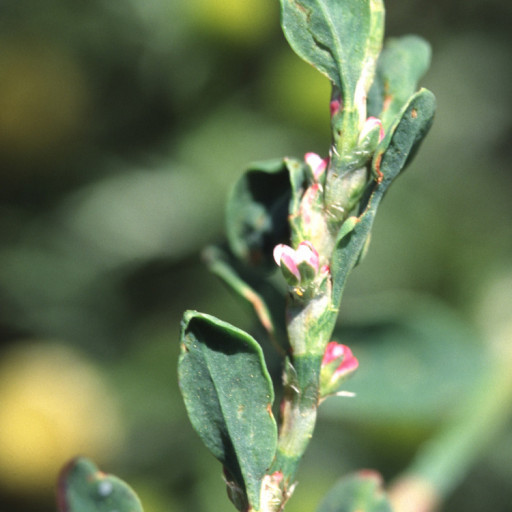
Plant Overview
Often nicknamed "Wiregrass" or "Doorweed," Polygonum arenastrum is the ultimate survivor of the pavement. While many gardeners dismiss it as a mere sidewalk weed, this prostrate traveler has mastered the art of living in the harshest conditions, often thriving in the very cracks where other plants wither. Its common name, "Knotgrass," refers to the swollen, jointed nodes along its tough, wiry stems that resemble tiny knuckles.
🔍 How to Identify
- 📏 Growth Habit: It forms dense, low-profile mats that hug the ground, spreading outward from a central taproot like a green, leafy lace doily.
- 🍃 Leaf Shape: The leaves are small, narrow, and oval with a distinct dull-green color. Unlike some of its relatives, the leaves on a single branch are usually all roughly the same size (hence the name "Equal-leaved Knotgrass").
- 🌸 Hidden Blooms: Look closely at the "joints" where the leaves meet the stem; you will find tiny, inconspicuous flowers that are greenish-white or tinged with a soft, dusty pink.
🏡 In Your Garden
- 🌱 The Pavement Specialist: This plant thrives in high-traffic areas and heavily compacted soil. If you see it popping up, it is a biological indicator that your soil is likely very tight or low in oxygen, as it loves the "crushed" environment of gravel paths and driveways.
- 🛡️ Resilience Factor: It is notoriously difficult to pull by hand once established because of its surprisingly deep and sturdy taproot. In the wild, it acts as a natural "soil binder," helping to prevent erosion in areas where other vegetation cannot take hold.
⚠️ Safety & Toxicity
- ✅ Safe for Touch: Polygonum arenastrum is non-toxic to the touch and does not cause skin irritation or rashes, making it safe to handle during weeding.
- 🐾 Pet & Human Note: While not considered poisonous, the plant contains small amounts of silicic acid and oxalates (similar to spinach). It isn't a preferred snack for pets, but it generally won't cause harm if a curious dog takes a small nibble.
✨ Fun Fact
- 🐦 Because it produces a massive abundance of tiny, nutrient-rich seeds throughout the late summer and fall, Knotgrass acts as a natural "bird feeder" for ground-foraging songbirds like sparrows and finches!

Detailed Care Instructions
To grow Polygonum Arenastrum (knotgrass) plants, follow these steps:
- Choose a suitable location: Knotgrass plants prefer full sun, but they can also tolerate partial shade. Ensure that the planting area has well-drained soil.
- Prepare the soil: Loosen the soil and remove any weeds or debris. Amend the soil with organic matter, such as compost, to improve its fertility and drainage.
- Plant the seeds: Scatter the knotgrass seeds evenly over the prepared soil surface. You can gently tamp them down but avoid burying them too deep, as they require light to germinate.
- Water the seeds: After planting the seeds, thoroughly water the area to ensure the soil is evenly moist. Continue to water regularly, keeping the soil moist but not waterlogged.
- Provide support (if needed): If growing as a climbing vine, you can provide support, such as a trellis or stakes, for the knotgrass plants to climb.
- Maintain the plants: As the knotgrass plants grow, ensure they receive enough water, especially during dry periods. Monitor for any pests or diseases and treat accordingly.
- Harvesting (optional): Knotgrass can be harvested throughout the growing season if desired. The young leaves are edible and can be used in salads or cooked dishes.
Remember to check if knotgrass is considered invasive or a weed in your region before planting it in your garden.

Place in a bright room that is sun drenched almost all day. Or directly in a south-facing window.

1. Check the soil moisture regularly: Before watering, it is important to check the moisture level of the soil. Stick your finger 1 inch into the soil, if it feels dry then it is time to water the plant.
2. Water the plant deeply: When you water the plant, make sure to water it deeply. Water should penetrate the roots of the plant for better growth.
3. Use room temperature water: The water temperature should be at room temperature. Cold water can shock the plant and hot water can damage its roots.
4. Water in the morning: Water the plant in the morning, as this allows the plant to absorb enough water before the sun dries it up.
5. Avoid overwatering: Overwatering can damage the roots of the plant and cause the plant to die. Make sure to let the soil dry out slightly before watering again.
6. Use a watering can or a watering hose: Using a watering can or a watering hose can help you water the plant evenly and control the amount of water you are giving to the plant.
7. Don't water the leaves: Water the plant at its base, avoiding watering the leaves as this can cause fungal diseases to develop.
8. Mulch the plant: Mulching the plant can prevent water evaporation from the soil, allowing the soil to stay moist for a longer period of time.
9. Water less frequently during the winter: During the winter season, the plant requires less water. Water the plant less frequently during this time.
10. Water when the plant is actively growing: During the growing season, the plant needs more water to support its growth. Water the plant more frequently during this time.
To fertilize this plant, apply a balanced fertilizer with equal parts nitrogen, phosphorus, and potassium every 4-6 weeks during the growing season. Be sure to use a slow-release fertilizer and avoid over-fertilizing, as this can lead to excessive growth and decreased plant health. Water the plant thoroughly after fertilizing to help the nutrients absorb into the soil.
For optimal growth, the Polygonum Arenastrum plant requires a well-draining soil mixture that is rich in organic matter. It is recommended to use a soil mixture that is slightly acidic with a pH level of 5.5 to 6.5. The soil mixture should also be able to hold moisture but not be waterlogged as this could lead to root rot. A good soil mixture could consist of equal parts of peat moss, perlite or vermiculite, and coarse sand. It is important to avoid using heavy clay soils or compacted soils as they can limit root growth and water absorption. The plant also requires regular fertilization with a balanced fertilizer to promote healthy growth and flowering.
Polygonum arenastum is a plant that can be propagated by division or stem cuttings. To propagate through division, carefully dig up the plant and separate the roots into smaller sections with a clean and sharp knife. Each section should have at least one healthy root system and a few leaves or stems. Plant the new sections in prepared soil with good drainage and keep them adequately watered.
To propagate through stem cuttings, select a healthy stem that is around 4 inches in length. Remove the lower leaves and dip the cut end in rooting hormone powder. Plant the cutting in a pot filled with moist potting soil and cover the pot with a clear plastic bag to create a humid environment. Keep the pot out of direct sunlight and keep the soil moist. The cutting should begin to develop roots in a few weeks. Once the roots have developed, transplant the new plant into the ground or a larger pot.








