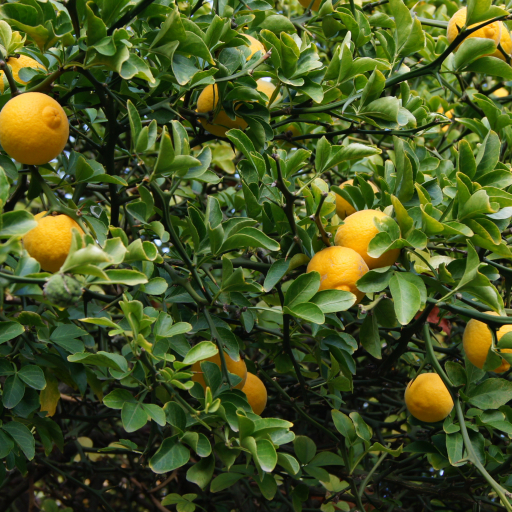
Plant Overview
Often called the Hardy Orange or Trifoliate Orange, this plant is the rugged, winter-defiant cousin of your favorite breakfast citrus. Native to China and Korea, it is famous for being one of the only citrus-related plants that can survive freezing temperatures down to -10°F (-23°C). In the gardening world, it is often whispered about as the "Living Barbed Wire" due to its formidable architectural presence.
🔍 How to Identify
- 🍃 The Triple Leaf: True to its name, the dark green leaves grow in distinct groups of three (trifoliate), which turn a brilliant, buttery yellow in the autumn.
- 🗡️ Menacing Thorns: The branches are armed with incredibly sharp, oversized green thorns that can reach up to 2 inches in length, creating a zig-zag skeletal pattern in winter.
- 🍊 Velvety Fruit: It produces small, golf-ball-sized oranges that are covered in a fine, downy fuzz—resembling a cross between a lemon and a peach.
- 🌸 Spring Blooms: Before the leaves fully emerge, the plant is covered in large, white, four-petaled flowers that carry a light, citrusy scent.
🏡 In Your Garden
- 🛡️ The Ultimate Security Hedge: Because of its impenetrable thorns, it is frequently planted as a "deterrent hedge" to keep unwanted guests or wildlife out of specific garden areas.
- 🧊 Cold-Hardy Logic: Unlike most citrus that drop dead at the first frost, Poncirus trifoliata is deciduous, meaning it drops its leaves to enter a deep dormancy, allowing it to survive northern winters.
- 🪴 A Strong Foundation: It is most famous in the agricultural world as a "rootstock." Most sweet oranges and lemons are actually grafted onto the roots of this plant to give them better disease resistance and cold tolerance.
⚠️ Safety & Toxicity
- 🟢 Status: Generally non-toxic, but physically formidable.
- 🧤 Physical Hazard: The primary danger is the thorns. They are stiff and sharp enough to puncture heavy gardening gloves or even thin tires. Extreme caution is advised when pruning or planting near walkways where children play.
- 👅 The Bitter Truth: While the fruit is technically edible and high in Vitamin C, it is incredibly bitter and packed with seeds. It is rarely eaten raw but is sometimes used to make a very tart marmalade or dried for traditional medicine.
✨ Fun Fact
In the 1800s, the USDA promoted the Hardy Orange as a "permanent fence" for farmers in the American South. Some of those original hedges are still standing today, over a century later, proving just how indestructible this plant truly is!

Detailed Care Instructions
To grow a Poncirus Trifoliata plant, also known as hardy orange or Chinese bitter orange, follow these steps:
- Climate: Poncirus Trifoliata is a cold-hardy plant that grows well in USDA hardiness zones 5-9. Make sure your climate is suitable for its growth.
- Soil: This plant prefers well-draining soil with a pH between 5.5 and 7.0. Sandy or loamy soils are ideal. Ensure the soil is fertile and rich in organic matter.
- Location: Choose a sunny spot for your Poncirus Trifoliata plant. It requires at least 6 hours of direct sunlight daily. Ensure the location is protected from strong winds.
- Planting: Dig a hole twice as wide and deep as the root ball of the plant. Place the plant in the hole, ensuring the base of the trunk is level with the surrounding soil. Backfill the hole and gently firm the soil around the plant.
- Watering: Poncirus Trifoliata prefers regular watering. Keep the soil consistently moist but not soggy. Water deeply whenever the top inch of soil feels dry.
- Mulching: Apply a layer of organic mulch around the base of the plant. This helps retain soil moisture, suppress weeds, and regulate soil temperature.
- Fertilization: Fertilize your Poncirus Trifoliata plant in early spring with a balanced slow-release fertilizer. Follow the instructions on the fertilizer package for application rates.
- Pruning: Prune your plant in early spring to shape it and remove any dead or damaged branches. This plant is thorny, so wear protective gloves and clothing while pruning.
- Protection: Poncirus Trifoliata is quite hardy, but younger plants may need protection during severe winters. Use burlap or wrap the plant with frost protection fabric to shield it from cold and wind.
- Pests and Diseases: This plant is relatively pest and disease-resistant. However, keep an eye out for common citrus pests such as aphids, scale insects, or spider mites. Use appropriate organic insecticides if necessary.
With proper care, your Poncirus Trifoliata plant should grow well and provide you with interesting citrus-like fruits and fragrant flowers.

Place in a bright room that is sun drenched almost all day. Or directly in a south-facing window.

1. Determine the watering needs of the plant according to its growth stage – young plants require more frequent watering compared to mature ones.
2. Check the soil moisture level before watering. Insert your finger into the soil up to the first joint – if it feels dry, water the plant.
3. Water slowly and deeply to ensure the water reaches the roots. Avoid watering overhead as this can promote disease.
4. Water the plant in the morning to allow excess moisture to evaporate during the day and discourage fungal growth.
5. Use a watering can or a hose with a soft spray nozzle to avoid disturbing the soil and causing erosion.
6. Water regularly during the growing season, especially during hot, dry weather. Reduce watering during fall and winter when the plant goes dormant.
7. Monitor the plant for signs of overwatering such as yellowing leaves, root rot, or wilting. Adjust the watering frequency accordingly.
8. Consider using a mulch around the plant to help retain soil moisture and reduce evaporation.
9. Avoid using hard or chlorinated water as it can damage the plant and affect soil pH. Use rainwater or let tap water sit out overnight before use.
To properly fertilize this plant, you should use a slow-release granular fertilizer in the early spring or late winter. Apply the fertilizer evenly around the base of the plant, following the instructions on the label for the appropriate amount. Be sure to water the plant well after fertilizing to aid in absorption. Avoid fertilizing in the fall or winter as this can encourage new growth that is likely to be damaged by cold temperatures.
For growing the plant known by its scientific name Poncirus Trifoliata, it is recommended to use a soil with a pH range of 5.5 to 6.5. The soil should be well-draining and rich in organic matter. Adding additional perlite or sand to the soil mixture can aid in drainage. The plant prefers a soil that is moist but not waterlogged. It is also important to ensure the soil has a sufficient amount of nutrients, so adding a balanced fertilizer periodically can help support the plant's growth.
Propagation of this plant can be done through the process of air layering or by taking stem cuttings. For air layering, you will need to identify a branch that is about one-year-old and wrap a section of that branch with damp sphagnum moss. After that, cover the moss with plastic wrap and wait for roots to start growing. Once the roots have formed, cut the branch from the mother plant and plant it into a pot with a well-draining potting mix.
For stem cuttings, select a healthy branch from the plant and cut it at an angle with a sharp, sterile knife. Remove the leaves from the lower half of the cutting, leaving a few leaves at the top. Dip the cut end of the stem into rooting hormone and plant it into a pot with a well-draining potting mix. Keep the cutting moist and in a warm, bright area until roots start to form. Once roots have formed, transplant the cutting into its permanent location.
Common pests of the trifoliate orange include Aphids. Make a habit of checking your trifoliate orange frequently for pests so that any infestations can be caught and managed early.








