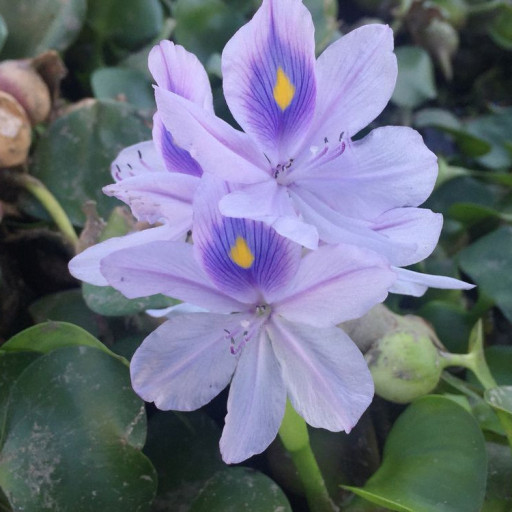
Plant Overview
Known as the "Green Plague" or the "Terror of Bengal," Pontederia crassipes (formerly Eichhornia crassipes) is a floating beauty that masks a fierce survival instinct. Originally from the Amazon Basin, this aquatic traveler has charmed the world with its orchid-like flowers while simultaneously becoming one of the most aggressive invasive species on Earth. It is the ultimate "double-edged sword" of the water world—stunning to look at, but relentless in its growth.
🔍 How to Identify
- 🎈 Bulbous Petioles: The most distinct feature is the spongy, air-filled swelling at the base of each leaf stem, which acts as a natural life jacket to keep the plant buoyant.
- 🍃 Waxy Foliage: The leaves are thick, glossy, and fan-shaped or rounded, often arranged in a rosette that sits gracefully on the water's surface.
- 🌸 The "Peacock" Flower: It produces a spike of 8 to 15 lavender-blue flowers. The topmost petal features a prominent yellow "eye" surrounded by a darker purple border, mimicking a peacock's feather.
🏡 In Your Garden
- 🌊 Containment is Critical: If you grow this in a backyard pond, it must be a closed system. Because it floats freely, it can quickly cover the entire surface, blocking light and oxygen for fish and submerged plants.
- 🧪 Phytoremediation Hero: Despite its "pest" reputation, it is a powerhouse at cleaning water. It aggressively absorbs heavy metals and excess nutrients, making it an excellent natural filter—provided you "harvest" and thin it out regularly to prevent overgrowth.
⚠️ Safety & Toxicity
- 🐾 Mildly Toxic: The plant contains calcium oxalate crystals, which are common in many house plants.
- 👄 Details: If ingested by pets or curious children, it can cause mouth irritation, drooling, and mild digestive upset. More importantly, its "danger" is ecological; never discard excess plants into local waterways, as they can cause total ecosystem collapse by choking out native life.
✨ Fun Fact
Pontederia crassipes is one of the fastest-growing plants known to man. Under ideal conditions, a small patch can double its physical mass in just 12 to 14 days, creating floating mats so dense that they can stop boat traffic and even cause bridges to collapse under their weight!

Detailed Care Instructions
To grow a Pontederia Crassipes (commonly known as water hyacinth) plant, you can follow these steps:
- Choose a suitable location: Water hyacinths are aquatic plants; thus, they require a pond, water garden, or container with water to grow. Ensure that the location gets ample sunlight.
- Acquire water hyacinth plants: You can either buy water hyacinth plants from a nursery or obtain them from someone who already has them in their pond or water garden.
- Prepare the planting container: If you are using a container, ensure it is watertight and has a minimum depth of 6 inches. Fill the container with water from a pond or treated tap water before introducing the plants.
- Place the plants: Gently place the water hyacinth plants in the container, ensuring that the roots are submerged in the water. Space them about 12-24 inches apart.
- Fertilization: Water hyacinths do not require additional fertilization. They obtain their nutrients from the water. However, if you notice slow growth, yellow leaves, or poor flowering, you can use a balanced aquatic fertilizer according to the manufacturer's instructions.
- Maintenance: Water hyacinths are relatively low maintenance. Remove any dead or decaying plants regularly to prevent them from rotting and sinking to the bottom. Thin them out if they become overcrowded.
- Water quality: Water hyacinths are excellent water purifiers and can help control algae growth. However, to maintain good water quality, ensure there is enough oxygen exchange in the water. You can use a water pump, air stone, or cascade feature to enhance circulation.
- Overwintering: If you live in an area with cold winters, water hyacinths may not survive outdoors. In such cases, you can bring them indoors during winter and place them in a tank with enough water and sunlight.
Note: Water hyacinths are considered invasive in some areas due to their rapid growth and ability to choke water bodies. Therefore, make sure to check the regulations regarding their cultivation in your region and prevent them from escaping into natural waterways.
- First, identify the Pontederia Crassipes plant in your garden or water feature. This plant is an aquatic plant and can be easily recognized by its elongated leaves and purple or blue flowers.
- Pontederia Crassipes plants need to be regularly watered to thrive. They must have enough water to keep their roots moist and submerged in water. Therefore, it is essential to keep the water level in your garden pond or water feature high.
- When watering your Pontederia Crassipes plant, avoid watering from above as this can damage the plant's delicate leaves. Instead, allow the water to naturally flow into the water feature without creating an artificial current.
- If you are growing your Pontederia Crassipes plant in a pot, ensure that the pot is submerged in water up to the rim. Additionally, you can use a water-soluble fertilizer to nourish your plants and help them grow.
- Finally, keep an eye on your Pontederia Crassipes plant and ensure that it's healthy. If its leaves start turning yellow, it could be a sign of overwatering or underwatering. Ensure that the water level is maintained and keep the plant's soil moist but not waterlogged.
To fertilize Pontederia Crassipes plants, follow these instructions:
- Start fertilizing the plant during its active growing period, typically in spring or early summer.
- Choose a water-soluble fertilizer specifically designed for aquatic plants. Look for a balanced formula with equal ratios of nitrogen (N), phosphorus (P), and potassium (K).
- Dilute the fertilizer according to the instructions on the packaging, usually about 1 tablespoon per gallon of water.
- Apply the diluted fertilizer directly to the water surrounding the plants, being careful not to exceed the recommended dosage.
- Fertilize the plants every two to four weeks throughout the growing season. Avoid over-fertilizing, as it may lead to excessive algae growth or harm the plants.
- Monitor the growth and health of the plants regularly. If you notice signs of nutrient deficiency (e.g., pale leaves, stunted growth), consider increasing the frequency of fertilization or adjusting the dosage as needed.
- During winter dormancy, withhold fertilization as the plant's nutrient requirements decrease.
- Always follow the manufacturer's instructions on the fertilizer package and consider the specific needs of your Pontederia Crassipes plants for optimal results.
The soil to use with this plant should be rich in nutrients and have good drainage. It is important to avoid heavy soils that may retain too much water and cause root rot. A mixture of peat moss, perlite, and sand is recommended to provide adequate drainage while providing enough moisture retention. A pH level between 6.0 and 7.5 is optimal for this plant. A high-quality potting mix that is specifically formulated for aquatic plants can also be used. Adding organic matter such as compost or well-rotted manure to the soil can help improve the fertility and structure of the soil. It is important to regularly check the moisture level of the soil and maintain proper watering to ensure the health and growth of the plant.
Pontederia crassipes, also known as water hyacinth, is a floating aquatic plant that can be propagated through different methods. Here are the details on how to propagate Pontederia crassipes:
- Division: One of the most common ways to propagate Pontederia crassipes is through division. Start by identifying mature plants with healthy shoots and roots. Gently remove the plant from the water, taking care not to damage the roots. The rhizomes, which are thick horizontal stems, should have multiple shoots and healthy root systems.
- Separate rhizomes: Using a sharp, clean knife, carefully separate the rhizomes into smaller sections. Each section should have a few shoots and a portion of the root system. Ensure that each new division has enough resources to thrive independently.
- Replanting: Once you have divided the rhizomes, it is time to replant them. Choose a suitable location with calm water and good sunlight exposure. Submerge the newly divided sections in water, ensuring that the shoots are above the surface. Gently press the rhizomes into the substrate or anchor them using rocks if necessary.
- Water conditions: Pontederia crassipes prefers warm water temperatures between 15 to 30°C (59 to 86°F) and can tolerate a pH range of 6.0 to 7.5. Maintain a water depth that allows the shoots to float freely, ensuring they receive ample sunlight. Additionally, the water should provide sufficient nutrients for healthy growth.
- Growth and maintenance: Pontederia crassipes is a fast-growing plant that can quickly create a dense layer of vegetation on the water surface. Regularly monitor the growth to prevent overcrowding. Trim excess shoots to maintain proper spacing and reduce competition for resources. Remove any dead or decaying plant material to prevent water quality issues.
- Prevention: Pontederia crassipes has the potential to grow invasively and disrupt native ecosystems. Ensure to prevent the plant from spreading into water bodies where it is not desired. Proper disposal methods, such as composting the plant material away from water sources or bagging and disposing of it in the trash, can help prevent its proliferation.
Remember to check with local authorities and regulations when propagating Pontederia crassipes, as it is considered an invasive species in some areas.








