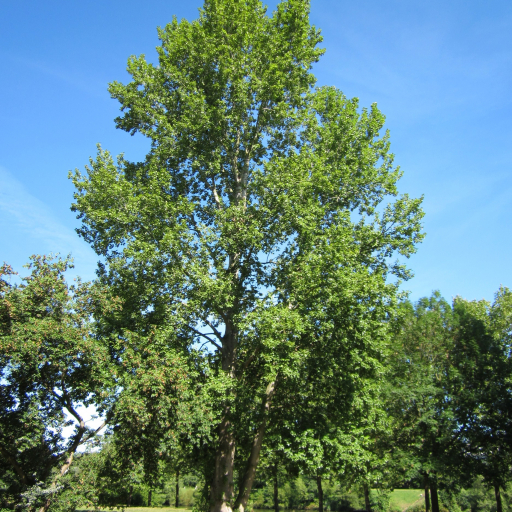
Plant Overview
The Grey Poplar is a majestic, fast-growing hybrid born from the natural cross-breeding of the White Poplar and the Common Aspen. Known for its ghostly, pale bark and leaves that seem to shimmer in the breeze, it is a common sight in European river valleys and grand estates. Historically, poplars were nicknamed "the people’s tree" (from the Latin populus) because they were often planted in public squares and along roads for shade.
🔍 How to Identify
- 🍃 The Leaves: They are broadly heart-shaped or round with "toothed" edges. While the top is a dull green, the underside is covered in a soft, felt-like grey fuzz—more subtle than the snowy white of its parent, the White Poplar.
- 🌳 The Bark: Young trees have smooth, greyish-white bark marked with diamond-shaped dark pits. As the tree ages, the base becomes deeply fissured, dark, and rugged.
- 🍂 The Catkins: In early spring, before the leaves appear, the tree produces drooping flower spikes called catkins. The male catkins are reddish-grey, while the female ones are yellow-green.
🏡 In Your Garden
- 💧 Thirst for Water: This tree is a "hydrophile," meaning it loves damp conditions. It is perfect for stabilizing riverbanks or soaking up excess moisture in boggy areas of a large property, but it will struggle in bone-dry soils.
- 🏗️ Root Awareness: Because it grows so quickly, its root system is incredibly aggressive and shallow. It is famous for lifting paving stones or interfering with underground pipes, so it should never be planted close to a house or driveway.
- 🌬️ Wind Resistance: Unlike some soft-wooded trees, the Grey Poplar is remarkably hardy against strong winds, making it an excellent choice for a rural windbreak or shelterbelt.
⚠️ Safety & Toxicity
- 🤧 Allergy Alert: Like many members of the willow family, the Grey Poplar produces large amounts of wind-borne pollen in the spring, which can be a significant trigger for hay fever sufferers.
- 🐾 Pet Safety: This plant is generally considered non-toxic to dogs, cats, and horses. However, the soft wood can be brittle; after a storm, check your yard for fallen branches that could pose a physical hazard.
✨ Fun Fact
Poplars are environmental cleaners! They are frequently used in "phytoremediation" projects because their massive root systems are incredibly efficient at absorbing and filtering heavy metals and pollutants from contaminated soil.

Detailed Care Instructions
To grow Populus × Canescens, also known as grey poplar or white poplar, follow these steps:
- Purchase healthy saplings or cuttings from a reputable nursery or garden center. Populus × Canescens is usually propagated from cuttings rather than seeds.
- Choose a suitable planting site. Populus × Canescens prefer full sun and moist, well-draining soil. They are adaptable to different soil types but thrive in fertile and loamy soil.
- Prepare the planting area by removing any weeds or grass. Dig a hole that is slightly larger and deeper than the root ball of the sapling or cutting.
- Place the sapling or cutting in the hole and backfill it with soil, gently firming it around the plant. Ensure that the crown is level with or slightly below the ground surface.
- Water the newly planted poplar thoroughly to settle the soil and eliminate any air pockets. Keep the soil moist but not waterlogged during the growing season.
- Mulch around the base of the plant to retain moisture and suppress weed growth. A layer of organic mulch, such as wood chips or straw, will also help to insulate the roots.
- Prune the poplar as needed to maintain its shape and remove any dead, damaged, or crossing branches. Early spring or late winter is the best time for pruning.
- Monitor the plant for signs of pests or diseases, such as aphids, leaf spot, or cankers. If necessary, treat with appropriate organic or chemical controls.
- Regularly fertilize the poplar to provide essential nutrients. Use a balanced, slow-release fertilizer according to the package instructions.
- During hot and dry periods, provide extra watering to ensure the poplar does not become stressed.
- Depending on the desired outcome, you can either maintain the poplar as a single tree or propagate new plants by taking cuttings from established ones.
Remember that Populus × Canescens is a fast-growing tree and can potentially become large over time. Consider the ultimate size and suitability for your planting location before planting.

Place in a bright room that is sun drenched almost all day. Or directly in a south-facing window.

The best way to water this plant is to moisten the soil around its roots. It is important to not over-water the plant as this can lead to root rot and other issues. The frequency of watering will depend on the climate and location of the plant. It is recommended to water deeply once a week rather than shallowly every day. Additionally, it is important to ensure the plant has good drainage to avoid standing water which can cause harm to the root system.
For best results, fertilize this plant in early spring before new growth appears. Use a slow-release or organic fertilizer specifically formulated for trees or shrubs. Apply according to the package instructions, taking care not to exceed the recommended rate. Water thoroughly after fertilizing to ensure the nutrients are distributed evenly throughout the root zone. Avoid fertilizing during drought conditions or in the heat of summer, as this can potentially burn the roots and damage the plant.
Populus × Canescens plant prefers a well-draining soil that is rich in nutrients and organic matter. The ideal soil should have a pH of around 6.0 to 7.5. Sandy loam or loamy soil is typically recommended for this plant. The soil should also be moist but not waterlogged, as excessive moisture can lead to root rot. It is important to ensure that the plant is not planted in soil that is too compact, as this can prevent proper root development. Adding compost or organic matter to the soil can improve its fertility and drainage, which can help to promote healthy growth of the Populus × Canescens plant. Additionally, adding mulch around the base of the plant can help to retain moisture and regulate temperature, which can also benefit the plant's growth.
To propagate this plant, you will need to take softwood stem cuttings during the spring or summer. The cuttings should be approximately 6-8 inches long and taken from new growth on the plant.
Remove the lower leaves from the cutting, leaving only two to three leaves at the top. Dip the cut end of the cutting in rooting hormone to encourage root growth.
Insert the cutting into a pot filled with well-draining soil mixture, ensuring that the stem is buried at least 1-2 inches deep. Water the cutting well and place it in a bright, but indirect, light location.
Keep the soil moist but not waterlogged and maintain a high humidity around the cutting by covering it with a clear plastic bag or by placing it in a propagator.
Once the cutting has produced new growth and roots have formed, it can be transplanted into a larger pot or into the ground.








